


Mr. Ye, 51, never imagined that an accident would leave him completely paralyzed in both lower limbs. He also never imagined that he would become the first person in China to be equipped simultaneously with a noninvasive brain-computer interface, a spinal stimulation chip, and a robotic exoskeleton.
On March 20, the team led by Prof. Liming Cheng, the academic leader of orthopedics at Shanghai Tongji Hospital, announced that it had completed China's first combined therapy using a noninvasive brain-computer interface, spinal cord electrical stimulation, and a lower-limb exoskeleton robot.
"We searched the global literature and found no published case report of this kind," Prof. Cheng told MedJ. Under the combined action of the three technologies, Mr. Ye successfully used "thought" to control the exoskeleton and achieve assisted standing and walking.
In the field of neurointeractive treatment for spinal cord injury, this is another innovative breakthrough made by a Chinese scientific team. According to available information, the team will further integrate stem cells, AI-designed small-molecule drugs for neural regeneration, and other approaches as it continues moving toward the "perfect repair" of spinal cord injury.
A World-Class Challenge
Spinal cord injury is a severely disabling form of damage caused by trauma or underlying disease. In recent years, the incidence of spinal cord injury, especially trauma-related injury, has risen markedly. Because nerve fibers cannot regenerate, the treatment of spinal cord injury has long been regarded as a "world-class challenge."
According to Prof. Cheng, last August Mr. Ye suffered a thoracic vertebral fracture and paralysis of the lower limbs after an accidental fall. "He underwent fracture reduction and fixation at a local hospital, but lower-limb function did not recover after surgery. His legs had no strength at all, and he was diagnosed with grade B spinal cord injury, or AIS B."
In clinical practice, AIS B is considered a moderate to severe spinal cord injury. Although the spinal neural pathways are not completely severed, the remaining neural function can only preserve some sensation. Key muscle groups below the level of injury have grade 0 strength and cannot contract or move independently, meaning that Mr. Ye might otherwise have spent the rest of his life in a wheelchair.
With no other options, Mr. Ye came to Shanghai Tongji Hospital on recommendation and tried rehabilitation through spinal cord electrical stimulation.
Prof. Cheng told MedJ that, in simple terms, healthy people generate movement commands in the brain, and those commands are transmitted through spinal nerves to control movement. In patients paralyzed by spinal cord injury, the normal motor transmission pathway is blocked.
Spinal cord electrical stimulation is equivalent to implanting a "neural pacemaker" at the site of injury. An external program sends electrical signals to keep the neural circuits below the level of injury in a "standby" state. When the patient attempts to move, those "preheated" nerves are more easily triggered by the residual weak signals and can thus produce movement.
Prof. Cheng said that after surgical implantation of the stimulation chip and more than 2 months of rehabilitation, Mr. Ye's lower-limb muscle strength improved partially, but still not enough to support standing or walking. "He became very frustrated. After so much effort, the improvement was minimal, and he could not see much hope. At one point he even thought about giving up."
That led Prof. Cheng to ask whether, given the current state of technology, the treatment strategy could go one step further.
Prof. Cheng told MedJ that his team has long been engaged in basic and clinical research on spinal cord injury. In addition to spinal electrical stimulation, the team has mastered a series of frontier technologies, including neural regeneration and repair, brain-computer interface-based neurointeraction, and robotic exoskeletons, and it has also maintained collaborations with many research institutions and innovative companies.
"If these technologies were integrated in a measured way to create an entirely new treatment paradigm, would the outcome be different?" Prof. Cheng asked himself.
Walking Driven by Thought
This March, Mr. Ye returned to Shanghai Tongji Hospital. On top of spinal cord electrical stimulation, Prof. Cheng's team set out to "add" two more devices for him: a brain-computer interface and a robotic exoskeleton.
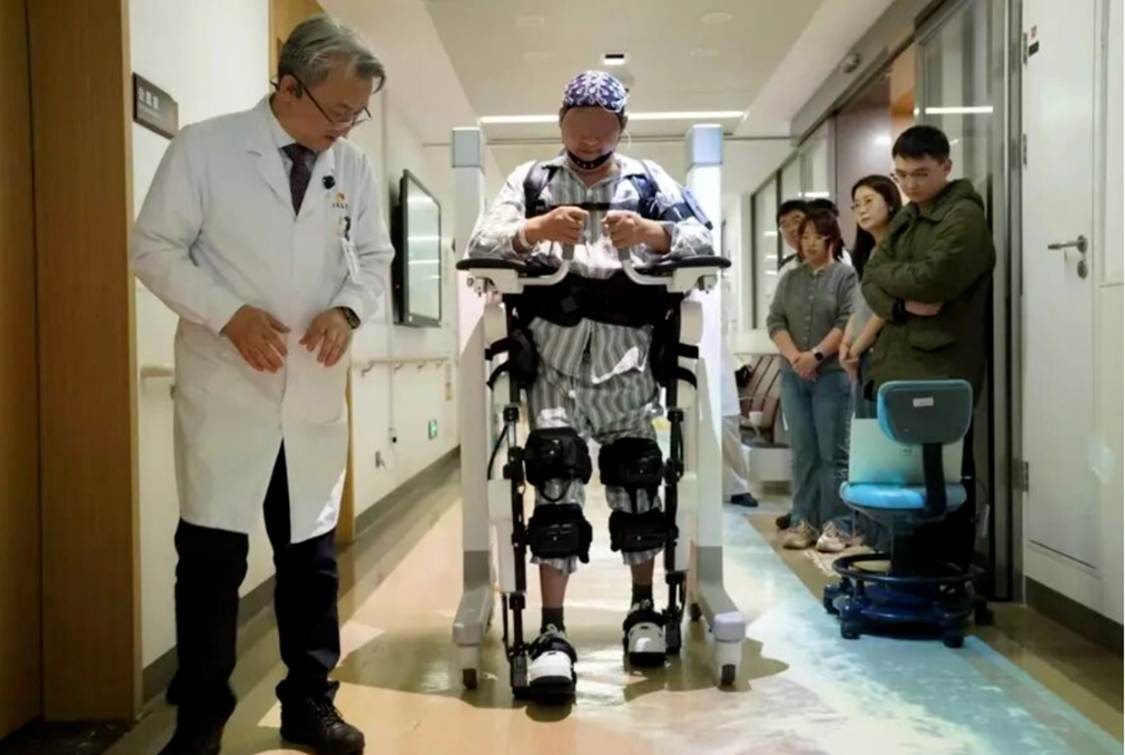
As a neurointeractive device, the brain-computer interface can read and decode brain signals, convert the brain's movement-related "thoughts" into amplified electrical signals, bypass the damaged neural pathway, transmit those signals directly to the exoskeleton, and ultimately translate human intention into the robot's actual movements.
The idea itself is not new, but further integrating spinal cord stimulation was a first. "In this new system, not only can the exoskeleton receive signals and assist walking, but when the brain attempts to step forward, the corresponding electrodes in the spinal chip discharge synchronously to stimulate contraction of the muscles responsible for stepping and the flexion and extension of the joints."
At the same time, spinal cord stimulation can work in concert with electroencephalographic signals to regulate the patient's gait, cadence, and stride length. "For Mr. Ye, it feels as though he is directing the movement of his lower limbs and walking with the exoskeleton, rather than the exoskeleton moving him," Prof. Cheng said.
However, rapidly and accurately extracting and decoding brain signals, then forming a closed-loop linkage with the previously implanted spinal stimulation device so that the system can receive, transmit, and execute signals stably, required an efficient signal-coordination system. According to Prof. Cheng, the team and the enterprise developer spent more than 2 months jointly developing a dedicated software system to solve the signal-integration problem.
"The enterprise development team brought deep engineering expertise and technical reserves, while we provided the medical closed loop of basic research and real clinical needs. This kind of interdisciplinary integration of medicine and engineering is the key to solving complex clinical problems," Prof. Cheng said.
Through that collaboration, on the afternoon of March 20, in the orthopedic research ward of the Tongkang Building at Shanghai Tongji Hospital, Mr. Ye, 7 months after paraplegia, achieved autonomous standing and walking for the first time through direct control by his own consciousness.
According to available information, Mr. Ye is recovering well and his psychological condition has improved markedly. Next, he will continue rehabilitation training with this system in the hospital, and further evaluation of the recovery of lower-limb function will be carried out.
It is worth noting that neuromodulation technologies represented by the "spinal neural interface" were originally designed mainly to restore motor function through compensation. But as research has progressed, such technologies have gradually shown the potential for "neural remodeling."
"In patients with incomplete paraplegia, the damaged neural pathways still retain some functional structure. Electrical stimulation may therefore promote self-repair of the injured neural circuits and rebuild the connections of the remaining nerve fibers. We hope that one day patients will be able to leave external devices behind and truly regain autonomous movement," Prof. Cheng said.
The "Perfect Repair" of Spinal Cord Injury
Prof. Cheng told MedJ that the current treatment used a nonimplantable brain-computer interface device. Compared with implantable devices, although signal-acquisition precision is relatively limited, the patient does not need surgery and safety is better. More importantly, the process is reversible: the device can be removed at any time, and treatment strategies can be changed flexibly as technology develops.
Statistics show that by 2019, more than 20 million people worldwide were living with spinal cord injury, with about 900,000 new cases each year. From 1990 to 2019, the global incidence, prevalence, and years lived with disability for spinal cord injury all increased substantially, with falls and traffic accidents being the leading causes.
"Neural repair or regeneration" and "neuromodulation" are regarded as the two most promising technical directions for treating patients with paraplegia.
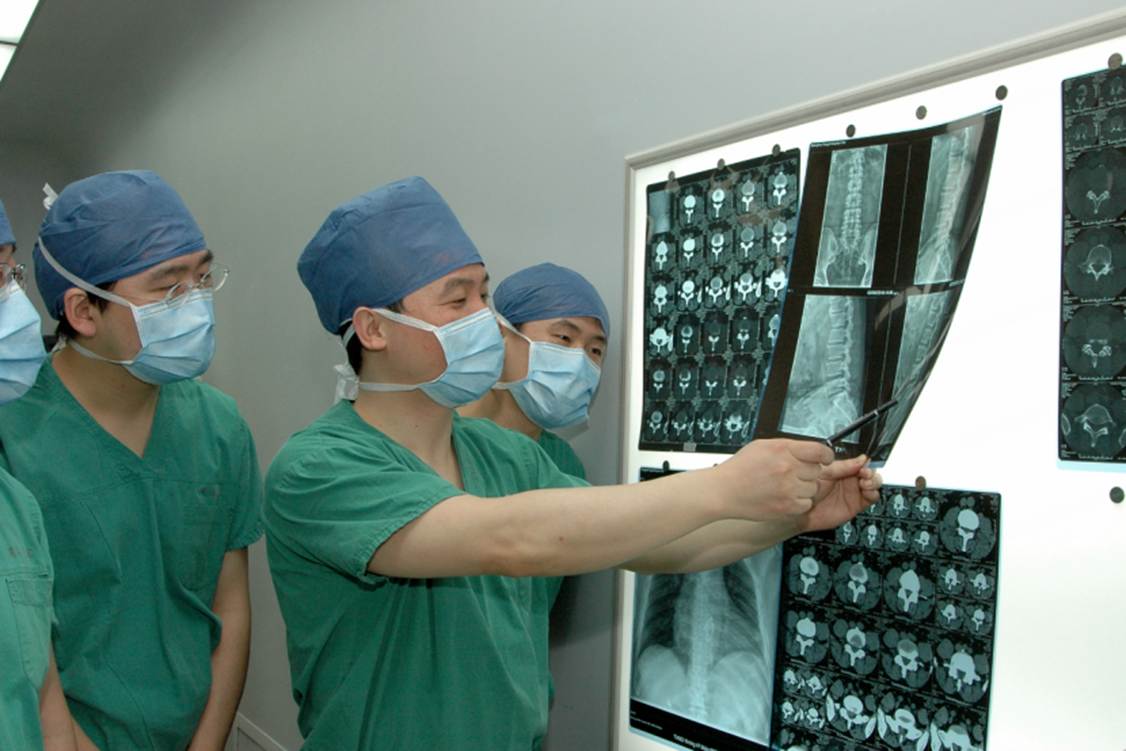
As early as 2009, Prof. Cheng established a spinal injury specialty at Shanghai Tongji Hospital and built a research system focused on spinal cord injury. The team targeted exploration of the pathological mechanisms of spinal cord injury and the clinical translation of neural repair, carried out a series of scientific research projects, and successively undertook multiple national key research and development programs.
In October 2025, Prof. Cheng's team published a major study in Nature Biomedical Engineering. Using induced pluripotent stem cell technology, the team regenerated spinal cord organoids, rebuilt neural circuits in mice with complete spinal cord injury, and enabled paralyzed mice to stand and step. The work was regarded by the international neuroscience community as a key step toward a clinical cure for paralysis.
At the same time, with the rapid development in recent years of neuromodulation technologies such as the "brain-computer interface" and the "brain-spine interface," Prof. Cheng further expanded the team's research direction. The present integration of three technologies is an innovative practice that deeply combines neuromodulation with rehabilitation engineering.
According to available information, the team will formulate the next clinical recruitment plan in due course on the basis of Mr. Ye's recovery, in the hope of accumulating more real-world data, iterating the algorithm, and upgrading the system to achieve better performance control.
Looking further ahead, Prof. Cheng told MedJ that the ideal repair of spinal cord injury should achieve "regenerative repair" - using biological approaches such as stem cells and exosomes to allow damaged spinal cord tissue to regrow and develop new function. Neuromodulation, by contrast, can promote the "functional remodeling" of local tissues on the basis of restored function.
"If these innovative explorations in different directions can ultimately converge and form a powerful combination to promote neural regeneration and the reconstruction of neural circuits, then we can continue moving toward the perfect repair of spinal cord injury," Prof. Cheng said.

