


In the fast-heating global race to develop lipid-lowering therapies, a Chinese team has delivered another major milestone.
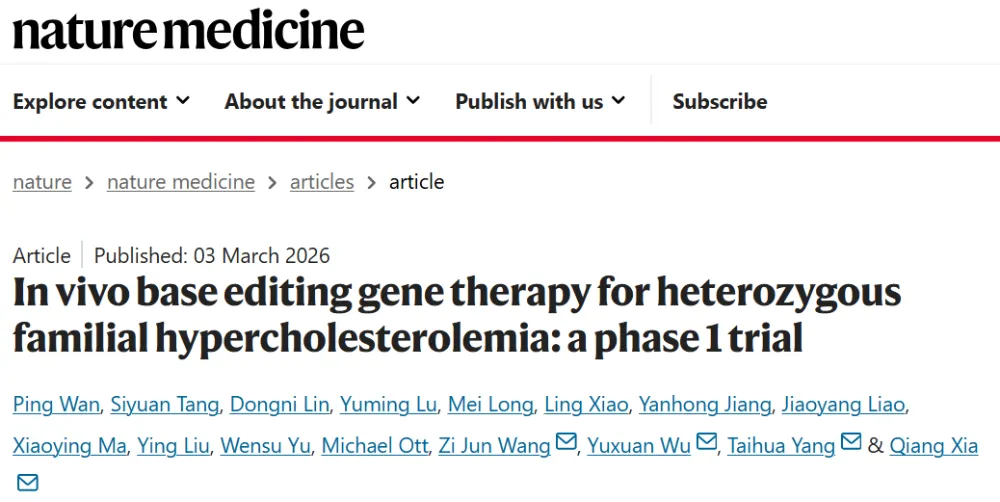
In early March, Nature Medicine published phase 1 results for a “once-for-life” base-editing therapy. In six patients with familial hypercholesterolemia, low-density lipoprotein cholesterol, or LDL-C, fell by more than 50% after gene editing, with durable lipid lowering and a favorable safety profile.
The study, conducted by the team led by Academician Qiang Xia at Renji Hospital, Shanghai Jiao Tong University School of Medicine, is the first to demonstrate the safety and efficacy of gene editing in patients with familial hypercholesterolemia. Nature Medicine called it a new milestone for the field.
Dr. Ping Wan, deputy chief physician of hepatic surgery at Renji Hospital and a principal investigator, told MedJ that the team will continue long-term follow-up. If efficacy is confirmed in larger trials, the approach could free patients from lifelong medication and reduce complications such as premature coronary heart disease and myocardial infarction.
Targeting hepatocytes to repair a genetic defect
According to statistics, China has 330 million people with cardiovascular disease, and about 4.58 million die from it each year, accounting for more than 40% of all deaths. Atherosclerotic cardiovascular disease, including stroke, coronary artery disease, and myocardial infarction, is a leading cause of death.
Hyperlipidemia driven by elevated LDL-C is a major risk factor for atherosclerotic cardiovascular disease. As one of the most common abnormal findings on health examinations, elevated LDL-C substantially increases the risk of heart attack, stroke, and even sudden death.
In the Nature Medicine study, the investigators enrolled six patients with heterozygous familial hypercholesterolemia. All had congenital defects in LDL-C metabolism, and LDL-C remained markedly elevated despite standard lipid-lowering treatment; two had already been diagnosed with atherosclerotic cardiovascular disease.
The new base-editing therapy developed in China is designed as a one-time gene-editing treatment. It effectively switches off a gene called PCSK9, which when overactive promotes degradation of LDL receptors, reduces hepatic clearance of LDL-C, and is one of the main drivers of hypercholesterolemia.
Results showed that among the three patients who received the high dose of 0.6 mg/kg, mean LDL-C fell by 33.2% within one week and by 48.09% at one month, from 4.70 mmol/L at baseline to 2.44 mmol/L. At six months, the mean reduction remained about 52.3%.
Notably, multidimensional testing detected no off-target editing, indicating that the therapy accurately hit PCSK9 and supporting the precision of the approach.
In terms of safety, no grade 3 or higher adverse events were observed, and no patient withdrew because of adverse events. The most common reactions were infusion-related fever and myalgia, which resolved spontaneously within 24 hours. Some patients had transient elevations in transaminases that also returned to normal quickly.
After publication of the results, Academician Xia said the study was the first to show that a single intravenous gene-editing infusion could achieve durable lipid lowering, offering new hope for reducing treatment burden and achieving long-term control.
A liver surgeon who wants patients to avoid transplantation
“This globally leading study did not happen overnight. It grew out of years of exploration driven by clinical need and repeated technical iteration,” Dr. Wan told MedJ.
Familial hypercholesterolemia, or FH, is caused by gene mutations that impair hepatic lipid metabolism, preventing the body from effectively processing lipids and causing persistent elevation of “bad cholesterol,” LDL-C.
At present there is no cure for FH, and lifelong lipid-lowering medication remains the mainstay. In practice, however, the burden of long-term treatment is heavy, irregular use and self-discontinuation are common, and lipid targets are often not achieved.
Dr. Wan has long worked in pediatric liver transplantation and has seen many patients with homozygous FH progress to the point of needing transplant. He found it regrettable that many of these livers still looked structurally normal, without cirrhosis or other organic damage, which led him to ask whether gene modification could spare some patients from transplant surgery.
To that end, the team had long explored gene-editing strategies aimed at correcting the root genetic cause of severe hyperlipidemia. They had previously attempted ex vivo gene editing in patients with inherited metabolic liver disease, but cell isolation, expansion, reinfusion, and integration posed major translational barriers.
Only with the rise of base-editing technology did a solution begin to come into view. Compared with conventional gene editing, base editing can precisely change a single base without cutting both strands of DNA and can do so with high efficiency.
Dr. Wan explained that pathogenic mutations in the LDL receptor gene, LDLR, are the core cause of FH. Direct in situ repair of LDLR in the body remains technically difficult, but in heterozygous FH, LDLR function is not completely lost. In such patients, shutting down another gene can compensate for the defect, and one classical bypass target is PCSK9.
In this study, scientists silenced PCSK9 by base editing, thereby enhancing LDLR function and helping hepatocytes clear LDL-C. Because the edit is permanent, the lipid-lowering effect may be long lasting.
“This concept may also apply to other forms of non-hereditary hyperlipidemia,” Dr. Wan told MedJ. The team has already launched studies in patients with atherosclerotic cardiovascular disease, whose lipid abnormalities are often driven by diet, lifestyle, obesity, and other acquired factors.
Available statistics show that 8% to 25% of Chinese adults have abnormal LDL-C levels, making cardiovascular disease a major public-health challenge.
According to Dr. Wan, early progress suggests that base-editing therapy also has good lipid-lowering effects in these patients, and an initial report may be released soon.
A new entrant in the star lipid-lowering track
In fact, PCSK9, the target of this base-editing therapy, has become one of the hottest targets in lipid lowering in recent years and is regarded as an outstanding example of drug development driven by human genetics.
PCSK9 was first identified through follow-up studies of four families with familial hypercholesterolemia, whose members had abnormally high lipid levels, very early heart disease, and poor responses to traditional lipid-lowering treatment. In 2003, researchers first established the association between PCSK9 mutations and FH.
Since then, silencing or inhibiting PCSK9 has become a major strategy for a series of new lipid-lowering drugs. Several have already reached clinical use, including evolocumab and tafolecimab, given every two weeks, monthly, or every six weeks, as well as inclisiran, an siRNA drug given every six months.
As a representative gene-editing therapy, the LDL-C reduction seen in this study has already matched existing agents and may even surpass them. Because it requires only a single infusion, it may eventually solve adherence problems in heterozygous FH and perhaps a much broader group of patients with hyperlipidemia.
It is worth noting that no therapy designed to permanently shut down PCSK9 has yet entered routine use.
PCSK9 was once a beneficial gene. In times of food scarcity, it helped human ancestors store energy by raising cholesterol. Only after modern living conditions changed did cholesterol become a burden. Growing evidence shows that people born with loss-of-function PCSK9 variants can maintain very low cholesterol levels over the long term, apparently without harm and with cardiovascular protection.
Even so, if gene editing is used to permanently turn off this gene, its ultra-long-term safety and possible effects on specific physiological processes will still require much longer clinical observation.
In addition, FH includes both homozygous and heterozygous forms, and the Nature Medicine study involved heterozygous patients only.
“Patients with homozygous FH have much poorer LDLR function and cannot compensate for the metabolic defect simply by inhibiting PCSK9. Some new bypass targets have been identified, but whether they are suitable for gene editing and how safe they are still require a great deal of research,” Dr. Wan said.
Reference:
[1] Wan P, Tang S, Lin D, et al. In vivo base editing gene therapy for heterozygous familial hypercholesterolemia: a phase 1 trial. Nature Medicine. 2026.
[2] Feng S, et al. Research progress on the pleiotropic effects of PCSK9 inhibitors. Chinese Journal of Cardiology. 2022.

