


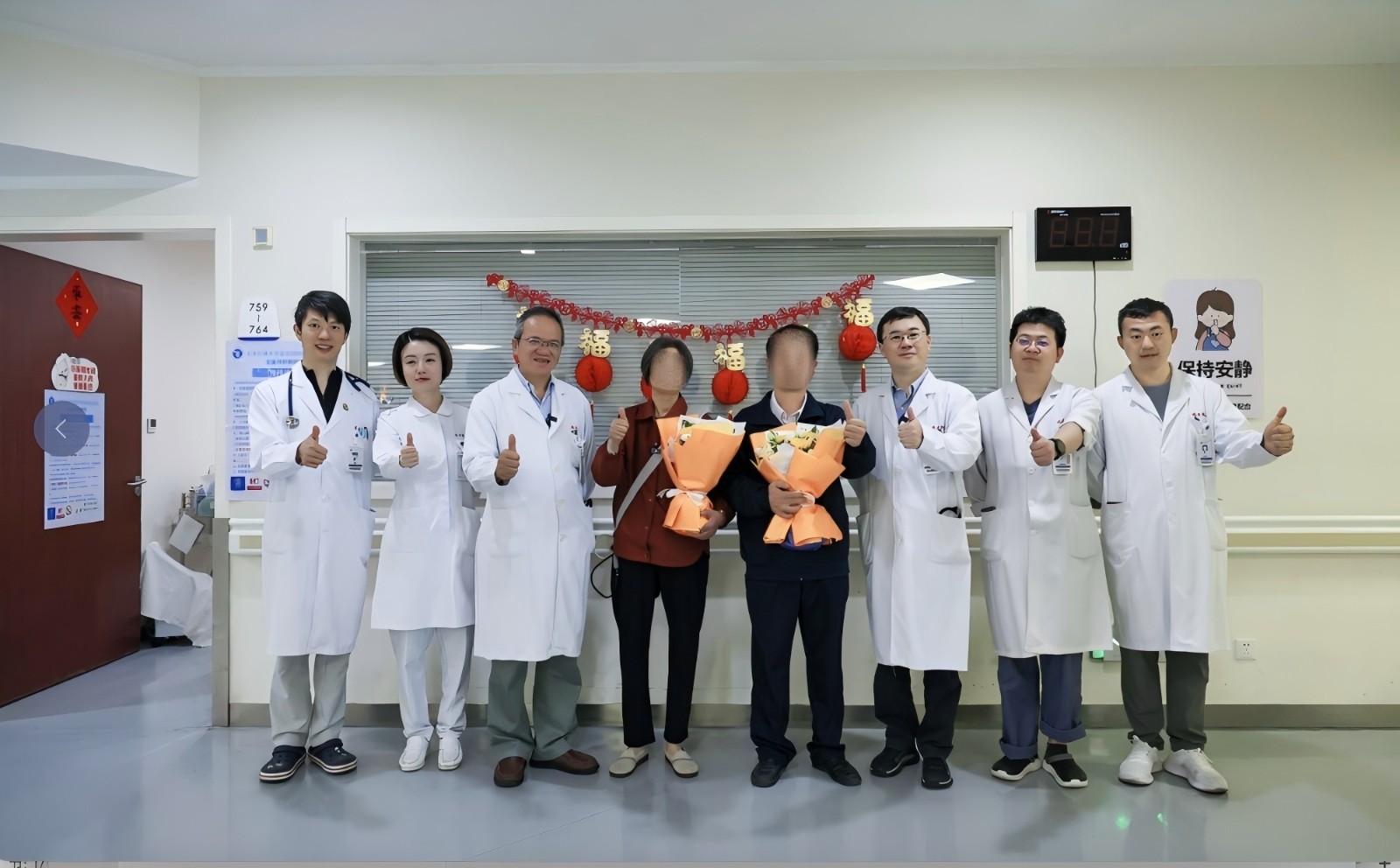
"Before, I would get exhausted just walking a little, but now I can walk a mile!" 58-year-old Aunt Zhang (a pseudonym) smiled as she patted her small shoulder bag. More than two months after her discharge, all her indicators are normal during this follow-up visit, and Aunt Zhang is very happy. "Thank you to the medical staff at Ruijin Hospital for their full treatment, which gave me a second chance at life."
At Ruijin Hospital's Department of Cardiac Surgery, she became the first patient in China to have a DuoCor™ dual-chamber ventricular assist device implanted while her heart was still beating, pressing the "restart" button on her life, which was on the brink of stopping.
Thought It Was Just Fatigue, But Her Heart Was About to Stop
For the past eight years, Aunt Zhang had felt short of breath when doing housework and often had purple lips. At first, she thought it was just due to "old age and fatigue." But during a routine checkup, her doctor found her heart was abnormally enlarged. After visiting several hospitals, she was diagnosed with heart failure, but the medication didn’t help.
Last winter, a cold triggered severe heart failure, and she even experienced leg edema and fainting spells. An echocardiogram showed that her heart function had dropped to less than half of normal (her ejection fraction was only 27%), and she was diagnosed with end-stage heart failure. Traditional medications and devices were no longer effective.
With only a glimmer of hope left, Aunt Zhang arrived at Ruijin Hospital's Department of Cardiac Surgery. After thorough examination, she was diagnosed with arrhythmogenic right ventricular cardiomyopathy, chronic heart failure (INTERMACS Class 4), heart function class IV, and non-rheumatic tricuspid regurgitation, and she already had a pacemaker (dual-chamber ICD implanted)."Her right ventricle was as thin as tissue paper, and the left ventricle had collapsed. Immediate treatment was necessary," said Dr. Zhou Mi, Chief Physician of the Cardiac Surgery Department.
Due to her heart failure being at its most severe stage, heart transplantation was the "optimal solution." However, heart transplant donors are difficult to find, so implanting a ventricular assist device (VAD) became the best option at the time. However, since Aunt Zhang's right and left ventricles were both failing, and the right ventricle failure was more severe, a left ventricular assist device alone would not be able to save her life.After considering various factors, including the patient's condition and the surgical indications, the expert team decided to challenge the procedure of implanting a dual-chamber ventricular assist device while the heart continued to beat.
A Last-Ditch Effort: "Dual Engines" on a Beating Heart
The dual-chamber ventricular assist device implantation is one of the most advanced cardiac failure treatments internationally. Unlike a single left ventricular assist device, this surgery required the precise implantation of two "mechanical hearts" alongside the patient's own heart in a limited pericardial space. The positioning, orientation, depth, and stability of the devices needed to be extremely precise, and the coordination and balance between the two pumps demanded a high level of technical expertise from the surgical team."Single-chamber assistance is like adding auxiliary wheels to a car, while dual-chamber assistance is like rebuilding the entire engine," said Dr. Zhao Qiang, Vice President and Chief of Cardiac Surgery at Ruijin Hospital. "We need not only to get the car moving but to ensure that both wheels run in sync."
Additionally, the right atrium, which was as thin as a dumpling skin, had to bear the pull of the metal pumps. Although each pump weighs only 90 grams, the smallest device currently in the world, the right heart system was fragile and prone to blood clots, requiring precise implantation and effective anticoagulation.To ensure the safety and success of the surgery, Professor Zhao Qiang led the team in comprehensive and detailed surgical planning.
On March 5, 2025, the surgery was officially performed. With the close cooperation of the anesthesia and surgical teams, Dr. Zhao Qiang, Dr. Zhou Mi, and Dr. Liu Yun performed the surgery while on extracorporeal circulation. The team first used a bovine pericardial patch to reinforce the soft right atrial wall, creating a safe foundation for the artificial heart.
Then, under ultrasound guidance and precise anatomical positioning, the left pump inlet was aligned with the mitral valve, and the right pump outlet was directed toward the tricuspid valve, establishing a perfect blood flow pathway. As the two pumps began to function in balance, the artificial heart began to "beat," completing the high-difficulty procedure successfully.
Turning Crisis into Recovery: A New Option for End-Stage Heart Failure Patients
After the surgery, the medical team closely monitored Aunt Zhang around the clock. They adjusted the speed and flow of her dual-chamber ventricular assist device based on real-time indicators, keeping a watchful eye on potential issues like blood clots and infections. With meticulous care and rehabilitation training, Aunt Zhang’s health steadily improved, and she successfully recovered. "They are really professional. Every time I come for follow-up, I feel so reassured. I can feel myself getting better and better," Aunt Zhang smiled.
The dual-chamber ventricular assist device is suitable for patients with full heart failure where drug treatments are ineffective, and who meet the criteria for heart transplantation or dual-chamber assist; or those who develop right heart failure after a left ventricular assist device (LVAD) implantation and need dual-chamber support.
"With the gradual maturation of artificial heart technology, a new 'bridge to life' has been built for many end-stage heart failure patients," said Professor Zhao Qiang. "From successfully implementing LVADs to now challenging dual-chamber assist technology, the Cardiac Surgery Department of Ruijin Hospital is committed to meeting patient needs, continuously advancing ventricular assist technology in clinical applications, and breaking through medical challenges to improve healthcare services, offering new hope for end-stage heart failure patients."

