


“If I relapse after six months, how much farther can I go? If I relapse after two and a half years, maybe some new drugs will have appeared by then, and I may still have another treatment opportunity.” In the latest installment of MedJ’s “Researchers Speak” column, these words from Prof. Weidong Han, Director of the Department of Biotherapy at the Chinese PLA General Hospital, captured the deepest fears and hopes shared by patients with relapsed or refractory non-Hodgkin lymphoma and their families.
Recently, American Journal of Hematology published a landmark study reporting the first 5-year follow-up of CD19/CD20 dual-target CAR-T therapy, TanCAR7, in relapsed or refractory non-Hodgkin lymphoma. This prospective clinical study, led by Prof. Weidong Han, Prof. Zhiqiang Wu, and Prof. Yao Wang of the Chinese PLA General Hospital, with Prof. Qingming Yang and Prof. Yang Liu as core co-investigators, followed 87 patients for a median of 63.4 months and showcased the strength of China’s cell-immunotherapy innovation while offering new hope to patients with relapsed or refractory disease.
A Decade in the Making: From the Limits of Single Targeting to the Breakthrough of Dual Targeting
As pioneers of CAR-T clinical research in China, Prof. Han’s team initiated the country’s first CAR-T reinfusion as early as 2012. By 2015 to 2017, as long-term follow-up data for single-target CAR-T matured, the team recognized antigen escape as a major clinical problem. Prof. Han recalled that both international and domestic single-target CAR-T products had durable remission rates of only about one third at three to five years. The key question became how to help more patients live longer and live better.
Unlike the collaborative model used for commercial products, the team adhered to a fully integrated pathway of independent research and development, independent manufacturing, and independent clinical translation. From structural design in the laboratory to cell preparation, patient recruitment, treatment monitoring, and toxicity management, everything was completed by the team itself. Supported by national research grants, the group produced a 16-study series covering development, clinical application, toxicity, and resistance.
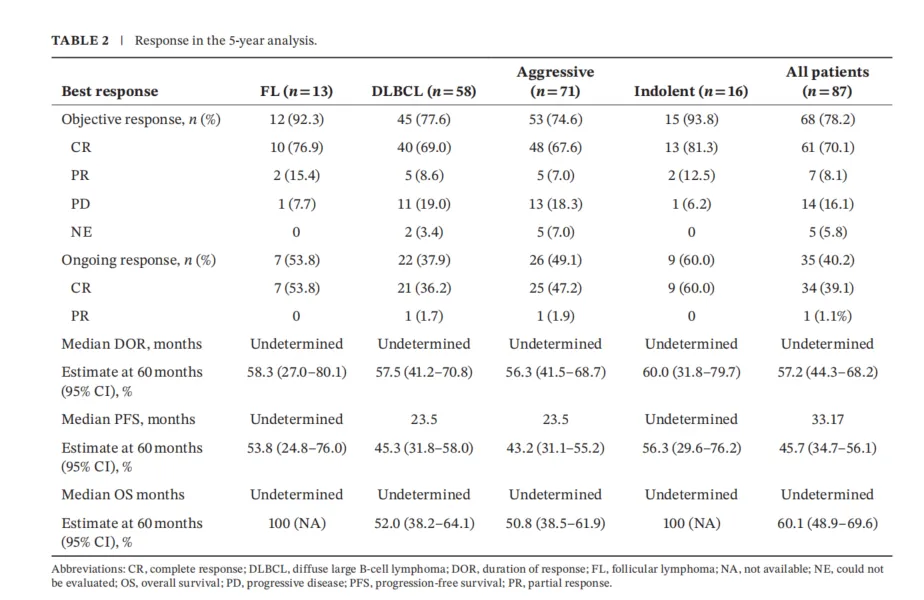
Between May 2017 and January 2020, the team enrolled 87 patients and then continued long-term follow-up. By April 2025, even the last enrolled patient had been followed for more than five years. The results were striking: the objective response rate reached 78%, the complete remission rate reached 70%, and 40% of patients remained in ongoing remission at the data cutoff. More importantly, the 5-year overall survival rate was 60.1%, median progression-free survival was 33 months, and no new long-term safety signal emerged.
Prof. Han stressed that these apparently cold numbers actually carry warmth. For a patient or family member, relapse at six months and relapse at two and a half years are entirely different situations. A longer remission window gives patients more opportunity to receive new therapies and achieve longer survival.
Hard-Core Interpretation of the 5-Year Data: Breakthroughs in Efficacy, Safety, and Mechanism
In this cohort of 87 patients with relapsed or refractory non-Hodgkin lymphoma, 82% had aggressive lymphoma and 18% had indolent lymphoma. More than one quarter had high tumor burden, defined as SPD >=100 cm2, and 46% had received four or more prior lines of therapy. Even in such a complex, high-risk population, the long-term outcomes remained impressive.
Prof. Qingming Yang said the core value of the study lies in validating that a dual-target strategy can overcome tumor heterogeneity and reduce relapse caused by antigen escape. Compared with single-target CAR-T, the dual-target approach achieved a leap in both progression-free and overall survival, moving the field from short-term remission closer to long-term cure.
Long-term safety, always a major concern for CAR-T therapy, was also reassuring. After more than five years of follow-up, no new late safety signals were observed. Cytokine release syndrome occurred in 70% of patients, but grade 3 or higher events occurred in only 10%. Immune effector cell-associated neurotoxicity syndrome occurred in 17%, with grade 3 or higher events in only 2%. No treatment-related second malignancy occurred, and the 5-year cumulative non-relapse mortality rate was only 10.5%. All patients experienced sustained B-cell aplasia after treatment, but most responders recovered B cells within one year, and no severe infection-related deaths occurred.
Behind this manageable safety profile was a refined toxicity-management strategy developed by the team. Prof. Liu explained that they used controllable immunosuppression targeting multiple cytokines to manage cytokine release syndrome while balancing inflammation control with preservation of efficacy. Unlike traditional approaches that rely mainly on corticosteroids and anti-IL-6 receptor antibodies, the team innovatively adopted a clinical management model combining multiple anti-inflammatory cytokine antibodies with plasma exchange. This approach effectively controlled cytokine release syndrome and neurotoxicity while preserving efficacy to the greatest extent possible. It has since been incorporated into China’s first expert consensus on CAR-T treatment for lymphoma and has been adopted by regulatory authorities and many treatment centers.
Prof. Yao Wang’s team further dissected why dual-target CAR-T could achieve such durable benefit. On the structural side, optimization of the order of CD19 and CD20 in tandem and adjustment of linker length produced a stable immune synapse, strengthened the first calcium-influx signal, enhanced tumor killing, and at the same time reduced T-cell exhaustion. On the cellular side, every patient whose CAR-T product contained more than 15% CD8-positive stem cell-like memory T cells achieved a durable clinical response, whereas loss of CCR7 expression in CD8-positive T cells was associated with resistance. On the tumor side, low NOXA expression, CD58 loss, and abnormalities in the mTORC1 pathway increased the risk of relapse, while high tumor burden and systemic inflammation, reflected by elevated CRP, were also important risk factors for resistance. These findings provide a theoretical foundation for identifying patients most likely to benefit and for further optimizing CAR-T therapy.
Prof. Liu added an intuitive analogy for the structural design: CAR-T acts like a claw, and CD19 and CD20 are two different claws. The team tested many combinations early on to determine whether the two claws should work in tandem or separately. The selected TanCAR7 design not only showed excellent cytotoxicity and cytokine secretion in vitro, but also formed a stable immune synapse, the crucial interface for CAR-T cells to engage and kill tumor cells.
Clinical Translation: How Dual-Target CAR-T Could Rewrite the Treatment Pathway
Based on this high-level 5-year evidence, Prof. Qingming Yang believes dual-target CAR-T could reshape the treatment landscape for relapsed or refractory B-cell lymphoma in three major ways.
First, it may help establish a new treatment standard and push therapy to earlier lines. Five-year follow-up is a key milestone in evaluating curative potential in oncology. The high remission rate and controllable toxicity of dual-target CAR-T suggest that it may become a preferred option not only for relapsed or refractory B-cell lymphoma, but also for some high-risk patients after first-line treatment, changing the current pathway dominated by single-target CAR-T or chemotherapy. For patients at an earlier stage of progression who remain in good clinical condition, earlier intervention with dual-target CAR-T may maximize efficacy while reducing risk.
Second, it may overcome the problem of single-target resistance and provide a new salvage option. For patients who relapse after single-target CAR-T because of antigen escape, dual-target CAR-T offers an effective rescue strategy. It also shows strong tumor-clearing ability in high-risk patients who are resistant to multiple lines of chemotherapy and otherwise have few remaining options.
Third, it may improve whole-course patient management and enable truly individualized treatment. By incorporating prognostic factors such as ECOG performance status, extranodal disease, tumor burden, and the proportion of TSCM cells, clinicians can better identify the patients most likely to benefit and tailor treatment accordingly. Prof. Yang noted that patients with ECOG 2, tumor burden above 100 cm2, or lesions larger than 10 cm may require earlier intervention or combined strategies, whereas patients with high TSCM levels can be expected to sustain response longer.
The Next Decade: From Long-Lasting Control to Broader Benefit
Building on this milestone, the team is continuing to address the remaining treatment challenges from multiple directions. In the area of resistance, Prof. Liu said the group has identified apoptosis-pathway resistance biomarkers in some patients. When NOXA expression is impaired, tumors are less effectively cleared even by dual-target CAR-T.
At the same time, the team has also found a potential solution in epigenetic therapy. Prof. Liu disclosed that a multicenter intervention study using chidamide in patients with poor-prognosis NOXA expression is close to its endpoint, and the trend has so far been very encouraging.
From the perspective of cellular optimization, Prof. Wang said the next upgrade of dual-target CAR-T will focus on two dimensions: cell source and structural design. One direction is to improve the intrinsic function of patients’ own T cells. The team has shown that epigenetic drugs can enhance the antitumor activity and memory properties of CAR-T cells, and early clinical data suggest this may outperform current approaches. Another direction is to enrich highly active subsets such as CD8-positive TSCM and combine them with novel molecular modifications to improve persistence and reduce exhaustion. On the structural side, the team plans to continue optimizing the connection mode of the dual targets and the signaling domains to achieve the ideal of “high efficiency with low exhaustion” - stronger tumor recognition together with more precise immune activation.
The broader strategic goal is earlier-line and more individualized use. Guided by the prognostic biomarkers identified in the present study, the team plans larger, more precise clinical trials to determine how to move dual-target CAR-T forward in the treatment sequence, develop stratified treatment strategies, and even explore applications in solid tumors and autoimmune diseases.
Conclusion
One study, one group of persistent researchers, and one era. From China’s first CAR-T reinfusion in 2012, to the dual-target design launched in 2017, to the world’s first 5-year follow-up published in a top journal in 2026, the Department of Biotherapy at the Chinese PLA General Hospital has spent 14 years forging a fully independent Chinese path in cell-therapy innovation. As Prof. Han put it, behind these seemingly cold data are patients’ hopes of survival and China’s confidence in bringing cell therapy onto the world stage.

