


A nationwide study by the team of Academician Hongbing Shen at the Chinese Center for Disease Control and Prevention has been published in The Lancet Regional Health - Western Pacific.
The study found that China's cancer-related premature mortality fell from 13.11% in 1990 to 6.66% in 2023, an average annual decline of 1.93%. The analysis describes trends across more than three decades, all provinces, adults aged 30 to 69 years, and 29 cancer types.
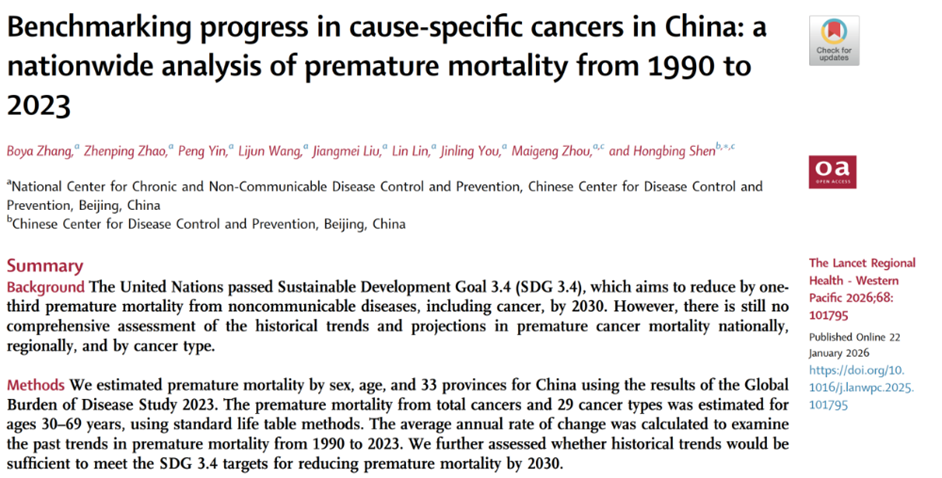
Premature mortality declined in every province
According to the study, premature mortality declined in all Chinese provinces. Stomach cancer, esophageal cancer, nasopharyngeal carcinoma, and Hodgkin lymphoma showed the fastest reductions over the past several decades. Cervical cancer and liver cancer also declined substantially.
Many of these cancers have relatively mature primary-prevention or early-screening strategies. Wider endoscopic screening and Helicobacter pylori control have improved early detection and treatment for gastric cancer; Epstein-Barr virus-related testing is used in high-risk areas for nasopharyngeal carcinoma; and broad hepatitis B vaccination has contributed to better liver cancer prevention.
However, a few cancers moved in the opposite direction. Multiple myeloma was the only cancer type in the study with an overall increase in premature mortality. Pancreatic cancer also rose among men, especially in North China, Northeast China, and Northwest China. Because pancreatic cancer lacks effective early-screening tools and has a 5-year survival rate often below 10%, the pattern may be difficult to reverse in the short term.
Breast cancer showed a striking sex difference: premature mortality declined among women but increased among men in most regions. Male breast cancer remains an area with major unanswered questions about etiology, treatment, and prognosis.
Lung cancer remained the dominant concern. In 2023, China's premature mortality rate from lung cancer was 1.97%, twice the rate of stomach cancer at 0.98%, and it caused about 350,000 deaths. Lung cancer accounted for 30.31% of male cancer-related premature deaths and 23.40% of female cancer-related premature deaths.
Regional and sex disparities remain
In 2023, the national premature cancer mortality rate was 8.95% among men, more than double the 4.32% rate among women. The gap appeared in every region and was especially prominent in Northeast China.
High smoking prevalence, harmful alcohol use, occupational exposures, and lower willingness to seek medical care are key contributors to this sex gap. They also affect the likelihood of achieving future targets.
The study predicts that women may reach the 2030 Sustainable Development Goal-related targets for premature mortality reductions in several cancers, including stomach cancer, esophageal cancer, nasopharyngeal carcinoma, liver cancer, bladder cancer, leukemia, and cervical cancer. For men, however, the annual decline in lung cancer premature mortality would need to be 3.74 times faster than the historical trend to meet the 2030 goal.
Geographically, the five highest male premature cancer mortality rates in 2023 were in Heilongjiang, Chongqing, Sichuan, Liaoning, and Shandong. The five highest female rates were in Heilongjiang, Jilin, Liaoning, Xinjiang, and Inner Mongolia.
The contrast between Heilongjiang and Hong Kong was especially notable: male premature cancer mortality differed by 1.98-fold, and female premature cancer mortality by 2.41-fold. Northeast China's high burden is associated with lifestyle factors, uneven medical resources, and lower coverage of screening methods such as low-dose CT.
By contrast, Hubei, Shanghai, and Hong Kong had some of the fastest declines, reflecting stronger medical infrastructure and better early-screening systems.
What should come next?
The World Health Organization treats reduction of premature mortality as a key indicator for chronic disease control. China's Healthy China 2030 plan also calls for major chronic disease premature mortality to fall by 30% from the 2015 level by 2030.
Cancer remains one of China's leading causes of death. In 2022, China had about 4.82 million new cancer cases and 2.57 million cancer deaths. The new study shows that overall progress has been substantial, but more targeted work is still needed.
Expanding low-dose CT lung cancer screening is one direct route to lowering lung cancer premature mortality, while tobacco control remains fundamental. For pancreatic cancer, multiple myeloma, kidney cancer, and other cancers whose premature mortality is still rising, investment in basic research and early recognition is essential.
At the regional level, high-burden northern areas need more resources, especially for cancer screening systems and grassroots oncology capacity. Men are disadvantaged across nearly all dimensions, and interventions such as smoking-cessation incentives, screening mobilization, and guidance to seek care remain insufficient.
The next phase will require integration of public health, clinical care, and social security resources to advance comprehensive cancer prevention and control.
Reference:
Boya Zhang, et al. Benchmarking progress in cause-specific cancers in China: a nationwide analysis of premature mortality from 1990 to 2023. The Lancet Regional Health - Western Pacific. Volume 68, 101795, March 2026. doi:10.1016/j.lanwpc.2025.101795
Disclaimer: This English version is prepared from the original Chinese DOCX for MedJ publishing workflow use.

