


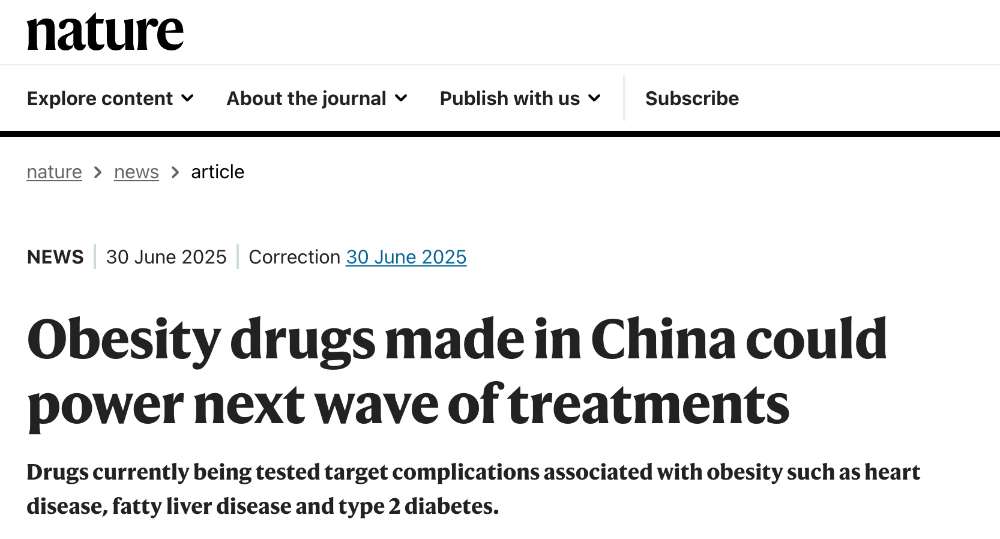
 On June 30, the prestigious international academic journal Nature published an article on its official website stating that weight-loss drugs developed in China are poised to drive the next wave of therapeutic innovation.
Endocrinologist Daniel Drucker, a professor at the University of Toronto’s Faculty of Medicine, remarked, “Today, China is gradually becoming an important innovator in the development of new weight-loss drugs.”
A Phase III clinical trial (the SLIMMER study) for Ecnoglutide (formerly known as Inoglutide) showed that participants who received weekly injections of the drug lost up to 13.8 kg over 48 weeks of treatment, compared to only about 200 grams in the placebo group. The results were published on June 21 in The Lancet Diabetes & Endocrinology.
Ecnoglutide was independently developed by Sciwind Biosciences, based in Hangzhou, and is the world’s first biased GLP-1 receptor agonist for weight loss. It works by mimicking the effects of the natural hormone GLP-1, which regulates blood sugar and appetite.
Unlike non-biased GLP-1 receptor agonists, Ecnoglutide selectively activates the cAMP signaling pathway while minimizing the recruitment of β-arrestin. This unique mechanism may be key to its enhanced clinical efficacy and improved metabolic benefits.
The SLIMMER study is currently the largest Phase III clinical trial for a weight-loss drug conducted in China. It enrolled 664 obese (BMI ≥28 kg/m²) or overweight (BMI ≥24 kg/m²) individuals with at least one weight-related comorbidity, across 36 sites nationwide. Participants were randomly assigned to receive weekly injections of Ecnoglutide at 1.2 mg, 1.8 mg, 2.4 mg, or placebo for 48 weeks.
In the highest dose group (2.4 mg), 92.8% of participants lost at least 5% of their body weight, compared to just 13.9% in the placebo group. The average weight loss in the 2.4 mg group reached 15.1%, while the placebo group lost only 0.3%.Furthermore, participants who received Ecnoglutide maintained most of their weight loss even after stopping the treatment — regaining only about 1% of their body weight in the following 7 weeks.
Professor Ji Linong of Peking University People’s Hospital, the lead investigator of the study, said at the 2025 ADA (American Diabetes Association) Scientific Sessions:
"A 15.1% weight loss in 48 weeks sets a new record for Phase III trials in the Chinese population and, for the first time on the global stage, demonstrates the clinical value of biased structural design. This marks a significant breakthrough in China’s endocrinology research."
He also noted that Ecnoglutide can improve risk factors for heart disease and diabetes, and reduce liver fat content.According to Nature, Daniel Drucker stated that China currently has dozens of GLP-1-based drugs in development or already on the market — “and there will be more in the future.”
One such drug is Mazdutide, a dual GCG (glucagon) and GLP-1 receptor agonist. Results published in The New England Journal of Medicine (NEJM) in May showed that weekly injections of Mazdutide helped more participants achieve 15% weight loss within 36 weeks, and also reduced cardiovascular risk compared to placebo.
Mazdutide was jointly developed by Innovent Biologics and Eli Lilly, and is the world’s first and only approved GCG/GLP-1 dual receptor agonist for weight loss. The drug is also being studied for additional indications such as metabolic-associated fatty liver disease and obstructive sleep apnea.
Nature also cited Sof Andrikopoulos, a researcher at the University of Melbourne’s Department of Medicine, who noted that newer GLP-1 drugs are increasingly targeting multiple pathways, enabling more personalized treatments.
He added that the next generation of drugs will target specific conditions associated with diabetes and obesity, such as sleep apnea, fatty liver, chronic kidney disease, and heart disease. “This will give us more options and make personalized medicine for obesity and diabetes more attainable.”
The Nature report also mentioned several other Chinese weight-loss drugs in development.For example, UBT251, developed by Chinese pharmaceutical company United BioPharma, is a novel triple-agonist targeting GLP-1, GIP, and GCG receptors. It is currently in early-stage trials and aims to treat not only obesity but also chronic kidney disease, fatty liver, and type 2 diabetes.
In March, United BioPharma signed an exclusive licensing deal worth up to $2 billion with Novo Nordisk. Under the agreement, Novo Nordisk gains exclusive rights to develop, manufacture, and commercialize UBT251 outside of mainland China, Hong Kong, Macau, and Taiwan.
Another promising drug is Bofanglutide, developed by Gan & Lee Pharmaceuticals. It is a biweekly GLP-1 receptor agonist, offering greater convenience and patient adherence. In March, the drug entered Phase II clinical trials in the U.S., where it is being tested head-to-head against tirzepatide.
In addition, Ascletis Pharma is developing ASC30, an oral weight-loss drug taken daily. Early trials showed that ASC30 led to a 6% greater weight loss compared to placebo. The company has submitted an application to the U.S. FDA to begin Phase II trials. Notably, major players like Novo Nordisk and Eli Lilly are also advancing oral GLP-1 drugs in parallel.
Finally, Sof Andrikopoulos emphasized the rationale for China developing such drugs:
“Obesity and diabetes are major health issues for Chinese and other Asian populations,” he said, adding that conducting trials with Asian participants is crucial to understanding how GLP-1 drugs perform in this demographic — which may reveal differences not observed in Western studies.

