


Personalized cancer vaccines, which utilize unique mutations in cancer cells (known as neoantigens) to activate the immune system to attack tumors, have demonstrated feasibility in multiple fields, such as melanoma.
On February 5th, a new study published in Nature revealed the potential of personalized cancer vaccines in treating renal cell carcinoma (RCC).
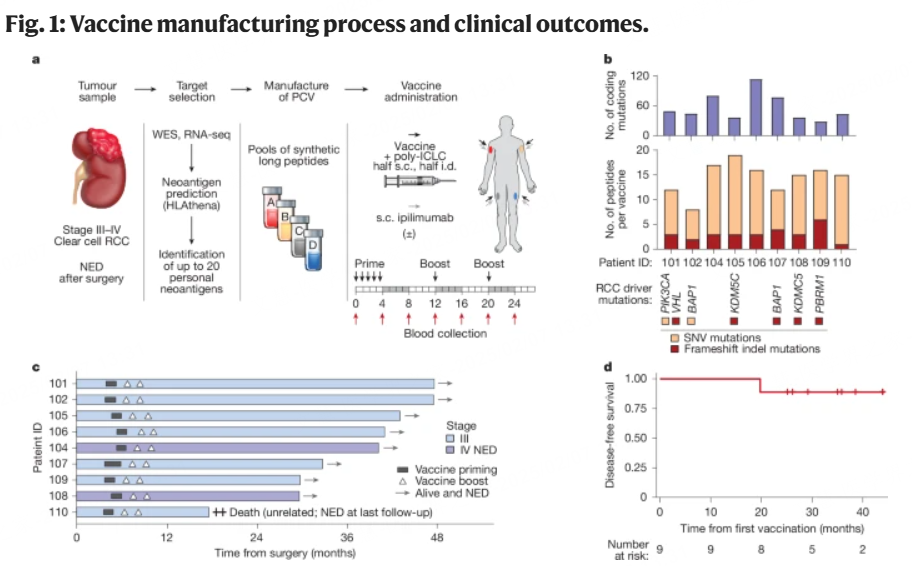
This study was led by the Dana-Farber Cancer Institute, an affiliate of Harvard Medical School. Phase I clinical data showed that among nine high-risk renal cell carcinoma patients treated with personalized cancer vaccines, none experienced recurrence after a median follow-up of 40.2 months from the time of surgical resection.
Renal cell carcinoma is the most common type of kidney malignancy, ranking third in incidence among urological tumors, following prostate and bladder cancers.
For patients with stage III and IV renal cell carcinoma, surgical resection is the standard treatment, followed by postoperative immune checkpoint inhibitor therapy to stimulate an immune response and reduce the likelihood of cancer recurrence. However, more than half of patients with advanced disease still relapse.
"Patients with stage III or IV kidney cancer have a high risk of recurrence," said Toni Choueiri, one of the study's corresponding authors, a professor at Harvard Medical School, and director of the Lank Center for Genitourinary Oncology at the Dana-Farber Cancer Institute. He added that existing methods to reduce risk are not perfect, and his team has been tirelessly searching for more options.
Personalized cancer vaccines are one such option. "The neoantigens targeted by this vaccine help guide the immune response, enhance targeting efficacy, and reduce off-target immune toxicity," Choueiri said.
Personalized cancer vaccines have shown promise in treating tumors with more mutations, such as melanoma. However, renal cell carcinoma is a disease with fewer mutations, and thus fewer targets are available for the vaccine. The research team also noted that when they initiated this study eight years ago, it was unclear whether this approach would be effective for kidney cancer.
"We are very excited about these results; all nine kidney cancer patients had such a positive response," Choueiri said.
The baseline characteristics of these nine patients were typical of high-risk renal cell carcinoma, with seven at stage III and two at stage IV, and all had metastatic disease at enrollment.
A neoantigen vaccine generates antitumour immunity in renal cell carcinoma
Researchers customized personalized vaccines for these nine high-risk, post-surgical patients, with five of them also receiving ipilimumab. The study results showed that after a median follow-up of 40.2 months from the time of surgery, none of the nine patients experienced recurrence. One patient died due to mental health-related complications unrelated to cancer or treatment.
The vaccine induced an anti-tumor immune response in all patients. Through a series of analyses, the research team found that the number of vaccine-induced T cells increased on average by 166-fold and that these protective T cells were maintained at high levels in the body for up to three years. Additionally, the study confirmed that the vaccine-induced T cells were active against the patients' own tumor cells.
In terms of safety, the most common adverse events were low-grade injection site reactions and transient flu-like symptoms, with no other more serious toxicities observed.
The study results are encouraging. In the adjuvant treatment setting, personalized vaccines may play an important role in eliminating residual tumor burden. However, the researchers also noted that this is an early trial with a small sample size, and larger-scale studies are still needed to fully understand its clinical efficacy.

