


The risks of developing chronic diseases and dying from them are influenced by metabolic, behavioral, environmental, and other factors. The circadian system coordinates physiological processes with the 24-hour light-dark cycle, and its disruption has been associated with various chronic diseases. Circadian alignment, the temporal alignment between physical activity and temperature rhythms, is one measure of coordination within the circadian system. However, its associations with chronic disease incidence and mortality have not previously been systematically evaluated in a large prospective cohort.
A prospective cohort study from Sir Run Run Shaw Hospital, Zhejiang University School of Medicine, presented at the 2026 Annual Meeting of the European Association for the Study of Diabetes (EASD), investigated these associations. The results showed that circadian alignment measures were independent predictors of incident type 2 diabetes (T2D) and all-cause mortality.

Photo of the Conference Presentation
Study Design: Assessing Circadian Alignment Using Data From 90,000 Participants
The study included approximately 90,000 UK Biobank participants who completed one week of physical activity and wrist temperature monitoring (Fig. 1). Researchers performed circular cross-correlation analysis on the participants’ physical activity and wrist temperature data, followed by Fourier decomposition, to extract three circadian alignment measures: 24-hour coupling strength (M24), phase deviation (D24), and 12-hour harmonic amplitude (M12). M24 reflects the strength and regularity of coupling between 24-hour activity and temperature rhythms; D24 measures the deviation of the temperature rhythm from its expected antiphase timing relative to the activity rhythm; and M12 reflects the strength of the activity-temperature rhythmic component that repeats every 12 hours.
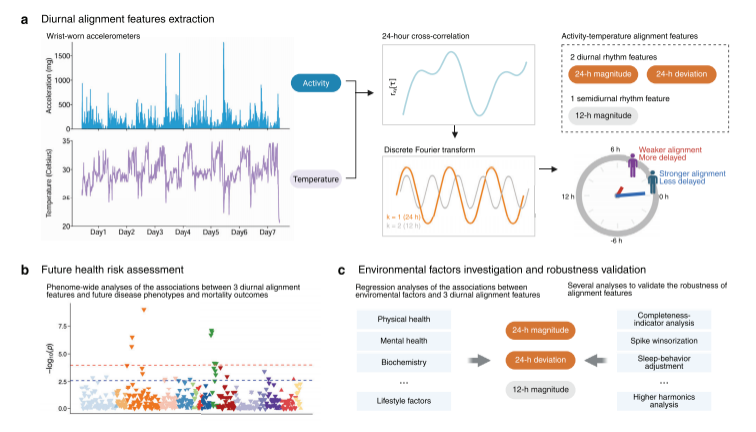
Fig. 1. Overview of the Study Design. Extraction of Activity-Temperature Alignment Features From One Week of Wearable Recordings, Phenome-Wide Association Analysis, and Analysis of Upstream Environmental Factors
The study used Cox proportional hazards models to assess associations between circadian alignment measures and newly diagnosed diseases and all-cause mortality during follow-up. The median follow-up was 7.83 years for incident disease analyses and 11 years for all-cause mortality analyses. The analyses adjusted for covariates including age, sex, body mass index (BMI), sleep duration, sedentary time, and moderate-to-vigorous physical activity (MVPA) to evaluate the independent predictive effects of circadian alignment measures. In addition, a genome-wide association study (GWAS) was conducted in 77,746 participants with genetic data to identify genetic loci associated with these measures.
To validate the transferability of the feature extraction method, researchers also applied the calculation method to an independent cohort, the Survey of Health, Ageing and Retirement in Europe (SHARE; n = 853), to assess whether circadian alignment measures with similar distributions could be derived under different conditions.
Key Findings: M24 Independently Predicts Incident T2D and All-Cause Mortality and Has a Heritable Biological Basis
After full adjustment for age, sex, BMI, sleep duration, sedentary time, MVPA, and other covariates, the results showed that weaker activity-temperature coupling and greater phase misalignment were independent predictors of incident T2D and all-cause mortality (Fig. 2). Specifically, each one-standard-deviation increase in M24 was associated with a 16% lower risk of incident T2D (HR, 0.84; 95% CI, 0.81-0.87) and a 7% lower risk of all-cause mortality (HR, 0.93; 95% CI, 0.91-0.96).
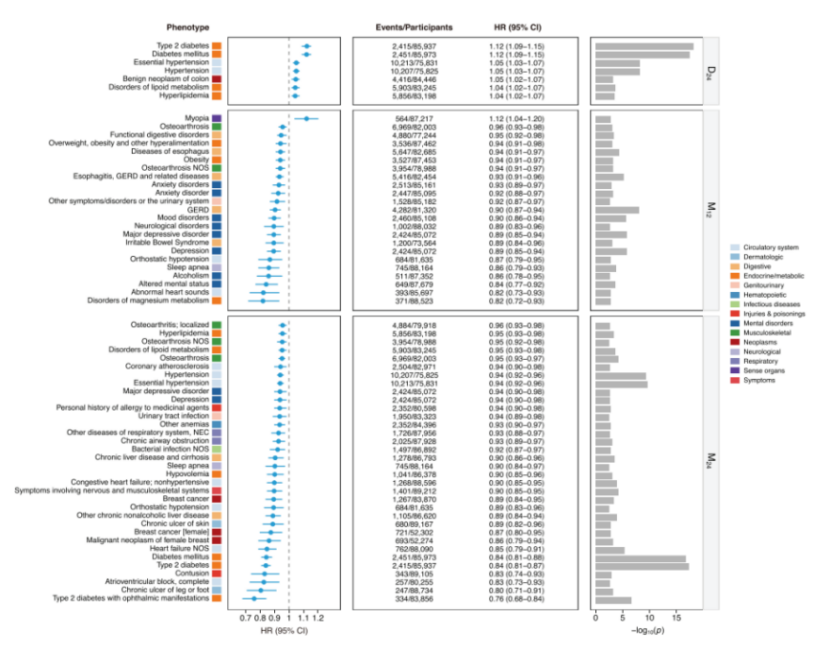
Fig. 2. Forest Plot of Significant Disease Phenotypes in the Phenome-Wide Association Analysis. Hazard Ratios (HRs) and 95% Confidence Intervals (CIs) for Incident Disease Phenotypes, Including Type 2 Diabetes, Significantly Associated With Circadian Alignment Measures After False Discovery Rate (FDR) Correction.
Population attributable fraction (PAF) estimates indicated that 26.5% of incident T2D cases and 10.4% of all-cause deaths were associated with suboptimal alignment. Suboptimal alignment referred to circadian alignment measures outside the optimal reference range, with M24 and M12 below the 95th percentile of the healthy population, or D24 above the 5th percentile.
Further genome-wide association analysis (GWAS; n = 77,746) identified 52 independent genetic loci at genome-wide significance (p < 5 × 10⁻⁸). Pathway enrichment analysis showed that these loci were concentrated in neuronal, thermosensory, and hypothalamic pathways. Their significant statistical associations with circadian alignment measures indicate that genetic variation may partly explain individual differences in alignment, suggesting an influence of genetic factors.
Conclusion
The findings suggest that circadian alignment measures are independently associated with the risks of incident type 2 diabetes (T2D) and all-cause mortality, providing preliminary evidence for their potential use as indicators in population health monitoring.
Several limitations should be noted. Device-recorded temperature is not core body temperature and only approximates local wrist skin temperature; the seven-day recordings provide only a cross-sectional snapshot and may not fully capture longitudinal stability or seasonal variation; the cohort consisted predominantly of middle-aged and older White adults, and the external validation in SHARE assessed only the transferability of the feature extraction method, without validating the generalizability of disease associations across diverse populations. In addition, circadian alignment measures may partly reflect behavioral regularity and adherence to environmental time cues, rather than internal circadian coordination alone.
Future studies should validate these findings in more diverse populations, use prospective and interventional designs to examine whether improving circadian alignment can reduce the burden of T2D, and explore the combined value of circadian alignment measures and other biomarkers for risk stratification to develop more accurate predictive models for metabolic diseases.

