


Gilead has announced a deal worth up to $5 billion to acquire German clinical-stage biotech Tubulis, including $3.15 billion in cash upfront and up to $1.85 billion in milestone payments. For a company that already entered the antibody-drug conjugate field through its 2020 acquisition of Immunomedics, the move is more than another pipeline add-on. It is a clear statement that the next round of ADC competition will be won not simply by owning a marketed product, but by controlling a platform that can repeatedly generate better molecules.
That strategic logic matters because the ADC space has changed dramatically. The first generation of ADCs proved that the concept could work, but suffered from unstable linkers, difficult payload control, and substantial off-target toxicity. Later products such as Adcetris and Kadcyla showed how improvements in linker chemistry and payload design could translate into real clinical value and revive the field. But once those technical basics matured, the market quickly moved into a period of target crowding. HER2, TROP2, and other popular antigens became battlegrounds populated by multiple similar programs, making it harder for late entrants to stand out on target selection alone.
Why Tubulis became a coveted asset
Founded in Munich in 2019, Tubulis has moved quickly from a young biotech to a company with both clinical assets and a recognizable technology identity. It attracted strong financing momentum, including an extended Series B in 2024 and a large Series C in 2025 backed by well-known life-science investors. More importantly, it has advanced two clinical-stage ADC candidates. TUB-040 targets NaPi2b and uses a topoisomerase I inhibitor payload for platinum-resistant ovarian cancer and non-small cell lung cancer. TUB-030 targets 5T4 and uses an exatecan-based payload for advanced solid tumors.
Among the two, TUB-040 is especially notable because NaPi2b remains an underexploited antigen despite strong biological rationale in ovarian cancer. The source article highlights that NaPi2b is highly expressed in a large share of epithelial ovarian cancers, while clinically advanced ADC competition at this target is still limited. Early data disclosed at ESMO in 2025 suggested encouraging activity in platinum-resistant ovarian cancer, with an objective response rate of 59% and a tolerable safety profile. That combination of target whitespace, early efficacy, and platform differentiation helps explain why Gilead was willing to pay a premium.
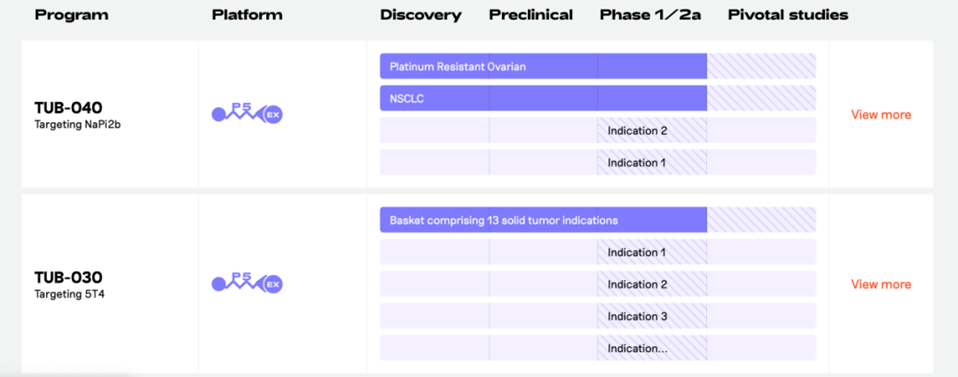
Fig. 2. Original article image.
The platform, not just the pipeline
The real prize, however, appears to be Tubulis' technology stack. Its P5 conjugation chemistry is designed for cysteine-selective conjugation and can support a drug-antibody ratio of 8 while maintaining stability. In practical terms, the promise is straightforward: more payload can be carried without the typical penalty of premature release in circulation. That matters because linker instability remains one of the most important hidden constraints in ADC design. A molecule may look potent on paper, but if the payload leaks too early, efficacy falls and systemic toxicity rises.
Tubulis pairs that conjugation approach with its Tubutecan linker-payload platform, which uses the topoisomerase I inhibitor exatecan. For Gilead, that is especially relevant because its marketed ADC Trodelvy also relies on a topo-I payload approach. A platform that offers stronger linker stability and potentially cleaner delivery creates an opportunity not only to advance Tubulis' own assets, but also to upgrade Gilead's broader ADC design capabilities. The company's Alco5 platform pushes that logic further by enabling stable coupling of payload classes that have historically been harder to incorporate, including cytotoxics and protein degraders. That broadens the range of future mechanisms of action rather than locking Gilead into one payload era.
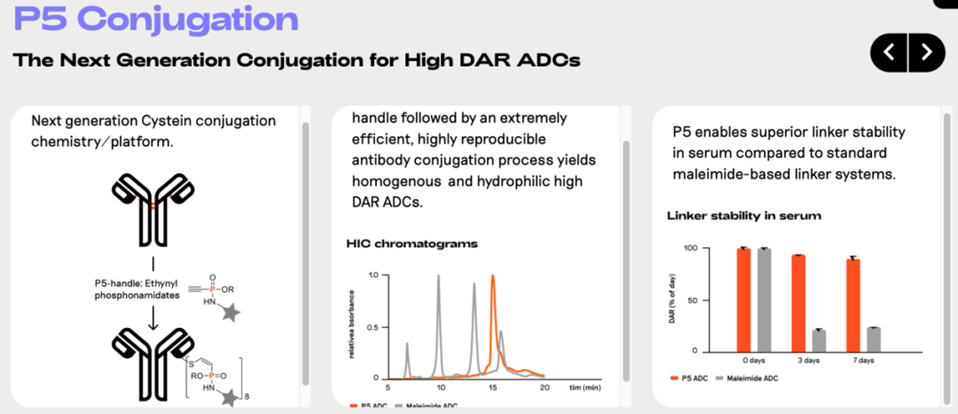
Fig. 3. Original article image.
ADC competition is moving from products to systems
This transaction fits a wider reset in how large companies think about ADC deals. Earlier business development in the category often revolved around a single late-stage asset or a narrowly defined regional right. Today, the more valuable target is frequently the engine behind the molecules. The reason is structural: a successful ADC requires the antibody, linker, and payload to work together as a system. Optimizing only one component rarely creates durable advantage. By contrast, owning a platform that repeatedly solves for stability, potency, delivery, and tolerability offers a much stronger long-term position.
The source article places Gilead's move in the context of other platform-driven transactions. AstraZeneca's rise in ADCs has been closely tied to Daiichi Sankyo's DXd technology base; Merck's broad collaboration with Kelun-Biotech similarly reflected more than interest in a single compound; and large oncology players such as Roche and Johnson & Johnson have increasingly treated ADC capability as a core strategic layer. In that sense, Gilead is not simply buying a company. It is buying time, technical optionality, and a seat in the next phase of the platform race.
Why Gilead needed a reset
Gilead's own position helps explain the urgency. Trodelvy gave the company a commercial foothold, but it has not established Gilead as an ADC leader. According to the source article, Trodelvy generated about $1.4 billion in 2025 sales, growing 6% year over year, while leading products such as Enhertu and Padcev expanded more rapidly. Just as importantly, Gilead's broader ADC pipeline has remained comparatively thin. Without a deeper bench or a clearer technical upgrade path, the company risked becoming dependent on a single established asset in a field defined by rapid iteration.
Tubulis gives Gilead a route out of that position. The company can immediately deepen its clinical portfolio with TUB-040 and TUB-030, while also importing a chemistry toolkit that could support internal next-generation programs across new targets and formats. The value is therefore both near term and architectural. If the platform performs in larger trials, Gilead may be able to reposition itself from a company with one meaningful ADC brand to a developer with a renewable ADC franchise.
A broader oncology architecture may be taking shape
Viewed alongside Gilead's recent dealmaking, the Tubulis acquisition also suggests a bigger oncology design. The source article notes that Gilead announced plans in February 2026 to acquire Arcellx, strengthening its cell therapy capabilities, and followed in March with the acquisition of Ouro Medicines to expand in autoimmune disease and T-cell engager territory. Put together, those moves hint at a future portfolio spanning ADCs, CAR-T, and T-cell redirecting approaches rather than relying on any single modality.
That matters because combination therapy is likely to define the next wave of cancer care. ADCs do not merely deliver cytotoxics; they can also reshape the tumor microenvironment and potentially improve the performance of immunotherapies or cellular therapies in selected settings. If Gilead can combine Tubulis-derived ADCs with its broader immuno-oncology assets, the company may create differentiated regimens rather than simply chase stand-alone label expansions. In an increasingly crowded market, that kind of cross-modality integration could matter as much as any individual response rate.
What could still go wrong
None of this removes development risk. Tubulis' leading programs are still in clinical development, and strong early signals do not guarantee registrational success or commercial durability. The ADC field is also now populated by powerful incumbents with established brands, extensive clinical infrastructure, and growing expertise in earlier-line expansion. Gilead will need to prove that Tubulis' chemistry translates into meaningful clinical differentiation, not just attractive platform narratives.
Even so, the logic of the deal is compelling. In a category where simple target duplication no longer guarantees value, the most attractive assets are increasingly those that improve the underlying engineering of ADCs themselves. By acquiring Tubulis, Gilead is effectively wagering that better platform design can still create a shortcut to relevance. Whether that bet results in a genuine leap forward will depend on clinical execution, but strategically, the company is trying to move from following the ADC race to helping define its next technical standard. Source: Yao Chuangxin, April 9, 2026.

