


On the journey to weight loss, exercise is often regarded as the ultimate "panacea." Although most people have the intention to lose weight, they often find it hard to resist the temptation of delicious food. Among contemporary young people, weight loss methods through exercise are diverse, with the belief that as long as they keep moving, they can indulge in high-fat, high-calorie foods without any concerns, such as:
"Morning run for tofu pudding, night run for barbecue";
"16+8 Eating Method"—eating 8 meals in 16 hours;
"Liquid Fast"—not drinking water but consuming milk tea;
"Mind Your Own Business and Keep Moving"—stopping others from commenting on weight while personally going out to enjoy delicious food.
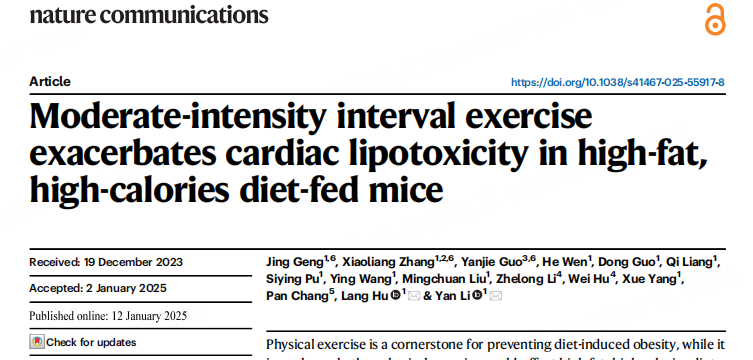
However, a recent research paper published in Nature Communications has shattered the beautiful illusion of those who rely solely on exercise for weight loss. The study shows that while moderate to high-intensity exercise can prevent obesity and metabolic syndrome caused by a high-fat diet, it can also exacerbate cardiac damage in mice fed a high-fat diet. This leads to the redistribution of circulating lipids to the heart, causing excessive lipid accumulation and lipotoxicity in the heart.
Seeing these results, are you, who just came out of the gym and were about to enjoy fried chicken legs, suddenly "defeated"? Let's delve deeper into the specifics of this article:
Experiment Unveiled: The Multifaceted Impact of Exercise on High-Fat Mice
Researchers divided mice into two groups: a normal diet group (10% fat calories) and a high-fat, high-calorie diet group (60% fat calories). Each group was further divided into sedentary and different exercise intensity groups (including low, moderate, and high intensity), with the experiment lasting for 8 weeks. The exercise groups ran on a treadmill for 60 minutes per day, 5 days a week, at speeds of 6m/min, 12m/min, and 18m/min, respectively. By observing and measuring various indicators, the study analyzed the impact of different exercise intensities on cardiac function in mice fed a high-fat, high-calorie diet.
"Fitness" Misconception: Moderate-Intensity Exercise Can Be "Harmful" to the Heart
Impact of Moderate-Intensity Exercise on Metabolic Syndrome in High-Fat, High-Calorie Mice:
A high-fat, high-calorie diet increases body weight, blood glucose, blood lipid levels, and white adipose tissue weight in mice, impairing insulin sensitivity.
However, moderate-intensity exercise intervention can prevent obesity, hyperglycemia, and hyperlipidemia induced by a high-fat, high-calorie diet, reducing body weight, blood glucose, triglyceride, and cholesterol concentrations, as well as white adipose tissue weight. However, it does not have a positive effect on insulin sensitivity.
Impact of Different Exercise Intensities on Cardiac Function in High-Fat, High-Calorie Mice:
Moderate-intensity exercise exacerbated cardiac dysfunction and pathological changes induced by a high-fat, high-calorie diet, such as reducing cardiac diastolic and systolic function indicators, worsening cardiac hypertrophy, fibrosis, and levels of pathological hypertrophy biomarkers.
In terms of exercise performance, sedentary mice fed a high-fat, high-calorie diet had impaired exercise capacity. Moderate-intensity exercise further reduced the exercise performance of these mice, while it did not significantly improve the exercise performance of mice on a normal diet.
Comparing different exercise intensities, low-intensity exercise improved cardiac function and exercise performance in high-fat, high-calorie mice. While moderate and high-intensity exercises were more effective in reducing body weight and improving blood lipids, they exacerbated cardiac damage and dysfunction, with high-intensity exercise causing more severe negative effects on the heart.
Lipid Metabolism in the Heart:
Moderate-intensity exercise increased lipid accumulation in the heart induced by a high-fat, high-calorie diet, increasing the number and size of lipid droplets in cardiomyocytes and raising the levels of triglycerides, diacylglycerols, ceramides, and cholesterol in the heart. High-intensity exercise induced even more severe lipid accumulation.
Lipid tracing experiments showed that moderate-intensity exercise caused the redistribution of circulating lipids from the liver and white adipose tissue to the heart, significantly increasing the levels of labeled palmitate and fluorescently labeled fatty acids in the heart while reducing lipid content in the liver and white adipose tissue. However, it did not significantly reduce lipid deposition in skeletal muscle.
Transcriptomic and proteomic analyses revealed that moderate-intensity exercise increased the expression of genes and proteins related to fatty acid uptake in the hearts of high-fat, high-calorie mice, while decreasing the expression of genes and proteins related to fatty acid degradation. This led to increased lipid uptake and reduced oxidation in the heart, causing abnormal lipid deposition and cardiac dysfunction.
Mitochondrial function analysis indicated that a high-fat, high-calorie diet itself impairs cardiac mitochondrial respiratory function. Moderate-intensity exercise further exacerbated this damage, reducing fatty acid oxidation capacity and affecting pathways related to the mitochondrial electron transport chain and ATP synthesis. It also altered mitochondrial ultrastructure (e.g., reducing mitochondrial size and decreasing cristae density), leading to lipid accumulation and cardiac dysfunction.
Summary
In conclusion, do not naively assume that you can eat whatever you want as long as you exercise. As shown in the experiment with mice, moderate-intensity exercise combined with a high-fat, high-calorie diet can control body weight and blood lipids to some extent but can have many adverse effects on cardiac function, lipid metabolism, and mitochondrial function. The same applies to high-intensity exercise!
Therefore, the next time the fried chicken legs and cupcakes in your hand look particularly tempting, consider this study and choose a reasonable diet structure and appropriate exercise. Otherwise, be aware that your heart may "trip you up"!

