


On July 23, 2026, AstraZeneca announced that its next-generation oral selective estrogen receptor degrader (SERD), camizestrant, in combination with a cyclin-dependent kinase (CDK) 4/6 inhibitor, had been approved by the European Medicines Agency (EMA) for the treatment of adult patients with estrogen receptor (ER)-positive, HER2-negative locally advanced or metastatic breast cancer — provided that an ESR1 mutation is detected during first-line endocrine therapy combined with a CDK4/6 inhibitor, and the disease has not yet progressed.
That final clause is the source of the entire controversy. For roughly half a century of medical-oncology practice, the default answer to “when should we switch drugs” has been: wait for radiographic progression. Once a tumor enlarges on CT or new lesions appear, the regimen is changed. The SERENA-6 trial moved that switch earlier — treatment is changed the moment a circulating tumor DNA (ctDNA) test detects an ESR1 mutation, rather than waiting for imaging progression.
The EMA endorsed this logic. On April 30, the U.S. Food and Drug Administration’s (FDA) Oncologic Drugs Advisory Committee (ODAC) voted 6 against, 3 in favor — against the same data. Two regulators, looking at identical evidence, landed in opposite directions. This was not a difference in review pace; it was a substantive disagreement about how disease progression should be defined.
The Switch That Moved Forward
Hormone receptor (HR)-positive, HER2-negative breast cancer is the most common subtype of the disease. Its standard first-line treatment is an aromatase inhibitor (AI) combined with a CDK4/6 inhibitor. AIs block the activity of aromatase, the enzyme that converts androgens into estrogens, depriving the tumor of the estrogen it depends on for growth.
But tumors develop acquired resistance. An ESR1 mutation lets the estrogen receptor remain active without estrogen, effectively bypassing the AI’s mechanism. According to the FDA briefing document, ESR1 mutations are detected in about 4% of patients with advanced disease at initial diagnosis, rising to roughly 40% by the end of first-line AI plus CDK4/6 inhibition, and to more than 50% among those treated for over a year. Critically, these mutations can be detected via peripheral-blood ctDNA, typically months before imaging changes become visible.
SERENA-6 (NCT04964934) was designed to exploit that lead time. SERENA-6 is a global, multicenter, randomized, double-blind Phase III trial conducted in two steps: first, patients who had received at least six months of first-line therapy without progression underwent ESR1 mutation testing by blood draw every 2–3 months; second, those who tested positive but had no clinical or radiographic progression were randomized 1:1 — one arm switched the AI to camizestrant (75 mg orally once daily) while continuing the same CDK4/6 inhibitor; the other arm continued the original regimen. The CDK4/6 inhibitor was identical in both arms; the only variable was whether, at the moment a molecular resistance signal appeared, the AI was replaced by camizestrant. The trial enrolled 315 patients. The primary endpoint was investigator-assessed progression-free survival (PFS); key secondary endpoints included investigator-assessed second progression-free survival (PFS2) and overall survival (OS).
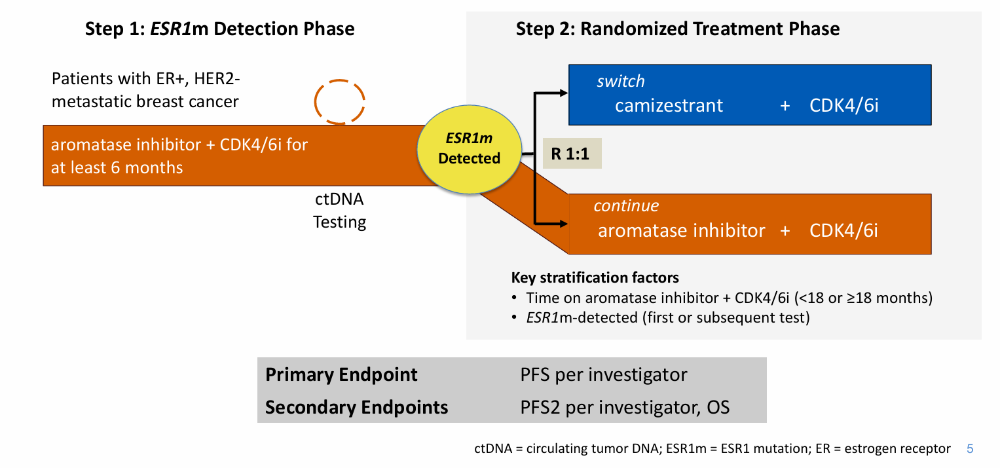 Fig.1.SERENA-6 Trial Design
Source: FDA
The trial met its primary endpoint at a planned interim analysis. As of the November 28, 2024 data cutoff, median PFS in the camizestrant-plus-CDK4/6i arm reached 16.0 months versus 9.2 months in the AI-plus-CDK4/6i arm, with a hazard ratio (HR) of 0.44 (95% CI 0.31–0.60), p < 0.00001. Relative to continued original therapy, the early-switch strategy was associated with a 56% reduction in the risk of disease progression or death.
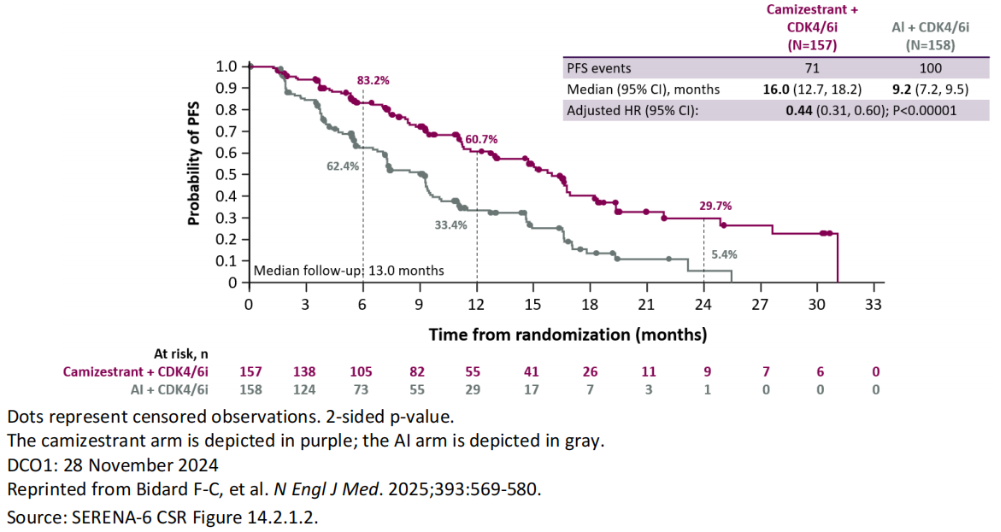 Fig.2.PFS Based on Investigator Assessments According to RECIST 1.1, Kaplan-Meier Plot (FAS) - DCO1
Source: FDA
The key secondary endpoint, PFS2, was also met at the January 2026 data cutoff: median PFS2 reached 25.7 months with camizestrant plus CDK4/6i versus 19.1 months with AI plus CDK4/6i, HR 0.63 (95% CI 0.46–0.86), p = 0.0037.
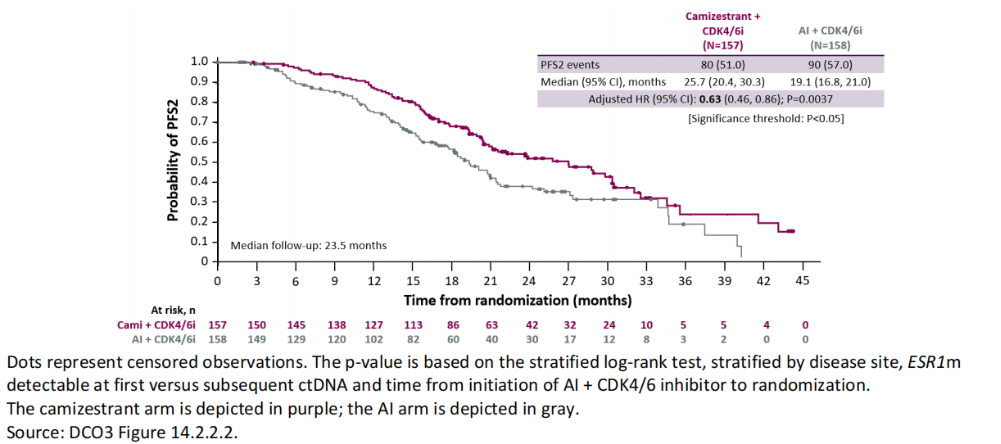 Fig.3.Time to Second Progression or Death (PFS2), Kaplan-Meier plot (FAS) - DCO3
Source: FDA
On the safety side, adverse events were broadly consistent with the known profiles of the component drugs, dominated by hematologic toxicity such as neutropenia. Ocular adverse events (such as photopsia and dry eye) were more common in the camizestrant arm. The discontinuation rate for camizestrant itself was around 1%.
If the data were this strong, where did the ODAC’s six “no” votes come from?
Five-layered Reasons for the Six “No” Votes
One clarification is in order: the debate was not about efficacy. The crux of the disagreement lay elsewhere.
First, it remains unclear whether switching at ESR1 mutation detection — before radiographic progression — confers a long-term benefit to patients. SERENA-6 was not designed to demonstrate that switching at ESR1 detection is better than switching at radiographic progression. In other words, SERENA-6 can prove that “switching now is better than not switching,” but not that “switching now is better than switching at radiographic progression.” From this, the FDA raised the inverse concern: switching early might mean not using each line of therapy to its fullest, since the control arm still made it a median of 9.2 months before progressing after ESR1 detection. For this reason, as early as the 2021 design stage, the FDA had required the informed-consent document to state that participants might be giving up a treatment that was still working for them.
Second, in first-line trials, PFS is typically measured from the time of advanced or metastatic disease diagnosis; in trials of later lines, the standard starting point is the time of radiographic progression. SERENA-6 took a different approach — using ESR1 mutation detection as the start of PFS. Although the FDA did not object to investigator-assessed PFS as the primary efficacy endpoint, the trial’s PFS started from a different time point than those used to support prior approvals in this disease, raising uncertainty over whether the observed PFS improvement was clinically meaningful.
Third, in the PFS and PFS2 analyses, the number of new therapies received after randomization differed between arms. In the PFS analysis, the experimental arm received one new therapy while the control received none; in the PFS2 analysis, the experimental arm received two new therapies versus one in the control. The unequal number of newly introduced treatments amplifies differences on these endpoints without necessarily translating into long-term patient benefit. For this reason, even though PFS2 was formally included in the statistical hierarchy, the FDA did not accept it and had communicated in writing in November 2024 that, under this trial design, PFS2 would not be accepted as a regulatory endpoint, because it cannot isolate the effect of the investigational drug itself.
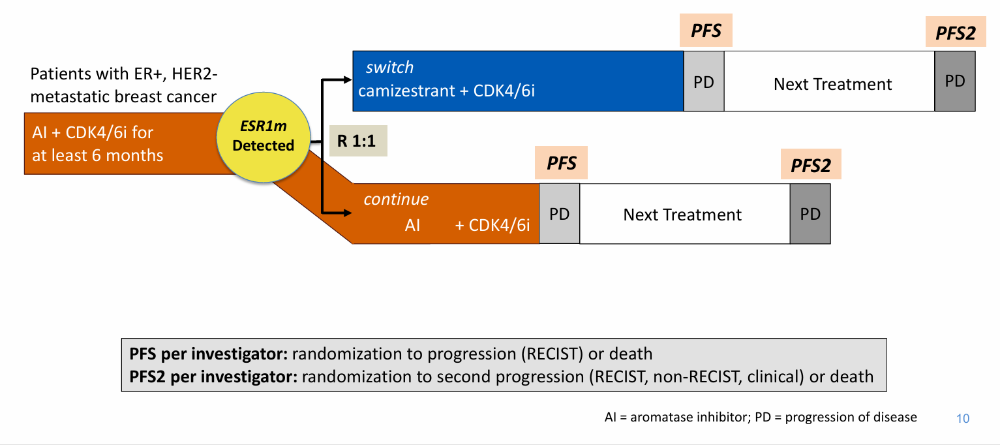 Fig.4.Neither PFS nor PFS2 Evaluate Benefit ofSwitching Treatment at ESR1m Detection
Source: FDA
Fourth, evidence of overall-survival benefit is insufficient. If OS had reached statistical significance, it would have been enough to overcome concerns about the trial design and PFS interpretation. But at the third data cutoff (January 2026), OS HR was 0.87 (95% CI 0.57–1.30), with event maturity at 30% (95/315 events), not statistically significant. The final OS analysis will be performed when at least 165 OS events (55% maturity) have been observed. Assuming a median OS of 35 months in the AI + CDK4/6i arm and 50 months in the camizestrant + CDK4/6i arm, an HR of 0.70 would yield only 63% statistical power. In other words, even under optimistic assumptions — a 30% reduction in mortality risk — the trial would have only a 63% chance of detecting that benefit. With 315 enrolled patients, the FDA explicitly noted concerns that the trial might not achieve statistical significance for OS.
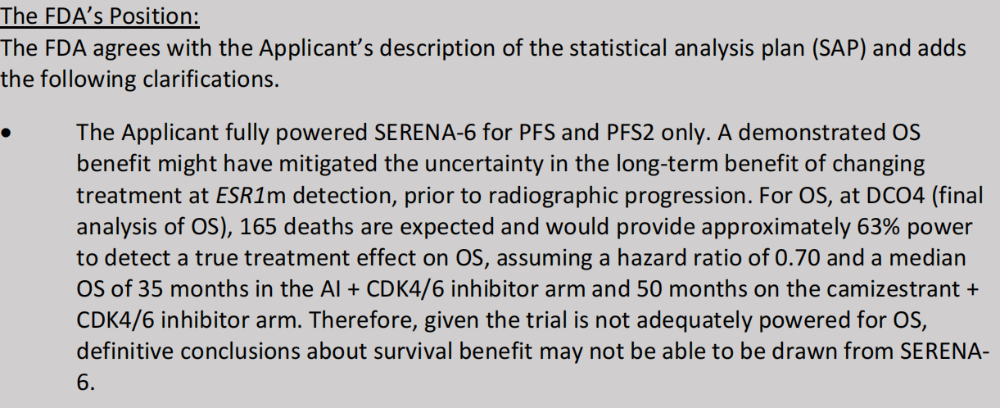 Fig.5.The FDA’s Position
Source: FDA
Fifth, the word repeatedly raised during the meeting was “precedent.” Approving this indication is not just approving a drug; it is also endorsing an entirely new clinical-practice rule: routine, serial blood sampling for patients without progression, and switching treatment the moment a molecular signal emerges. Once such a rule is set, it would immediately affect thousands of patients who have not yet progressed, and would serve as a template for future similar applications.
The “Yes” Side, and the FDA’s Response
Even with six opposing votes, SERENA-6 drew three supporting votes at the ODAC meeting, on grounds that the magnitude of the PFS improvement was substantial, the early OS trend was favorable, and “intervening at the molecular resistance signal” is biologically plausible.
Academic support went further. A 2026 expert commentary in Breast Cancer Research and Treatment argued that for a substantial share of patients, the option of “switch later” does not exist biologically: about 40% of the control arm progressed on imaging within six months of ESR1 mutation detection, while in the PADA-1 trial, 68% of control-arm patients crossed over to a different treatment after progression, with a subsequent median PFS of only 3.5 months. The commentary also cited other precedents — avelumab maintenance, PARP inhibitor maintenance — for approving interventions made before radiographic progression.
But the FDA, in its briefing document, addressed these arguments:
On the PADA-1 trial’s median 3.5-month post-progression PFS, the FDA noted that this was an exploratory subgroup analysis restricted to control-arm crossovers, accounting for only 54% (47/87) of controls. Whether a patient crossed over depended on investigator and patient preference, producing a biased sample that cannot be used to claim early switching is superior.
The FDA also sketched a trial design it considered more appropriate: randomize patients to predefined treatment sequences, with one arm switching at ESR1 mutation detection and another continuing first-line therapy until radiographic progression, then switching to a prespecified second-line regimen. Only such a design, the FDA argued, can actually answer the timing question.
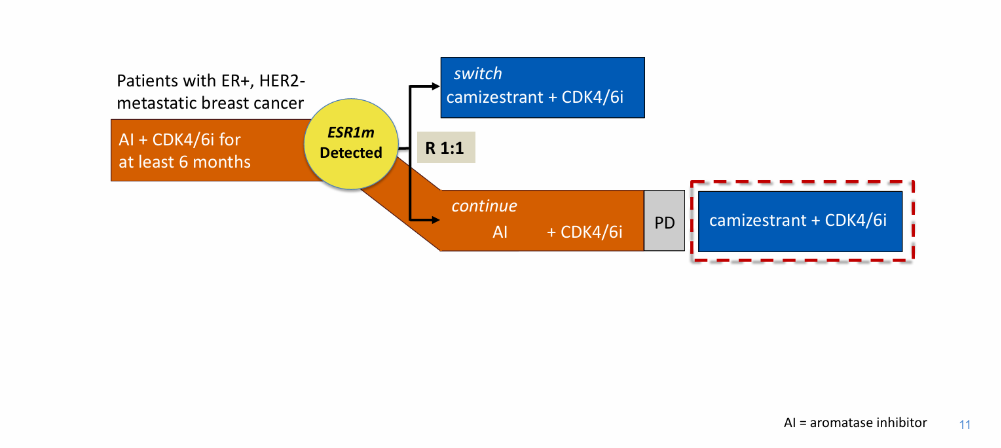 Fig.6.No Crossover Permitted in SERENA-6
Source: FDA
Why Europe Gave a Different Answer
One common misreading needs to be cleared up: the ODAC vote is not the FDA’s final decision, and the FDA has not rejected camizestrant. The U.S. review is still ongoing; the action date has been delayed to allow review of additional submitted analyses. The European and U.S. divergence has at least two layers:
First, the questions being asked were different. The ODAC was asked to judge whether an entire treatment strategy is valid; the EMA review focused more narrowly on whether, within a well-defined population, the benefit–risk balance of the regimen is favorable. The former is a paradigm-level judgment; the latter is a product-level judgment.
Second, regulatory culture differs. The FDA has historically been more cautious about whether a surrogate endpoint represents real benefit, particularly when an approval might simultaneously establish new clinical-practice norms.
Conclusion
None of the ODAC’s six “no” votes were cast against the drug’s efficacy. The heart of the dispute can be condensed into one sentence: SERENA-6 proved that “switching drugs helps,” but did not prove that “switching early helps” — and it is the latter that the proposed indication actually claims.
For oncology as a whole, the significance of SERENA-6 extends well beyond breast cancer. When ctDNA can detect resistance months before CT does, lung cancer, colorectal cancer and hematologic malignancies are all heading toward the same intersection: molecular signals arriving earlier, imaging lagging behind, while the rules governing when to switch drugs remain anchored in the imaging era. When technology lets us see resistance months earlier, the question is no longer “can we see it,” but “once we see the signal, when should we act on it?” SERENA-6 itself has not answered this question — but it has forced everyone to start facing it.

