


After nearly 30 years without a breakthrough drug, androgenetic alopecia (AGA) has finally seen major therapeutic progress.
On December 3 local time, Italian drugmaker Cosmo said its investigational drug clascoterone 5% topical solution produced positive results in two pivotal Phase III trials. Compared with placebo, treated patients had markedly increased hair counts, with improvement up to 539%.
AGA is the most common form of hair loss worldwide. Related to genetic factors and androgen effects, it affects about 1.2 to 2 billion men globally. In China alone about 130 million people are affected, and the patient population is becoming younger.
According to Cosmo, this was the largest study ever conducted of topical therapy for male AGA. Unlike existing marketed drugs, the investigational therapy offers a new approach: directly blocking the androgen receptor to intervene at the root of AGA.
Dr. Ming Lei, associate chief physician in the Hair Diagnosis and Treatment Department of Peking University Shougang Hospital, told MedJ: “From the public information, the mechanism really is a disruptive innovation, and its effect may be better than that of existing drugs.” If further clinical benefit and safety can be demonstrated, he said, it may redefine AGA treatment.
A breakthrough mechanism for treating hair loss
Dr. Lei said that hair loss can be broadly divided into AGA, alopecia areata, telogen effluvium, and other types. “AGA accounts for about 90%; in other words, if you see 10 people with hair loss, nine have AGA.”
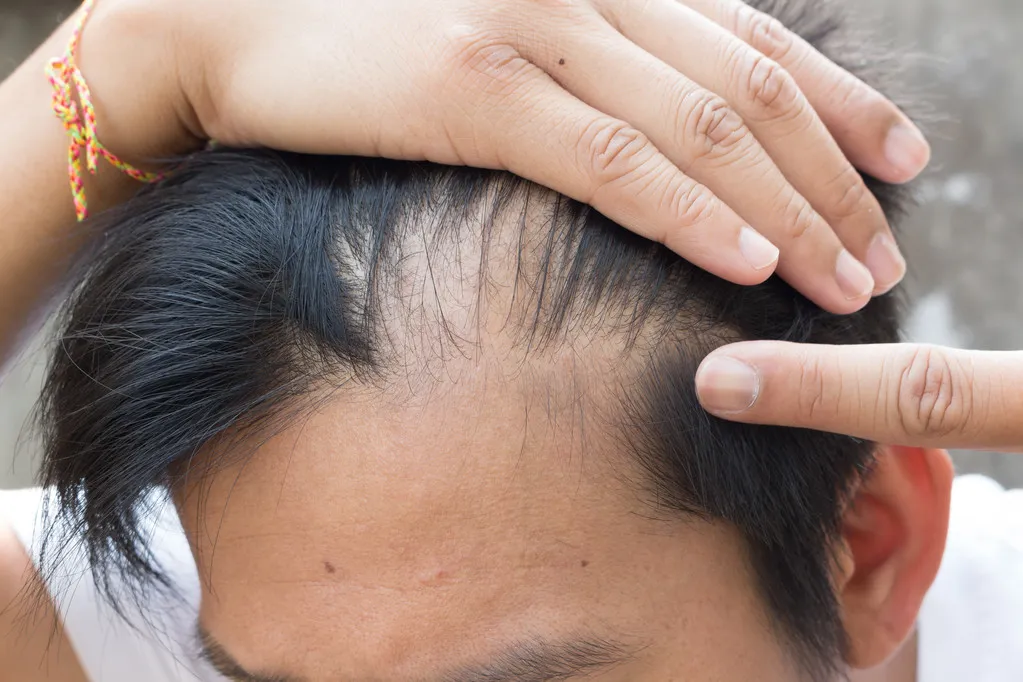
To date, globally recognized drug treatment for AGA has mainly centered on two old drugs. One is minoxidil, first marketed in 1988. It can be used topically by both men and women to promote hair growth, though the mechanism remains unclear.
The other is finasteride, approved in 1997 for male AGA. Taken orally, it specifically inhibits type II 5-alpha-reductase, reducing conversion of testosterone to dihydrotestosterone (DHT) and preventing DHT from damaging hair follicles.
Cosmo’s investigational product is clascoterone 5% topical solution, designed specifically for AGA. Clascoterone is a topical androgen-receptor inhibitor that acts directly on hair follicles and blocks DHT from binding to the androgen receptor, thereby directly reducing the negative effect of androgens on follicles.
“AGA has two main causes. One is androgens, the decisive factor in the disease, and that is why it is called androgenetic alopecia,” Dr. Lei explained.
Genetics are the other factor. The Chinese Guidelines for the Diagnosis and Treatment of Androgenetic Alopecia cite domestic epidemiologic surveys showing that 53.3% to 63.9% of AGA patients have a family history, with paternal inheritance more prominent than maternal. Genome sequencing and mapping studies have already identified a number of susceptibility genes that may influence androgen levels.
“That means clascoterone can target the two main biological drivers of male hair loss. It is a very good development strategy,” Dr. Lei said.
The two Phase III studies announced by Cosmo, SCALP 1 and SCALP 2, had identical designs and were conducted simultaneously in the United States and Europe, randomly enrolling 1,465 male patients in total.
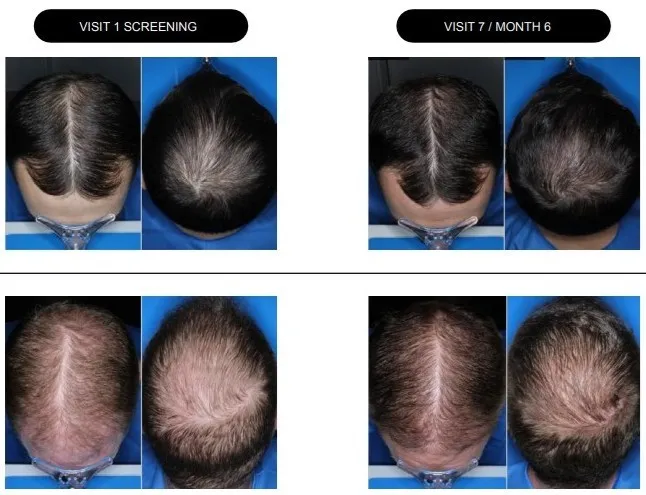
According to the company statement, clascoterone 5% topical solution significantly improved subjects’ hair counts, with both statistical significance and clinical relevance.
In one study, target area hair count (TAHC) improved by 539% versus placebo. In the other, TAHC improved by 168% versus placebo.
In addition to the objective hair-count metric, patient-reported outcomes also confirmed benefit. One study met the endpoint with statistical significance, while the other showed a positive trend, indicating that patients genuinely perceived improvement.
In terms of safety, adverse events observed during treatment were similar to those in the placebo group and were mostly unrelated to the drug.
Notably, after the trials ended, more than 90% of participants chose to continue treatment in an open-label extension study. That may indirectly reflect patients’ recognition of the efficacy and treatment experience.
Experts say there is still a long road ahead
Clascoterone did not appear out of nowhere.
In August 2020, its 1% cream formulation was approved in the United States for acne in patients aged 12 years and older, and 1.6 million prescriptions have been written so far. At the time, reports said it was the first acne drug approved in the United States in nearly 40 years with a novel mechanism of action.
With the new hair-loss data now available, clascoterone may gain a new indication. According to the company statement, Cosmo expects to complete 12 months of safety follow-up in spring 2026 and, after data collection is complete, plans to submit for marketing approval simultaneously in the United States and Europe.
Cosmo estimates that clascoterone’s potential market in the U.S. AGA field alone exceeds $20 billion and that 1.2 to 2 billion men worldwide could benefit. On the back of this news, Cosmo’s share price once surged more than 40%.
The global journal Genetic Engineering & Biotechnology News has analyzed that if sales meet expectations, clascoterone could become one of the world’s best-selling drugs.
Prof. Maria Hordinsky, a dermatology professor at the University of Minnesota who participated in the Phase III research, believes that if successfully approved, clascoterone 5% topical solution may become a milestone in male AGA therapy and redefine the treatment paradigm.
“In fact, there is still a long way to go,” Dr. Lei told MedJ. For a new drug to reach market and become a core therapy, it must prove not only efficacy but also long-term safety, and the studies must be reproducible.
In his view, current information on clascoterone 5% topical solution does not fully rule out some concerns. First among them is whether long-term use could affect systemic hormone levels and thereby cause sex-related adverse effects in male patients, especially older men or those with underlying diseases.
According to the Chinese Guidelines for the Diagnosis and Treatment of Androgenetic Alopecia, finasteride, which prevents hair loss by inhibiting conversion of androgens into DHT, has this problem. A small number of patients may experience reduced prostate-specific antigen, gynecomastia, testicular pain, and impaired sexual function.
In August this year, PLOS One published an article describing the epidemiology of AGA and the treatment landscape. It noted that most male AGA patients are 20 to 39 years old, while female AGA patients are concentrated at 60 to 69 years. Sex-related side effects greatly affect men’s willingness to be treated.
“I have seen many patients in clinic who resist oral finasteride because they worry it will affect male characteristics. The incidence of such adverse effects is not high—published reports put it at 3% to 5%, meaning about one in 20 people may develop side effects,” Dr. Lei said.
With clascoterone 5% topical solution specifically, its core mechanism is androgen-receptor inhibition, so in theory it may also influence systemic hormone levels, especially in older patients with underlying disease. The current Cosmo statement does not explain this in detail. Other literature says clascoterone can be rapidly converted into corticosteroid hormones and no effect on human hormone metabolism has been found.
Dr. Lei speculated that two points are involved. First, unlike oral finasteride, clascoterone 5% topical solution is locally applied, so drug-related systemic side effects may be smaller. Second, Cosmo says the drug components are rapidly metabolized in the body into a small amount of corticosteroid hormone after administration, which may mean higher safety.
Dr. Lei said the risks still cannot be completely excluded, especially because hair-loss treatment is a long-term undertaking.
MedJ checked ClinicalTrials.gov and found that the two Phase III studies enrolled men aged 18 years or older with mild to moderate AGA involving the temporal and vertex scalp and a history of ongoing hair loss.
Both studies included a six-month double-blind treatment phase followed by a six-month single-blind extension phase. During those 12 months, the treatment group applied the drug twice daily to local areas of hair loss.

“We can see that severe AGA was not included in the investigational drug studies,” Dr. Lei said. He hopes to see more safety data after use in older people, those with underlying disease, and those prone to electrolyte disturbances.
Multiple hair-loss studies are underway
Whatever clascoterone’s future may be, one trend is clear: AGA treatment is moving toward greater precision and more localized intervention.
In January this year, the topical small-molecule drug T-02 reported positive first-in-human Phase I data. The drug is a plasminogen activator inhibitor intended to activate hair-follicle stem cells. Its oral formulation, ET-02, is in preclinical research for AGA.
In June, the topical small-molecule drug PP405 reported Phase IIa data and is expected to enter Phase III in 2026. The drug stimulates hair growth by inhibiting a protein related to the dormancy of hair-follicle stem cells, thereby activating dormant stem cells, driving cell proliferation and glycolysis.
TDM-105795, a topical small-molecule drug developed by China’s Ticare Bio, is a potent thyroid hormone receptor agonist that likewise targets dormant hair-follicle stem cells and promotes rapid entry of follicles into the growth phase.
According to Phase IIa data reported in February 2024, in a 1-square-centimeter test area, the mean change in hair count from baseline was an increase of 24.3 hairs with high-concentration TDM-105795 solution (0.02%), 20.3 hairs with low-concentration solution (0.0025%), and 14.0 hairs in the placebo group.
China also has investigational agents with similar targets in the androgen-receptor inhibitor track. In July this year, Kintor Pharmaceutical announced that its self-developed, potentially first-in-class KX-826 tincture 1.0%, a topical androgen-receptor inhibitor, had completed enrollment of all 666 patients in the Phase III stage of a pivotal trial.
This is a multicenter, randomized, double-blind, vehicle-controlled adaptive Phase II/III design study. The Phase III trial is being conducted at 25 clinical research centers across China, with 24 weeks of treatment at the specified dose followed by two weeks of safety observation, and is expected to be completed in early 2026.
Among the many studies in hair-loss treatment, Dr. Lei hopes to see more progress for women with AGA.
In China, the prevalence of AGA is about 21.3% in men and 6.0% in women. The Chinese Guidelines for the Diagnosis and Treatment of Androgenetic Alopecia note that women have fewer drug options. Some can use spironolactone, whose main adverse effects are menstrual irregularities, reduced libido, and breast tenderness. In addition, 2% topical minoxidil can be used, with an efficacy rate of 50% to 85%.
Dr. Lei stressed that AGA treatment emphasizes early intervention, which requires less money, time, and manpower and works better. “If you notice a lot of hair falling out during washing, broken hairs all over the pillow in the morning, a gradual recession of the temples in men, or a visibly wider part and thinner braids in women, all of these suggest hair loss.”
He said that after drug therapy for mild or moderate hair loss, most patients do quite well: the condition can be stabilized without further worsening, and some patients can even regrow hair. But once it progresses to severe disease or beyond, drugs are likely to be ineffective and hair transplantation surgery may be needed.

