


Milestone
The relevant milestone is strategic rather than regulatory: the autoimmune bispecific field generated twelve major business-development transactions in 2025, becoming one of the most aggressively financed themes in immunology. That matters because deal volume in itself does not prove clinical success, but it does indicate that large companies now regard multispecific immune modulation as more than a speculative extension of oncology playbooks. It is becoming a central thesis in autoimmune drug development.
Why the field is attracting attention
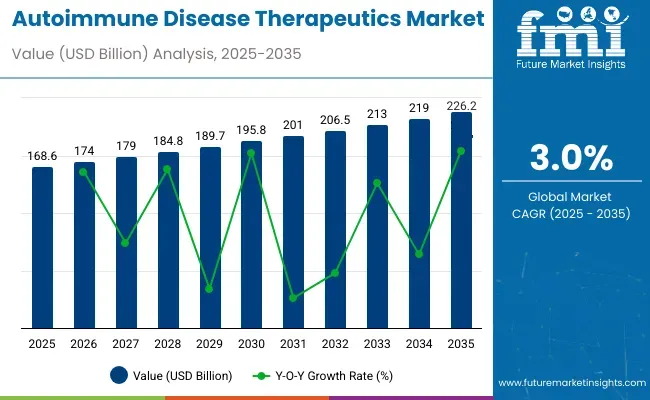
Autoimmune disease is a large and growing market. Projections place the global autoimmune drug market at $226.2 billion by 2035, with China alone expected to reach $26.3 billion by 2032 and grow at 23.3% annually. At the same time, the global bispecific market is projected to expand rapidly, rising from more than $12.4 billion in 2024 toward far larger scale over the next decade. Those numbers matter because they frame autoimmune bispecifics not as a scientific curiosity, but as a modality sitting at the intersection of huge unmet need and a platform already validated in other therapeutic areas.
Mechanistic rationale
The scientific case is straightforward. Autoimmune diseases are rarely driven by a single linear pathway. Parallel cytokine circuits, overlapping cellular compartments and compensatory signaling all contribute to incomplete response or escape from monotherapy. Bispecifics promise either simultaneous blockade of two inflammatory nodes or combined engagement of an immune cell and inflammatory mediator. That can mean better efficacy, greater depth of immune reset or lower dosing burden if one molecule can replace multi-drug sequencing. Importantly, mechanistic innovation here is not just "more targets." It is the attempt to match complex network disease with network-level pharmacology.
What the current evidence shows
Several already approved or near-commercial proof points are visible. Telitacicept, targeting BLyS and APRIL, was approved in China for systemic lupus erythematosus and later expanded to rheumatoid arthritis, validating dual B-cell pathway suppression. Faricimab, though more vascular-inflammatory than classic autoimmune, proved that dual-pathway biology can translate into extended dosing in chronic disease. Ozoralizumab showed that a bispecific nanobody format could combine TNF blockade with albumin binding to extend half-life. More exploratory assets are also generating clinically interesting signals.
Why partnerships are accelerating
The transaction environment reflects two realities. First, global pharma increasingly views Chinese biotech as a source of differentiated multispecific assets rather than low-cost regional licensing. Second, deal structures are becoming deeper and more sophisticated, often including large upfronts, milestone packages, royalties and even equity. That evolution suggests buyers are paying not only for specific molecules but for platform capability.
Risks and what still must be proven
The enthusiasm is rational, but the evidence base remains early for many programs. Autoimmune bispecifics must show that dual-pathway modulation improves outcomes enough to justify development complexity and potential safety tradeoffs. In chronic inflammatory disease, incremental efficacy is not sufficient if infection risk, immunogenicity or manufacturability become limiting. The field therefore needs controlled late-stage data, not just attractive mechanistic diagrams and phase I response rates.
Outlook
Even with those caveats, the direction of travel is clear. Autoimmune therapy appears to be entering a phase analogous to oncology's shift from monospecific antibodies toward multi-target design. The commercial question is no longer whether autoimmune bispecifics will matter, but which target combinations will prove robust enough to define standards. Over the next several years, success will likely cluster around programs that build on already validated biology while delivering either clear efficacy gains or meaningful convenience advantages. That is why the sector has become a deal center: the upside is large, and the first durable clinical winners could reshape immunology portfolios for a decade.

