


In the Douban group "We Are Looking for Doctors to Date," more than 20,000 people are contemplating "how to date a doctor." They call themselves the "Doctor Daters" alliance, hoping to find a doctor boyfriend or girlfriend soon.
In the eyes of the group members, doctors are the perfect choice for a spouse—they professionally and efficiently help those who suffer; they are caring, ambitious, and have a certain temperament when wearing a "white coat"; they have stable jobs, enjoy a certain social status, and have a considerable income.
Compared to the popularity of doctors in the marriage market, doctors in marriages do not have a good reputation—"never at home," "busy with work," "many night shifts," etc., are common labels.
Even the group of male surgeons has long been joked about having "an average of four marriages per person." A study has shown that 50% of surgeons experience job burnout, and the divorce rate among surgeons is also a "red flag," 15% higher than the general public.
What is the truth? To solve this long-standing "unsolved case" in the medical field, Harvard Medical School and Massachusetts General Hospital recently collaborated to publish a research paper in the "Annals of Surgery" to "properly describe the impact of the medical profession on marital health."
Original Research Text
This study included the marital status of 54,831 doctors and compared it with that of millions of social peers.
Among them, in the group of doctors, 3,171 were from surgery, and another 51,660 were from other clinical departments. The average ages of the two groups of research subjects were 51.6 years and 50.2 years, respectively, both predominantly male (82.9% and 61.9%).
The study first showed that doctors have a higher marriage rate. The marriage rate among surgeons is as high as 82%, while for doctors from other departments it is 78%. Among the reference group of social peers, the marriage rate is only 54%. This may also confirm the popularity of the medical profession in the marriage market.
Following that, the study debunked the social misconception about the stability of doctors' marriages, finding that compared to peers in other professions, doctors have a lower divorce rate.
In the unadjusted analysis, the proportion of surgeons with a history of divorce was 21.3%, while for non-surgeon doctors it was 17.9%. The divorce rate among the control group in society was as high as 26.8%.
The study also investigated the marital history of doctors. In terms of social surveys, the occurrence rate of two or more marriages was 18.9%, while for surgeons it was 16.6%, and for doctors from other clinical departments it was 13.1%.
In summary, the study showed that doctors are generally more likely to get married and start a family. Compared to other professions in society, doctors have a lower probability of divorce.
In addition, the study also investigated the divorce rate within the doctor group and found that compared to the non-surgical system, the risk of divorce among surgeons increased by 19%, and the rate of remarriage increased by 23%.
After adjusting for variables such as age, marriage duration, income, weekly working hours, and number of children, the divorce rate among surgeons was still 22% higher than that of non-surgeon doctors.
To make the study more rigorous, the research team also verified each variable separately and found that the three major variables affecting the stability of surgeons' marriages were, in order: male, white, and Asian.

In July 2021, Han Jo Kim (left), a Korean-American spinal surgeon in the United States, filed a lawsuit in court to divorce from "former beauty queen" Regina Turner. Image source/Facebook
In recent years, the medical community has frequently conducted research on the marital status of doctors and published it in top journals. As early as 2015, Harvard Medical School and Massachusetts General Hospital had conducted a large-sample survey on this topic.
At that time, the team analyzed the marital history of nearly 6.6 million individuals aged 46-50 based on a large community questionnaire survey in the United States. The study found that the divorce rate among doctors, dentists, and pharmacists was lower than that of other professions, ranging from 21.5% to 22.9%. For lawyers, who are also popular choices for marriage, the divorce rate was 27.7%.
Further analysis showed that at the time of the survey, the proportion of doctors who were divorced was about 7.7%, significantly lower than the 17.2% of individuals in other industries.
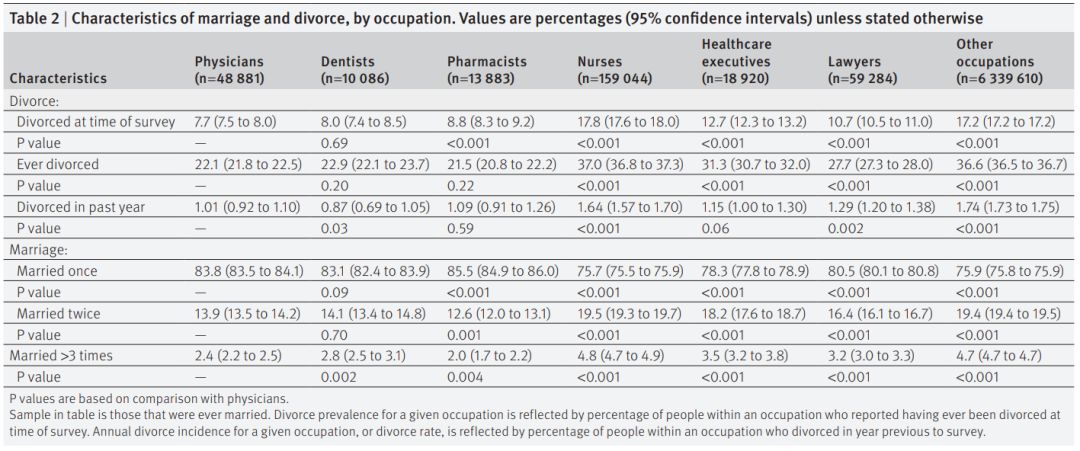
Research original chart/source: BMJ
The well-known American medical website Medscape annually releases the "Physician Happiness Report," in which marital status is a required question. In the surveys conducted over the years, both residents in training and specialized doctors with many years of experience have divorce rates lower than the social average.
Clinical psychologist Wayne M. Sotile has been studying the marital status of doctors for over 40 years. He found that there has long been a misunderstanding about the divorce rate among doctors. "From the surveys, it appears that the marital status of doctors is very stable, with a high proportion of both men and women who are married or in a relationship."
Wayne M. Sotile jokingly said that compared to the extremely high single rates in American society, the doctor group can be considered "pure love warriors."
In the 2024 annual survey, 82% of respondents expressed "very satisfaction" with their marriage. Among them, the divorce rate for male doctors surveyed was 5%, and for female doctors, it was slightly higher, at 7%.
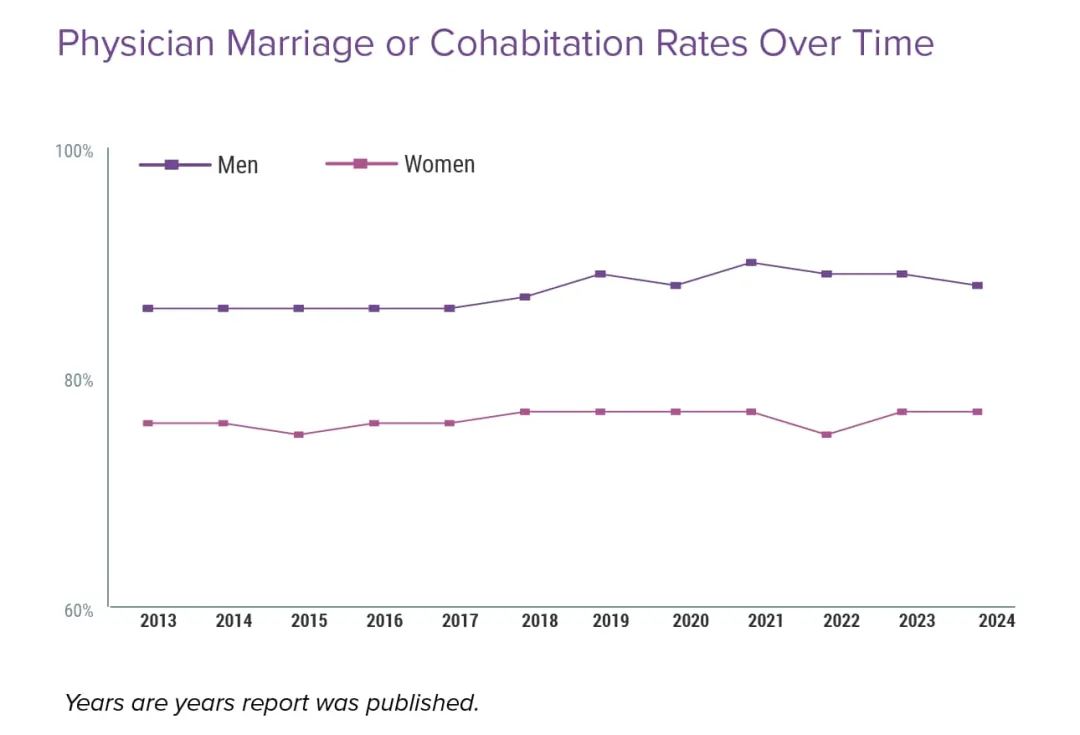
Medscape survey shows that since 2013, the marital status of physicians has remained relatively stable.
Last year, "MedJ · Yi Mi Research" conducted a detailed survey on the marital status of Chinese doctors and released the "Medical Community 2023 Medical Workers' Marital Status Research" report.
The study showed that among all surveyed Chinese medical staff, nearly ninety percent were in a marital or romantic relationship, with an average marriage age of 30.7 years; the combination of "male doctor + female medical staff" was relatively common, while female doctors tended to prefer partners with stable jobs and institutional guarantees; families where the partner was also in the medical field reported relatively higher levels of marital happiness.
The internationally renowned cardiology journal, the Journal of the American College of Cardiology (JACC), has also published a treatise on doctors' love and marriage. Unlike the previous studies, this article was a "divorce reflection" written by a doctor.
The doctor in question was Joshua A. Daily, a cardiologist at Arkansas Children's Hospital, who had been married for 12 years and considered himself a good father and husband. However, one day when he came home from work, his wife suddenly announced that "the marriage was over," and they went their separate ways.
Dr. Daily wrote a paper reflecting on the lessons he learned from his failed marriage, identifying two major reasons that undermine the quality of doctors' marriages and pointing the finger at clinical work:
1.Reduced time spent with partners outside of sleep and increased frequency of night shifts;
2.Professional burnout among doctors, the state of physical and mental fatigue and exhaustion caused by the pressures of work.

Dr. Daily's Original Article
Daily wrote, "Any discussion about physician divorce must involve professional burnout. This is very common among physicians, with the latest estimates suggesting a 50% incidence rate. It can have profound effects on physicians and their families, reducing partner satisfaction and increasing the likelihood of divorce."

