


Prof. Laurence H. Beck Jr. of Boston University, who discovered phospholipase A2 receptor (PLA2R) autoantibodies, delivered a lecture at the 2026 American Society of Nephrology (ASN) Kidney Week annual meeting in Denver, Colorado, USA, titled “Viewed through membranous nephropathy: lessons from translating a new autoantibody discovery into clinical practice”. Using PLA2R as his worked example, Prof. Beck traced in sequence the evidence base that moved the antigen from discovery to validation, the changes the antibody has brought to diagnostic and treatment pathways after entering clinical use, the boundaries of applicability that have become apparent in practice, and the conditions under which the process can be generalised. He also discussed the opportunities the field has missed and the questions that remain unresolved.
Article Key Points
• Serum from 26 of 37 patients with primary membranous nephropathy recognised a 185-kD band, later identified as PLA2R
• After rituximab, anti-PLA2R titres fell below detection at 6-9 months, well before proteinuria remission at 18-24 months
• PLA2R accounts for about 55% of known target antigens in membranous nephropathy; about 10% of cases remain unexplained
• ELISA positivity requires more than 20 RU/ml, grey zone 14-20 RU/ml; immunological remission needs ELISA below 2 RU/ml
• US approval in 2014 covered diagnosis only; longitudinal monitoring for disease activity remains off-label
Discovery of Anti-PLA2R Autoantibodies and the Etiologic Evidence
Prof. Beck first reviewed the process by which PLA2R autoantibodies were discovered, and the subsequent evidence supporting the causal association. The critical breakthrough in the field began with a hypothesis awaiting verification: the Heymann nephritis rat model had suggested that circulating autoantibodies can target podocytes and cause disease, and it was therefore proposed that a corresponding target antigen might exist in human membranous nephropathy. To test this hypothesis, Prof. Beck’s team used normal human glomerular proteins as the antigen and patient serum for immunoblotting. The results showed that patient serum recognised a band of approximately 185 kD, whereas serum from patients with other glomerular diseases and from normal controls showed no reaction. The protein in this band was subsequently identified as M-type PLA2R (Fig. 1).
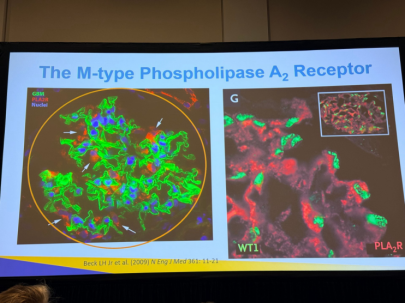
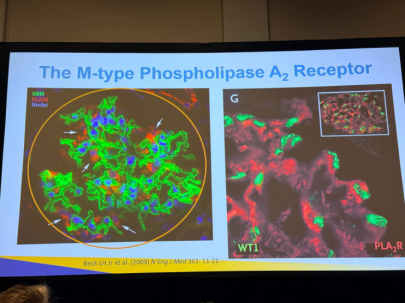 Fig. 1. Normal human glomerular proteins used as antigen, with serum from patients with primary membranous nephropathy recognising an approximately 185-kD band, while serum from patients with other glomerular diseases and from normal controls showed no reaction; immunofluorescence shows granular deposits of phospholipase A2 receptor along the glomerular basement membrane (GBM)
A single discovery is not sufficient to establish clinical value; the association between the antigen and the disease requires further verification. The subsequent evidence came from two directions. On disease specificity, in the initial validation cohort 26 of 37 patients with primary membranous nephropathy (70%) had serum that specifically recognised the antigen, while participants with secondary membranous nephropathy, other glomerular diseases and healthy controls showed no such reaction. On genetics, genome-wide association studies showed that the genetic signal peak for membranous nephropathy lies at the PLA2R1 and HLA-DQA1 loci, providing independent validation for the discovery of the autoantigen.
From Proteinuria to Antibodies: Serologic Monitoring and Non-Invasive Diagnosis
At the level of clinical application, Prof. Beck used treatment cohort data to demonstrate the value of anti-PLA2R antibodies. Previous assessment of treatment efficacy relied mainly on proteinuria and serum albumin, which cannot reflect immunological change early in treatment. The emergence of anti-PLA2R antibodies has provided a dynamic monitoring tool that reflects disease activity earlier.
A rituximab (RTX) treatment cohort published by Prof. Beck’s team in 2011 showed that in patients with primary membranous nephropathy, anti-PLA2R titres fell below the limit of detection within 6-9 months of the first RTX course, whereas proteinuria remission lagged markedly and usually required 18-24 months or longer to reach partial or complete remission (Fig. 2). This pattern of immunological remission preceding clinical remission allows clinicians to assess treatment response and adjust regimen earlier, on the basis of falling anti-PLA2R titres, before proteinuria has changed appreciably.
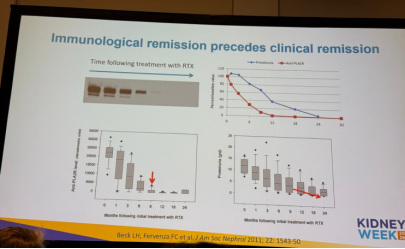 Fig. 2. After rituximab (RTX) treatment, anti-phospholipase A2 receptor antibodies fall before proteinuria, that is, immunological remission precedes clinical remission
Anti-PLA2R antibodies have also had an important effect on traditional diagnostic pathways. A series of studies from the Mayo Clinic indicates that in patients with typical nephrotic syndrome, positive serum anti-PLA2R antibodies, relatively stable renal function and secondary causes already excluded, serological testing alone can support a non-invasive diagnosis of primary membranous nephropathy, and some patients may avoid kidney biopsy. It should be noted that clear boundaries remain in force for both this non-invasive diagnosis and for the definitions of immunological remission.
The Antigen Landscape and the Challenges of Translation
While affirming the clinical value of PLA2R, Prof. Beck also identified three principal limitations that remain in its current clinical use: coverage gaps in the target antigen spectrum, decision thresholds that are not yet unified, and the prognostic complexity created by differences in antibody epitopes.
First, the coverage of PLA2R among target antigens in membranous nephropathy is limited. A summary published in Kidney International in 2023 showed that, among the known target antigens in membranous nephropathy, PLA2R accounts for about 55%, with the remainder including neural epidermal growth factor-like protein 1 (NELL1, 10%), exostosin 1/2 (EXT1/2, 7%) and thrombospondin type 1 domain-containing protein 7A (THSD7A, 2%), and that about 10% of patients still have an unexplained cause (Fig. 3).
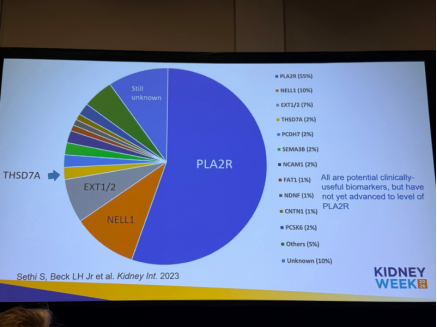 Fig. 3. Sethi and Prof. Beck summarise in Kidney International (2023) the distribution of target antigens in membranous nephropathy, with PLA2R accounting for 55% and the remainder including NELL1, EXT1/2 and THSD7A
Second, the serological thresholds used for diagnosis and for assessing antibody loss in PLA2R-positive patients have not been unified. For diagnosis, enzyme-linked immunosorbent assay (ELISA) uses a positive cut-off of more than 20 RU/ml to preserve specificity, with a grey zone of 14-20 RU/ml and a negative result below 14 RU/ml. The positive threshold applies only to establishing the diagnosis and does not mean that the antibody has disappeared or that the disease is in remission. For patients with low titres between 2 and 20 RU/ml, combining indirect immunofluorescence (IFA) helps to distinguish true positives. When assessing whether the antibody has disappeared and immunological remission has been reached, stricter cut-offs are required, such as ELISA below 2 RU/ml and/or a negative IFA, with repeat testing advisable.
Third, even in PLA2R-positive patients, differences in the epitopes recognised by the antibody significantly affect prognostic assessment. A cohort published in 2016 showed that, across independent subgroups defined by epitope pattern, patients whose serum recognised only the PLA2R CysR domain had a spontaneous remission rate of 43% and none progressed to dialysis, whereas in patients in whom epitopes had extended to CTLD1 and CTLD7 the spontaneous remission rate fell to 12% and the proportion reaching dialysis rose to 31%. The broader the epitope region recognised, the poorer the prognosis.
Prof. Beck emphasised that these limitations show that the translation success of PLA2R rested on specific disease and methodological conditions, and that the translation of other targets cannot be copied directly to other antigens.
Standardisation and Collaboration: A Path That Can Be Generalised
In the second half of the lecture, Prof. Beck addressed the opportunities the field has missed and the questions that remain unresolved, drew lessons from the translation of PLA2R, and proposed a path that could be generalised. He noted that when PLA2R antibody testing was approved by the US Food and Drug Administration (FDA) in 2014, it was permitted only for diagnostic purposes. Although longitudinal monitoring of antibody levels has clinical value for assessing disease activity and is already recommended in guidelines, it remains off-label use today. The field also realised only relatively late that using this biomarker as a plausible surrogate endpoint in clinical trials would require large-scale global data. PARASOL-MN is the collaborative project set up to collect and harmonise global data and to link biomarkers with clinical outcomes.
For the development of assays for new targets, Prof. Beck described the practical difficulties currently encountered. Assay development has long focused on PLA2R, while other target antigens in membranous nephropathy were discovered later, are uncommon because of low prevalence, are poorly represented in existing biobanks, and cannot easily be collected in sufficient numbers for adequate validation. Large international biobanks and collaboration are therefore needed to advance them.
Anti-nephrin autoantibodies illustrate the technical bottlenecks involved in developing new targets. This class of antibodies was first described from observations of “dust-like” podocyte IgG deposits in minimal change disease, but pathologists remain divided over whether the phenomenon is genuine and whether it indicates the presence of antibodies. In addition, routine immunofluorescence cannot visualise these antibodies, and differences in the source of recombinant antigens directly affect assay sensitivity, so results across cohorts are often inconsistent and harder to pool than for PLA2R.
Drawing on this experience, Prof. Beck set out five action recommendations for the development of assays for future targets (Fig. 4), covering standardisation of assay methods, sharing of reagents and samples, elucidation of biological mechanisms, coordinated development across targets, and the participation of industry and regulators.
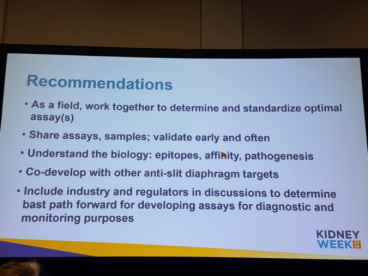 Fig. 4. Prof. Beck’s five action recommendations for the development of future assays: jointly identifying and standardising optimal assay methods; sharing assay methods and samples, with early and repeated validation; elucidating the biological basis, including epitopes, affinity and pathogenic mechanism; developing in coordination with other anti-podocyte target antigens; and including industry and regulators in assay development discussions
Conclusion
The translation history of anti-PLA2R antibodies indicates that whether an autoantibody can become a clinical tool depends on whether the characteristics of disease biology, assay methodology and clinical need are matched to one another. Prof. Beck’s summary was that although the discovery reshaped the diagnostic and treatment pathways of membranous nephropathy, its success depended on a particular combination of conditions, and that the translation of subsequent antigens and biomarkers still needs to proceed with attention to their own characteristics.
Looking ahead, the field needs to continue to advance assay standardisation, unify definitions for the low-titre grey zone and for immunological remission, and build clinical-grade assays for more rare antigens. Coordinated standardisation of assay methods and global data integration will be essential as antibody-mediated glomerular disease moves from the success of a single target towards a generalisable translation pathway.

