


Alebund Pharmaceuticals, a Shanghai-based biotechnology company focused on kidney disease, made its debut on the Hong Kong Stock Exchange on June 29 under the ticker 09637.HK, becoming the first HKEX-listed biotech dedicated exclusively to therapies for kidney disease.
Shares closed at HK$46.00 on the first trading day, up 103.54% from the HK$22.60 offer price, lifting the company's market capitalization above HK$15.6 billion. The offering raised roughly HK$1.18 billion in net proceeds after a 15% overallotment option, according to company disclosures. An 11-investor cornerstone syndicate, including sovereign wealth fund GIC, RTW, and Tencent, committed about US$81.5 million, or roughly 49.78% of the global offering.
Founded in 2018, Alebund has assembled a portfolio of seven clinical-stage candidates and one commercial product, Mircera, the long-acting erythropoiesis-stimulating agent originally developed by Roche, which Alebund markets in mainland China. The pipeline spans the major complications of chronic kidney disease (CKD), a condition that the company and industry analysts estimate affects more than 800 million people worldwide, including roughly 124 million in China.
Lead Program in Hyperphosphatemia
The company's most advanced candidate, AP301, is an oral phosphate binder being developed for hyperphosphatemia in dialysis-dependent CKD patients. In a Chinese registrational Phase III trial, AP301 reduced mean serum phosphate by 2.22 mg/dL at week 12, compared with 2.17 mg/dL for sevelamer carbonate, the active comparator. The proportion of patients reaching target serum phosphate at 52 weeks was 66.7% in the AP301 arm versus 58.6% in the sevelamer arm; treatment discontinuation due to adverse events was below 5%.
The asset originated at Vidasym, a U.S. biotechnology company acquired by Alebund. The company has indicated that it plans to file a New Drug Application with China's National Medical Products Administration (NMPA) imminently, with a global multi-regional Phase III trial launched in July 2025, enrollment now complete, supporting a planned U.S. Food and Drug Administration (FDA) submission in the third quarter of 2027.
Investors should note that the full Phase III dataset has not yet been published in a peer-reviewed journal, and direct head-to-head conclusions between AP301 and sevelamer cannot be drawn with confidence outside a formal non-inferiority or superiority design.
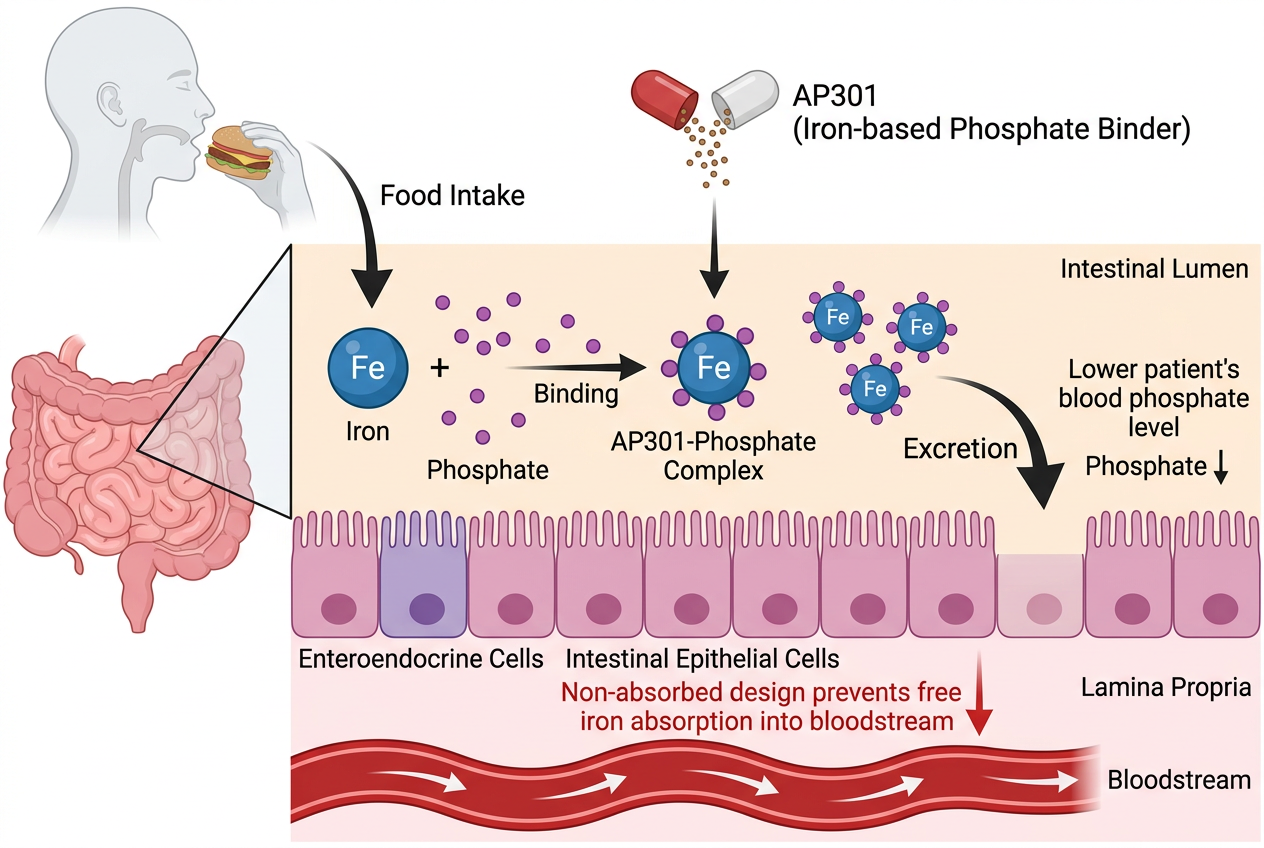 Fig.1.The Mechanism of Action of AP301
A Second Shot at Hyperphosphatemia
AP306, described by the company as a first-in-class pan-phosphate transporter inhibitor, has received Breakthrough Therapy designation from the NMPA. In a Chinese Phase II trial, AP306 monotherapy reduced mean serum phosphate by 2.51 mg/dL from baseline, with approximately 95% of patients reaching serum phosphate below 5.5 mg/dL by weeks 7-8, compared with about 50% in the sevelamer arm, according to company disclosures. The reported daily pill burden also fell sharply, from 6-12 tablets with conventional binders to 2-3 tablets with AP306.
In July 2026, Alebund announced that the first participant had been randomized and dosed in a global Phase IIb multi-regional trial of AP306. Outside Greater China, the asset has been licensed to R1 Therapeutics. As with AP301, the supporting Phase II data have not yet appeared in a peer-reviewed publication.
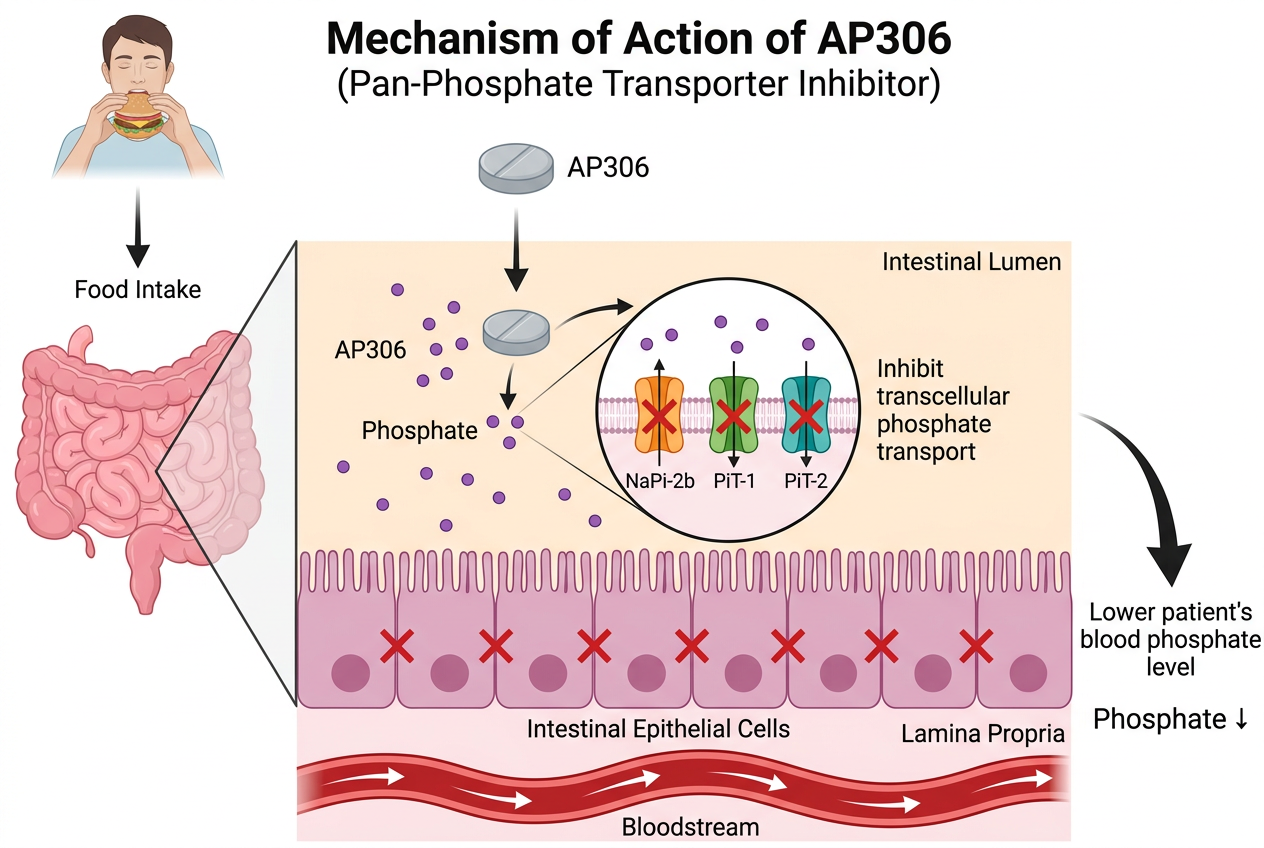 Fig.2.The Mechanism of Action of AP306
Earlier-Stage Programs
Two additional candidates remain at earlier clinical or regulatory stages.
AP303, a dual PPAR agonist, has been granted Orphan Drug Designation by the FDA for autosomal dominant polycystic kidney disease (ADPKD), with planned indications also including diabetic kidney disease (DKD), IgA nephropathy (IgAN), and focal segmental glomerulosclerosis (FSGS). Phase I studies in Australia and China have been completed, and IND clearance has been secured from both the FDA and the NMPA. A basket Phase II trial in DKD and IgAN is planned for the second half of 2026.
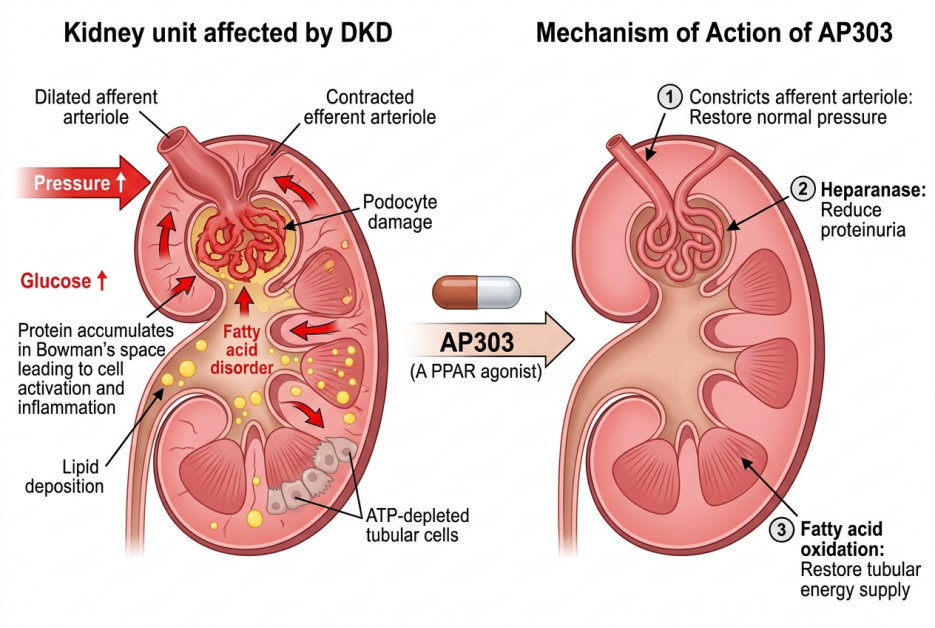
Fig.3.The Mechanism of Action of AP303
AP308 is an engineered recombinant IgA protease designed to degrade circulating IgA and IgA-containing immune complexes, an approach sometimes described as a molecular scissors strategy for IgA nephropathy. IND submissions in the U.S. and China are slated for the third quarter of 2026. The program remains at the preclinical-to-IND-enabling stage, with no human proof-of-concept data yet reported.
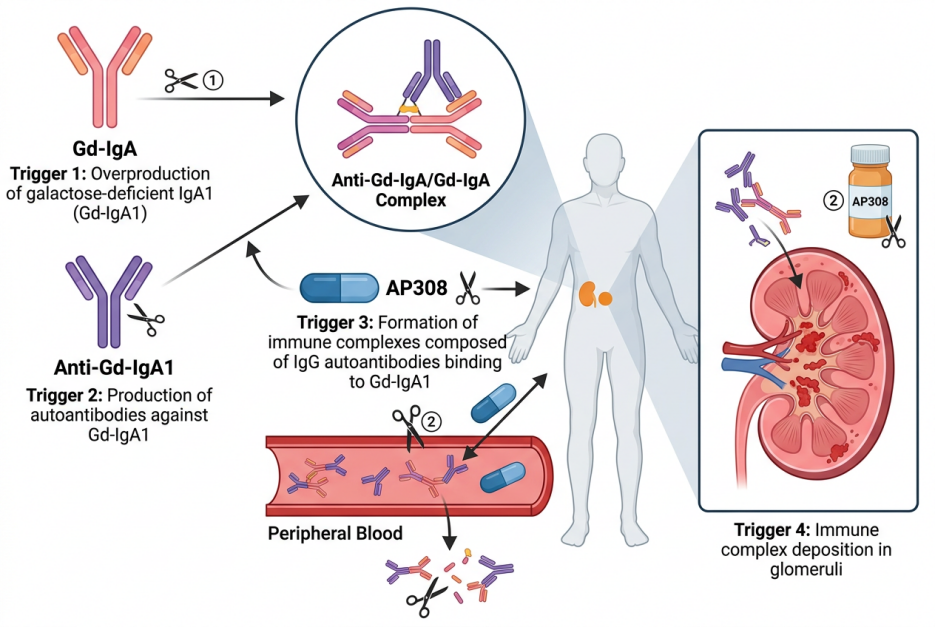 Fig.4.The Mechanism of Action of AP308
Commercial Anchor: Mircera
Alebund's revenue is currently derived almost entirely from Mircera (methoxy polyethylene glycol-epoetin beta), a long-acting erythropoiesis-stimulating agent originally developed by Roche. Alebund secured exclusive mainland China commercialization rights in October 2023 through a supply and promotion agreement with Roche. The drug, first approved by the NMPA in 2018 and added to China's National Reimbursement Drug List in 2023, is one of four long-acting ESAs currently available in China for renal anemia, and has been deployed in more than 300 hospitals.
Mircera-derived revenue rose to RMB 30.56 million in 2025 from RMB 6.525 million in 2024, even as research and development expenses climbed from RMB 235 million to RMB 373 million over the same period, figures that underscore the company's pre-profit stance.
Market Context and Use of Proceeds
The company cites industry estimates projecting the global CKD drug market to grow from roughly US$244 billion in 2025 to about US$504 billion in 2035. The global hyperphosphatemia drug market is estimated at US$1.8 billion in 2025, expanding to US$6.4 billion by 2035, while the China dialysis hyperphosphatemia market, where approximately 76% of patients fail to reach target serum phosphate versus 52% in the U.S. and 39% in Japan, is projected to grow from RMB 1.8 billion in 2025 to RMB 10.7 billion in 2035. The figures are drawn from company-cited third-party projections, including those from China Insights Consultancy (CIC), and are presented in Alebund's prospectus.
Of the IPO proceeds, about 34% is earmarked for the AP301 China NDA and the global Phase III program, 37% for advancing AP306, AP308, AP303, and other pipeline programs, and 12% for capacity upgrades at the company's Yangzhou manufacturing facility.
What to Watch
Alebund's near-term trajectory will depend on whether AP301 secures timely NMPA approval and whether the global Phase III program can replicate the Chinese registrational results in a more genetically and clinically diverse population. The company's reliance on a single revenue-generating asset for the foreseeable future, alongside a deep pre-revenue pipeline, leaves it exposed to typical biotech sector volatility. None of the company's clinical data referenced above have yet been published in peer-reviewed journals, and the company has not yet made the underlying Phase III and Phase II datasets available for independent verification.

