


After 7 Electroconvulsive Therapies, Transgender Ling'er Sues the Hospital
Ling'er, a 27-year-old transgender woman with a male biological sex, sued the psychiatric hospital that treated her after undergoing 7 electroconvulsive therapies. In August of this year, the case was heard online in the first instance.
Ling'er, who identifies as female, was sent to a mental health center by her parents two years ago and was diagnosed with "anxiety disorder and self-discrepant sexual orientation." She was then hospitalized for 97 days and underwent modified electroconvulsive therapy (MECT), among other treatments.
During the trial, both the medical and patient sides debated whether transgenderism is a disease. The hospital argued that the purpose of electroconvulsive therapy was to control the patient's emotions and improve cognition, not to change sexual orientation. Ling'er, however, stated that the hospital forcibly admitted her without her consent and carried out a series of unnecessary treatment measures.
A senior expert in the field of transgender diagnosis and treatment at a top-tier hospital, Dr. Wang Ming (a pseudonym), told "MedJ" that medicine no longer classifies transgender people as patients with mental psychological diseases. Doctors should help them accept themselves. "Transgender people may have varying degrees of gender anxiety, and it is recommended to choose medical methods that can help alleviate anxiety based on sufficient self-exploration."
In mid-November, Ling'er informed "MedJ" that there had been new developments in the case. The parties have reached a settlement under the auspices of the court, and Ling'er received a settlement compensation of 60,000 yuan from the hospital.

Ling'er is currently working in cleaning services in Tianjin / Photography: Guo Xuemei
Having Undergone 7 Electroconvulsive Therapies
Ling'er narrates that she has always preferred to play with girls since childhood and confirmed her transgender identity in college after learning more. Transgender is a broad concept that includes transgender women, transgender men, genderqueer, etc., generally referring to those who cannot identify with the gender they were assigned.
Earlier, Ling'er thought this was a disease and had discussed it with the school's psychological counselor, "wondering how to eliminate her feminine emotions and return to being a normal man." After graduation, Ling'er worked as an entertainer and a live streamer. She often wore women's traditional costumes on her social media accounts because she loved folk music since childhood. "When working as an entertainer, I found that living as a woman was quite comfortable and harmonious, and my physical conditions also suited being a petite girl," Ling'er told "MedJ."
However, Ling'er's parents did not understand. Her mother is a teacher, her father is a factory worker, and she is the second child and only son in the family. Ling'er said that her parents have always had objections to her wearing women's clothes and growing her hair long, and they have argued countless times.
In 2022, Ling'er's relationship with her parents continued to deteriorate, and her mother decided to take her to the hospital for "treatment." Ling'er told "MedJ" that before being sent to the hospital, she had taken her parents to a top-tier hospital in Beijing to consult an expert in transgender diagnosis and treatment, hoping to help her parents understand and accept her, but with little effect. Eventually, she was sent to a mental health center by her parents.
This is a public second-tier hospital and the only local institution integrating prevention, diagnosis, treatment, teaching, research, and rehabilitation in the field of mental health. The hospital's psychiatry department is a municipal key medical discipline.
Ling'er recalls that after the first outpatient visit, the hospital prescribed her traditional Chinese medicine, "hoping that I could be cured by taking Chinese medicine, but later found it didn't work, and the second time they started to hospitalize me."
Ling'er's medical records show that in July 2022, her family told the doctor that Ling'er often argued with them due to sexual orientation issues and had a bad temper. To further control her emotions, she was admitted to the hospital with "dysthymia" and diagnosed with "anxiety disorder and self-discrepant sexual orientation."
After her mother signed documents such as the "Informed Consent for Involuntary Hospitalization" and "Inpatient Safety Informed Consent," Ling'er was hospitalized for 97 days, but she told "Medical Community" and several media outlets that she never agreed to be hospitalized.
In response, the "Informed Consent for Involuntary Hospitalization" states that Dr. Zhang assessed Ling'er's condition as posing a danger to the safety of others, in accordance with Article 30, Paragraph 2, of the Mental Health Law, and that hospitalization treatment should be implemented. However, the first nursing risk assessment form after her admission showed that she had no aggressive behavior, no self-harm or suicidal behavior, and was in a low emotional state.
During her hospitalization, due to poor efficacy of drug treatment, the hospital informed Ling'er's parents and began MECT treatment for her seven times in the second month of her stay. The Shanghai Mental Health Center's public account once stated that MECT, also known as modified electroconvulsive therapy or electrotherapy, is a common physical therapy for treating mental disorders.
Ling'er stated that she had repeatedly requested to stop the treatment but was refused until the end of October 2022, when the treatment was stopped due to treatment costs and other reasons, and she was discharged. This year, with the help of friends, she decided to sue the hospital, demanding confirmation that the hospital's forced medical treatment was an infringement and claiming more than 80,000 yuan in compensation.
The hospital argued in court that Ling'er had cognitive disorders and that the treatment had been consented to by her guardian. Electroconvulsive therapy was in accordance with regulations, and the hospital was not at fault. Ling'er's attending physician, with more than 30 years of clinical experience in psychiatry, believed that Ling'er's illness was "sexual orientation disorder."
Regarding the diagnosis and treatment, in August of this year, the doctor explained in an interview with "The Paper" that "(if Ling'er's) parents committed suicide because of this, (would Ling'er) affect social security?"
Transgender Emphasis on Depathologization
One of Ling'er's lawyers, Guo Bin, provided document materials showing that Ling'er's side mainly raised two major inquiries about the hospital's diagnostic and treatment measures. First, whether it was reasonable for the hospital to diagnose Ling'er with "self-discrepant sexual orientation," and second, whether MECT treatment for Ling'er was necessary.
According to the World Health Organization's (WHO) "International Classification of Diseases 11th Revision" (ICD-11) published in 2018, descriptions related to transgender have been removed from the "Mental and Behavioral Disorders" category and replaced with the new term "gender incongruence," emphasizing the depathologization of transgender internationally.
Wang Ming told "MedJ" that in addition to biological sex, people's psychological conditions usually have diverse expressions, and in terms of sexual cognition, they can be summarized into three main aspects: gender identity, gender expression, and sexual orientation.
"What is transgender? It is actually a minority group in terms of gender identity. For example, a person who is biologically a boy but does not fully identify as a boy, and sometimes even identifies as a girl, often has low visibility and acceptance in society because their gender cognition is inconsistent with that of the majority," Wang Ming said.
Currently, medicine no longer classifies transgender or gender-diverse people as patients with mental psychological diseases. At the same time, for transgender people, treatment has shifted from previous psychiatric treatments such as antidepressants to hormone therapy or surgical treatment in reproductive endocrinology.
Given this, is MECT treatment necessary for the transgender community?
According to Ling'er's medical records, on August 22, 2022, the hospital performed the first MECT treatment on her, and the informed consent stated: due to current emotional instability and impulsive behavior, it meets the indications for electroconvulsive therapy (i.e., MECT).
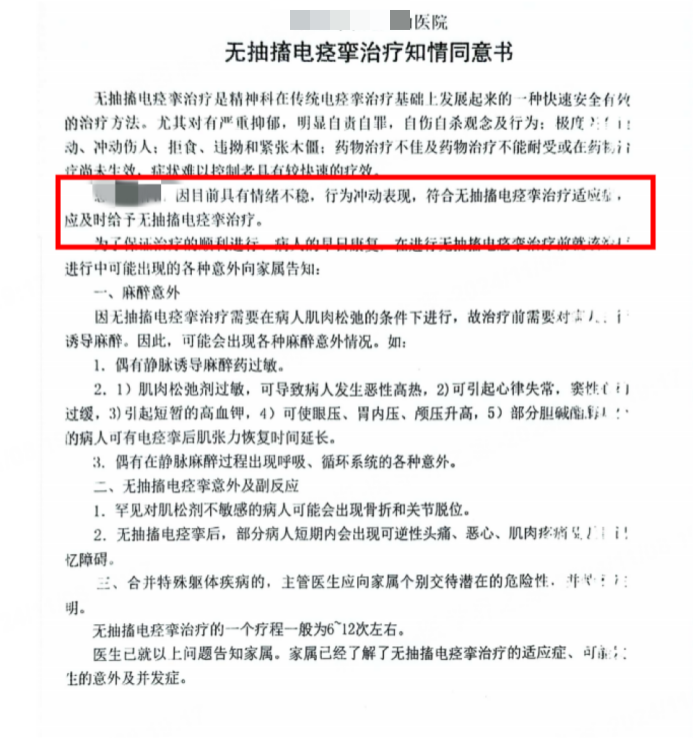
The informed consent form signed on August 22, 2022 / Photo provided by the interviewee
A popular science article from the Shanghai Mental Health Center shows that the use of MECT treatment must meet corresponding indications, such as when drug and psychological treatments are ineffective, MECT can be used to treat severe depression, bipolar disorder, schizophrenia, somatoform disorder, intractable pain, etc. In addition, when patients exhibit life-threatening symptoms, such as suicide, refusal to eat or drink, catatonia, etc., it is also recommended as the main treatment method.
On the medical level, how should the transgender community be "treated"? According to the 2022 edition of the "Expert Consensus on Multidisciplinary Diagnosis and Treatment of Gender Identity Disorder in China," endocrine treatment is an important component of gender-affirming medical care needed by transgender individuals, in addition to gender-affirming surgery.Regardless of the treatment method, Wang Ming stated that what doctors should do is help them accept themselves and alleviate the anxiety caused by the "discrepancy between mind and body."
According to a nationwide survey conducted in 2016, it is estimated that there are approximately 4 million transgender individuals among the adult population in our country.
The "2021 National Transgender Health Research Report" further points out that the incongruence between gender identity and assigned gender causes varying degrees of gender dysphoria in over 70% of transgender individuals.
Among them, as high as 86% of transgender individuals have attempted to conceal or alter their sexual characteristics through various means, such as hair removal, plucking facial hair, binding their chests, and wearing tight underwear, with about two-thirds being troubled by pain due to these concealment and alteration practices.
"Some transgender individuals can alleviate their anxiety by changing their lifestyle, such as cross-dressing, confiding in others, and diverting their attention. If these methods can help them and they can maintain the status quo, that is naturally better because it avoids the risks associated with any medical procedures," said Wang Ming.
He also stated, "When these methods are insufficient to help them, we will consider medical intervention. However, medical intervention is not about changing their gender identity."
Diagnostic Challenges
In reality, it is not easy for the transgender community to access medical assistance.
For instance, to undergo "gender-affirming medical services," one must first visit a psychiatrist. In the medical field, the term "gender identity disorder" is still used in the diagnostic process in China.
In November 2022, China published its first "Expert Consensus on Multidisciplinary Diagnosis and Treatment of Gender Identity Disorder in China," which mentions that the diagnosis of gender identity disorder must be issued by a psychiatric or psychological department of a tertiary hospital. In addition to a clear diagnosis based on the ICD-10 diagnostic criteria, it also requires medical history collection, auxiliary examinations, mental examinations, and one year of follow-up.
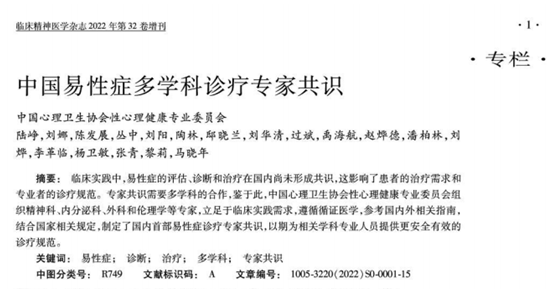
Chinese Expert Consensus on Multi-disciplinary Diagnosis and Treatment of Transsexualism
After completing the aforementioned procedures, a preliminary diagnosis is made by a deputy director or higher-level psychiatrist, and then another deputy director or higher-level psychiatrist completes the review diagnosis. Only then can the diagnosis of gender identity disorder be established.
"MedJ" previously reported that due to a lack of understanding, many parents exert pressure on medical professionals and institutions involved. Currently, in China, the diagnosis and treatment of "gender identity disorder" usually require parental consent, which alone excludes many transgender individuals from formal medical care.
As a result, the phenomenon of transgender individuals self-medicating and misusing medication is very common, with some even using industrial hormones or veterinary drugs due to an inability to purchase sex hormones, or using extremely high doses, leading to severe health damage.
Therefore, the "2021 National Transgender Health Research Report" recommends:
Implementing ICD-11 to depathologize transgender individuals in the field of mental health; establishing a formal transgender medical care system, improving access to hormones and puberty blockers, and strengthening physical examinations and monitoring; advocating for bodily autonomy in transgender medical care, with transgender individuals having the right to autonomously decide on hormone use or surgery, while being responsible for their decisions; and enhancing the training of medical staff to ensure non-conversion therapy and non-discrimination towards transgender individuals.
Wang Ming told "MedJ" that the controversial incident involving Ling'er actually reflects the low level of understanding of transgender people in society and the imperfection of the relevant medical system.
"Many psychiatrists are not familiar with the diagnosis and treatment of transgender individuals, and the different diagnostic criteria used by hospitals, or the non-use of the latest version, can also lead to clinical diagnostic disputes," Wang Ming believes that this issue should be considered from the perspective of medical training and education.
"For some psychiatrists, they may have never received education on this topic in medical school, so they lack experience when encountering such individuals. In recent years, China has been promoting various expert consensuses and guidelines, hoping to popularize transgender-related diagnostic and treatment knowledge in psychiatric professional schools," Wang Ming said.
This may be a task that requires more time, but it is of great significance.

