


Obstructive sleep apnea (OSA) affects nearly 1 billion adults worldwide. For decades, diagnosis rates have remained low, and continuous positive airway pressure (CPAP) has been the first-line treatment. New Phase III data suggest an oral agent may finally offer a pharmacologic option: AD109, developed by U.S. biotech Apnimed, has demonstrated efficacy in adults with mild, moderate, and severe OSA, and its New Drug Application (NDA) has been accepted by the U.S. Food and Drug Administration (FDA). MedJ sat down with Prof. Haiyan Ge, Chief Physician in the Department of Pulmonary and Critical Care Medicine at Fudan University Huadong Hospital, to interpret these findings.
In July, Phase III data for AD109 were published in the American Journal of Respiratory and Critical Care Medicine. After 6 months of treatment, mean change in the apnea-hypopnea index (AHI) in the AD109 arm was -3.3 events/hour, a 44.1% improvement from baseline, while the placebo arm rose by 0.7 events/hour.
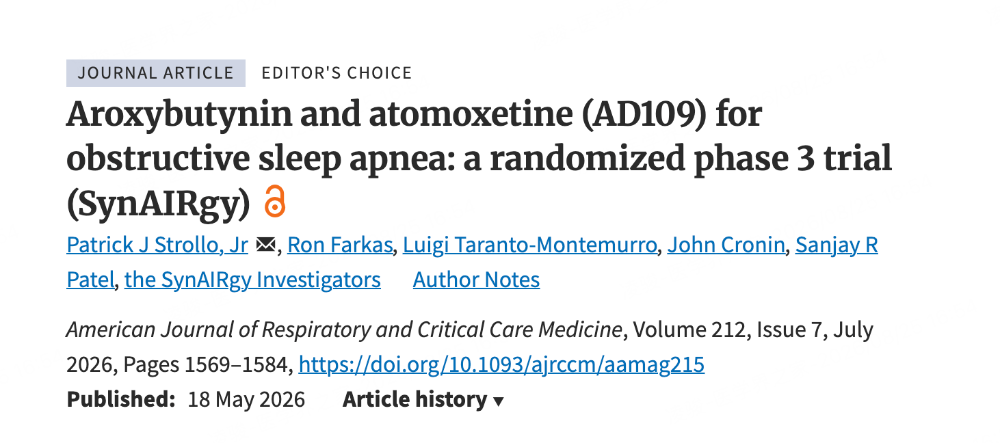
Improvements emerged as early as week 4. By month 6, median AHI in the AD109 group fell from 19.8 to 13.3 events/hour. Nocturnal hypoxic burden dropped by 44.7% with active treatment vs 8.5% with placebo. Overall, 41.8% of participants had their OSA severity downgraded; 17.6% achieved full disease control, defined as AHI<5, compared with 9.3% on placebo.
If approved, AD109 would likely become the first oral drug targeting OSA’s neuromuscular mechanism of airway collapse. AD109 combines atomoxetine with R-oxybutynin, a novel isomer derived from oxybutynin. The combination works through neural signaling: it modulates upper-airway motor pathways, enhancing the contractility of the tongue and pharyngeal muscles during sleep, thereby maintaining airway patency.
Why a Pharmacologic Option Matters
CPAP effectively stents the airway open and rapidly relieves obstruction in moderate-to-severe OSA, but real-world adherence has long been a clinical weak point. Patients must wear the device nightly on a long-term basis, and issues such as portability for travel and routine cleaning have kept adherence stubbornly suboptimal.
Against this background, the unmet need has been an oral therapy that directly addresses airway collapse in OSA patients as a whole — not only those with obesity. AD109, the lead candidate from Apnimed, is positioned to fill exactly this gap. The trial recruited patients with mild, moderate, and severe OSA who had either refused or could not adhere to CPAP; enrolled BMI ranged from 18.5 to 42 kg/m², covering normal weight through class III obesity.
Ge called this “a long-awaited therapeutic direction.” She underscored the broader framing: OSA is a chronic condition that has long been underestimated, and untreated disease carries far more serious long-term risks than commonly appreciated.
A New Therapeutic Avenue
Ge explained the underlying mechanism: during sleep, pharyngeal muscle tone declines, allowing the upper airway to collapse or obstruct, triggering apneas and hypopneas. Repeated events drive intermittent hypoxia, placing sustained stress on the respiratory and cardiovascular systems; without timely intervention, severe OSA can progress to metabolic complications and, in some cases, pulmonary hypertension.
The recent rise of GLP-1 receptor agonists for weight loss has added a treatment avenue for OSA patients with comorbid obesity, but the central mechanism remains indirect — it improves OSA by reducing body weight. For patients whose airway collapse is driven primarily by age-related decline in pharyngeal muscle tone, weight loss may not fully restore airway function.
Equally important is the substantial non-obese OSA population. Ge’s multidisciplinary snoring and sleep clinic at Huadong Hospital has observed that nearly 40% of OSA patients seen in routine practice are not obese — a figure that complicates any purely weight-centric treatment paradigm.
AD109’s mechanism acts directly on neural pathways that control the tongue and upper-airway muscles, enhancing excitatory signaling, relieving inhibitory input, and increasing contractility. “This direct action on neural signaling is likely why AD109 may benefit OSA patients irrespective of body weight, including the non-obese,” Ge noted. Across both groups in the trial, AD109 reduced AHI and improved nocturnal hypoxemia, and as an oral agent it offers a more convenient option for patients who resist or cannot tolerate CPAP.
Limitations and Long-Term Evidence
Ge also noted an important caveat. Even if approved, AD109 is unlikely to fully displace CPAP based on the absolute magnitude of AHI reduction; the more realistic role is for early or mild OSA, or as an adjunct or supplement in moderate-to-severe disease.
The drug is not without shortcomings. In the trial, approximately 21% of participants discontinued treatment due to adverse events, including dry mouth, nausea, insomnia, and urinary difficulty. Several external experts have also noted that the absolute AHI reduction — averaging 6 to 7 events/hour — may be modest for severe patients. Christopher Winter, a U.S. neurologist and sleep medicine specialist, commented: “I’ve seen the most severe patients with AHI over 150. Many patients in real practice have disease far more advanced than in the AD109 study.”
A more fundamental question is whether drug therapy can alter the long-term trajectory of OSA. Ge emphasized that the most clinically meaningful threats from OSA are its downstream complications. Cardiovascular risk accumulates silently over years: chronic intermittent hypoxia can elevate pulmonary artery pressure and progress to sustained pulmonary hypertension and cor pulmonale; long-standing hypoxia can also precipitate cardiac electrical instability and arrhythmias.
CPAP has decades of observational data supporting cardiovascular benefit with consistent long-term use. AD109, as a new agent, still needs time to demonstrate equivalent long-term outcomes. “Whether short-term AHI and hypoxic-burden improvements translate into long-term cardiovascular benefit will require extended follow-up,” Ge said.
A Chronic Disease, Not a Cure
Ge stressed that OSA cannot be framed as a condition amenable to short-term cure. Her multidisciplinary clinic at Huadong Hospital integrates pulmonology with otorhinolaryngology and adjacent specialties: patients with clear anatomic abnormalities of the pharynx are referred for ENT evaluation of potential surgical correction, while those with comorbid obesity or metabolic issues enter long-term multidisciplinary follow-up.
She addressed a common patient question — “I’m not overweight, how can I have OSA?” — by noting that airway anatomy, not body weight alone, drives the disease. People with shorter, thicker necks tend to have more crowded pharyngeal soft tissue and are more prone to collapse during sleep; with aging, pharyngeal muscle tone itself declines independently of weight.
Even if AD109 ultimately gains approval, Ge argued, the overall treatment paradigm for OSA will not change. “Multidisciplinary follow-up and long-term disease monitoring remain the core of managing this chronic condition,” she said. “For people with long-standing snoring or suspected apnea, completing a sleep study early to confirm diagnosis, followed by standardized treatment, is currently the most direct and important means of reducing the risk of long-term OSA complications.”

