


This is bad!” That was Dr. Huang Wei’s immediate reaction upon seeing the patient, Mr. Zhang.
As an Associate Chief Physician at the Department of Hepatobiliary and Pancreatic Surgery I, Third Xiangya Hospital of Central South University, Dr. Huang and his team have handled countless cases of abdominal trauma.
But Mr. Zhang’s case was the most severe he had ever seen: the stomach and duodenum were completely ruptured, the neck of the pancreas was completely torn, the common bile duct was severed, the left lateral lobe of the liver was lacerated, the superior mesenteric vein was ruptured with massive bleeding, and the right renal artery was occluded. Nearly all the vital and fragile organs in the upper abdomen were simultaneously and devastatingly injured.
“Multiple critical organs were shattered,” said Dr. Huang. The local hospital quickly realized the severity and complexity of the case and urgently transferred Mr. Zhang to the Third Xiangya Hospital in hopes of giving him a fighting chance.
This was also Dr. Huang’s first time performing such a high-risk emergency surgery on a trauma patient — and the first time he had ever performed a pancreaticoduodenectomy (Whipple procedure) on a non-cancer case.
A Race Against Death
Mr. Zhang is an ordinary factory worker. On May 28, he was working when a heavy machine crushed his upper abdomen.
“It was like a pile driver smashing into his upper abdomen — twice,” Dr. Huang described.
By the time Mr. Zhang was transferred to the Third Xiangya Hospital, nearly six hours had passed since the injury. He was conscious but visibly in agony, repeatedly crying out in pain. He had tense abdominal muscles and a soaring heart rate. CT scans showed multiple organ injuries and massive internal bleeding — his life hung by a thread.
Multiple departments — hepatobiliary and pancreatic surgery, gastrointestinal surgery, urology, intensive care — and several experts quickly assembled for an informal but urgent multidisciplinary consultation. A surgical plan had to be formulated in the shortest time possible.
The expert consensus: extremely difficult to treat
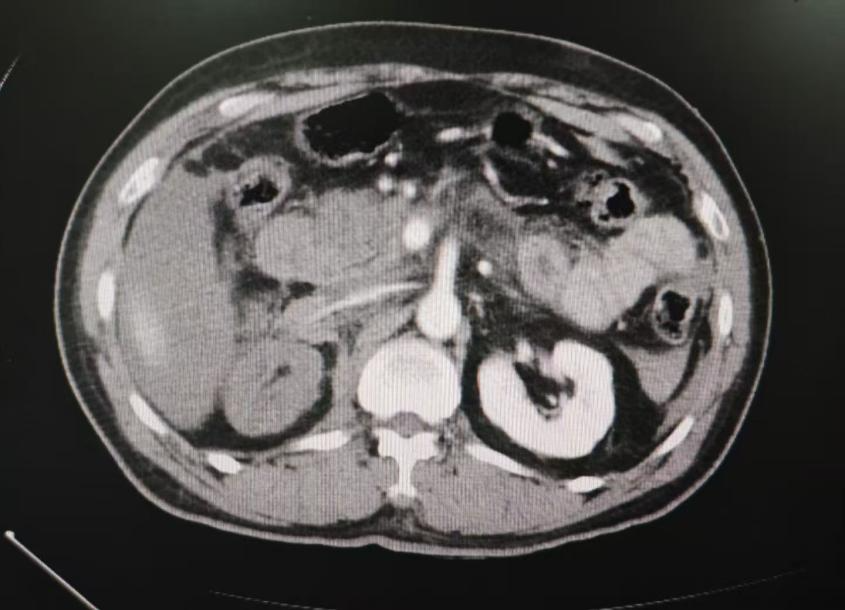
Preoperative imaging of the patient
First, the laceration of the superior mesenteric vein and left lateral liver lobe was causing ongoing, massive internal bleeding.The superior mesenteric vein is a major vessel in the abdominal cavity. A rupture is like opening a massive water valve — blood gushes out. Immediate hemostasis was crucial, but the hospital faced a blood supply shortage and had to coordinate resources urgently.
Second, the complete rupture of the stomach, duodenum, pancreas, and bile duct had caused digestive fluids to spill and mix with blood and food remnants, causing intense pain and increasing the risk of peritonitis and sepsis.Surgical removal of this mixture was time-consuming and meticulous — and time was the one thing Mr. Zhang lacked.
Third, the extent of organ damage could not be fully assessed by CT. Many injuries could only be confirmed during exploratory surgery. The surgical team would have to make real-time decisions on the operating table.
But there was no time to lose. Mr. Zhang had gone into hemorrhagic shock. The hepatobiliary and pancreatic team made a decisive call: proceed with emergency exploratory surgery and help him outrun death.“We couldn’t finalize a surgical plan preoperatively — we only had a rough outline. We were prepared for real-time adjustments during surgery,” Dr. Huang said.
A Surgery That Combined All High-Difficulty Challenges
Dr. Feng Chao, Chief Physician, and Dr. Huang Wei, among others, took the lead in the operating room. As they carefully opened Mr. Zhang’s abdomen, blood spurted out.“It was a belly full of blood,” said Dr. Huang.After quickly suctioning the blood, the team began locating bleeding sources, especially the superior mesenteric vein, to stop the hemorrhage.
This task was like searching for a leak in the middle of a flood. The vein walls are thin, and trauma causes jagged, frayed tears that can worsen during suturing.If sutures are too loose, bleeding continues; too tight, and the narrowed vessel impedes blood flow, risking intestinal necrosis.“We had to walk a tightrope — stopping the bleeding while maintaining patency,” said Dr. Huang.
As the surgery progressed, the team determined that Mr. Zhang needed a pancreaticoduodenectomy combined with liver laceration repair.Pancreaticoduodenectomy is the largest and most complex surgery in hepatobiliary-pancreatic surgery — often dubbed the “Mount Everest” of abdominal operations. It is usually performed for periampullary cancers and involves the highest technical demands.
“The pancreas lies deep in the abdominal cavity and is rarely injured, but when it is, the damage is catastrophic,” Dr. Huang said.The procedure involves removing the pancreatic head, duodenum, part of the bile duct, gallbladder, and part of the stomach — essentially dismantling the digestive core.
Removal is only the first step. The team then had to reconstruct the digestive system, ensuring every anastomosis was tight and leak-proof — particularly between the fragile pancreatic remnant and intestine, and the delicate bile duct and intestine.A leak could lead to fatal infection.
They also had to carefully reconnect the stomach and intestines to avoid complications like gastric paralysis and delayed gastric emptying, which could hinder future eating.
Dr. Huang explained that this massive operation was necessary because the organs were too damaged to salvage. Trying to patch them might lead to leaks and life-threatening infections.More importantly, Mr. Zhang, already in hemorrhagic shock, could not withstand multiple complex and prolonged repairs.
This was also why the team decided not to address the right renal artery occlusion during surgery.By the time of surgery, the golden window to rescue the kidney had passed. The priority was to control bleeding and save his life. Kidney salvage was considered a “secondary issue” and a “necessary loss.”
After six hours of surgery, Mr. Zhang was finally out of danger. Dr. Huang said it was his first time performing a pancreaticoduodenectomy for trauma in an emergency setting.
Rebuilding the Digestive System
On July 16, after more than 50 days of continuous, multidisciplinary treatment, Mr. Zhang was discharged from the hospital. Dr. Huang described his recovery as “quite satisfactory.”
The severely injured digestive system had largely recovered — he could eat like a normal person again. Though nutrient absorption still needed time to improve, and occasional bloating occurred, progress was clear.
Due to the serious nature of his injuries, Mr. Zhang developed acute kidney failure and pancreatic leakage during recovery — all anticipated by the surgical team.Thankfully, they had preemptively placed drainage tubes, allowing timely removal of pancreatic secretions.
For kidney issues, the hepatobiliary team collaborated with nephrology and dialysis specialists to provide renal replacement therapy as needed. The team continues to monitor the compensatory function of Mr. Zhang’s left kidney.
The Department of Hepatobiliary and Pancreatic Surgery I at the Third Xiangya Hospital is a nationally renowned center for hepatobiliary and pancreatic disease treatment and a key national clinical specialty.
Under the leadership of Director Luo Hongwu, Prof. Liu Xunyang, Prof. Huang Feizhou, and others, the department performs various complex procedures every year — including pancreaticoduodenectomy, right and left trisectionectomy, central hepatectomy, giant liver tumor resection, total pancreatectomy, and bile duct cancer surgery.
It also specializes in standardized treatment for cirrhotic portal hypertension, hepatobiliary-pancreatic diseases, and minimally invasive techniques — particularly leading in endoscopic portal hypertension surgery nationwide.
The team adheres to a “patient-centered” philosophy, never shying away from complex and critical conditions. With scientific precision, advanced techniques, and compassionate care, they safeguard public health.
“The most critical factor in Mr. Zhang’s recovery was timely diagnosis and surgical intervention,” Dr. Huang said.Multidisciplinary collaboration also played a key role — guiding postoperative management and handling complications. Mr. Zhang’s individualized treatment plan was jointly developed and confirmed by teams in hepatobiliary surgery, critical care, nephrology, and infection control.
Furthermore, Mr. Zhang remained positive and cooperative, even amid complications — which greatly contributed to his recovery.This case gave Dr. Huang new ideas for managing similar traumatic emergencies — such as forming dedicated trauma teams including all related specialties to further reduce the time from injury to surgery.“This could improve survival outcomes even more,” Dr. Huang said.

