


Could surplus glucose in the body simply be electrolysed away? It sounds like a scene from science fiction, but a recent study has made it true in mice. A wirelessly powered electrocatalytic device implanted under the skin not only brought elevated blood glucose back down rapidly within 1 hour, but also drove the body to consume fat and lose weight. Could this drug-free approach to glycaemic control and weight loss offer new hope for the large population with diabesity?
For type 2 diabetes (T2D) and obesity, current treatment depends heavily on drugs such as GLP-1 receptor agonists, or on insulin. Long-term medication, however, brings gastrointestinal side effects and high costs. Is there a way to avoid taking drugs or injections, and instead clear excess blood glucose using only physical or chemical means?
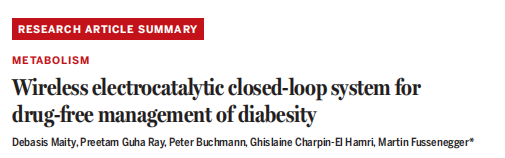
A study from the University of Basel, Switzerland, and other institutions has recently appeared online in Science. The research team developed a wireless, powered, implantable device called ECHO (electrocatalytic closed-loop health optimization). It combines electrochemical catalysis with real-time glucose monitoring, achieving closed-loop glycaemic control and weight loss in a mouse model without any glucose-lowering medication.
Study Design: When Electrocatalysis Meets Continuous Glucose Monitoring
The core of the ECHO device is an electrocatalyst made of platinum-decorated gold nanoclusters embedded in a graphite felt (GF) matrix. When stimulated by a specific voltage, the catalyst selectively oxidises glucose in the blood to gluconate. Gluconate is a low-energy metabolite that is rapidly excreted by the kidneys in urine.
In the animal experiments, the researchers implanted the device subcutaneously in obese mice with T2D, a model combining diabetes and obesity. To achieve closed-loop operation, they connected the ECHO device to a commercially available continuous glucose monitor (CGM) system and a smartphone. When the CGM detected that the mouse blood glucose exceeded a preset threshold of 10 mmol/L, the system automatically issued a command to activate the subcutaneous device wirelessly, switching on the electrocatalytic glucose-removal mode for a single 5-minute powered pulse; when blood glucose fell back into the normal range, the device stopped running.
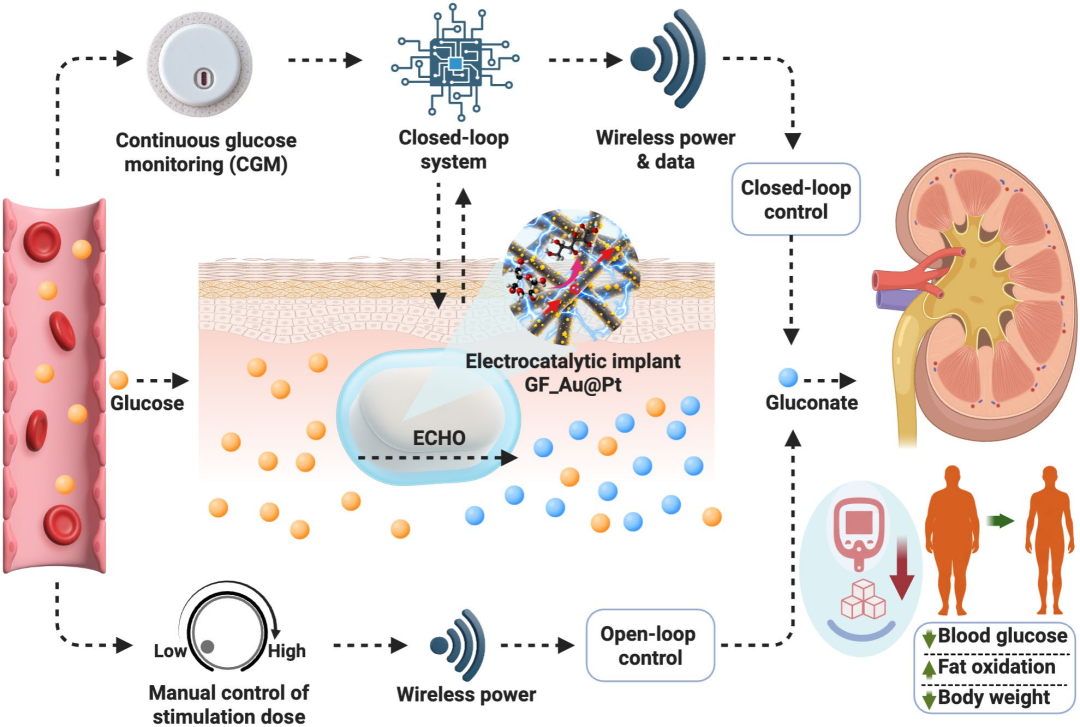 Fig. 1. Working Principle and Metabolic Closed Loop of the ECHO System
Glycaemic Effect: Normalisation in One Hour, No Hypoglycaemia over Six Weeks
In vitro, the catalyst showed high glucose specificity under very low wireless power conditions of 0.75 V and 10 mA. Against a 30 mmol/L glucose solution, it reduced the concentration to 7 mmol/L within 2 hours.
In living mice, the effect was equally striking.
Rapid onset: after wireless activation, the ECHO device brought the hyperglycaemia of T2D mice back to the normal range within 1 hour.
Sustained stability: with once-daily repeated stimulation, blood glucose remained within the normal range over 6 weeks of continuous treatment, and no hypoglycaemic events were observed.
Favourable safety: the device produced no detectable physiological, inflammatory, or behavioural abnormalities over 6 weeks of operation in the body.
The Weight-Loss Mechanism: Not Only Removing Glucose, but Forcing the Body to Burn Fat
More strikingly, ECHO produced significant weight loss alongside the reduction in blood glucose.
The metabolic logic behind this is that, because glucose in the body is oxidised and excreted directly, a controlled caloric deficit is created, equivalent to an energy gap, and the body is forced to draw on stored reserves. Whole-body metabolism in the mice then shifts, from burning glucose to burning fat. Adipose tissue breakdown increases, and free fatty acid and ketone body levels rise.
The data show that after treatment, body weight and blood triglyceride levels fell significantly in the mice, while circulating free fatty acid and ketone body levels rose, which are markers of fat breakdown and hepatic ketogenesis. The mice lost weight without showing any change in appetite or abnormal behaviour.
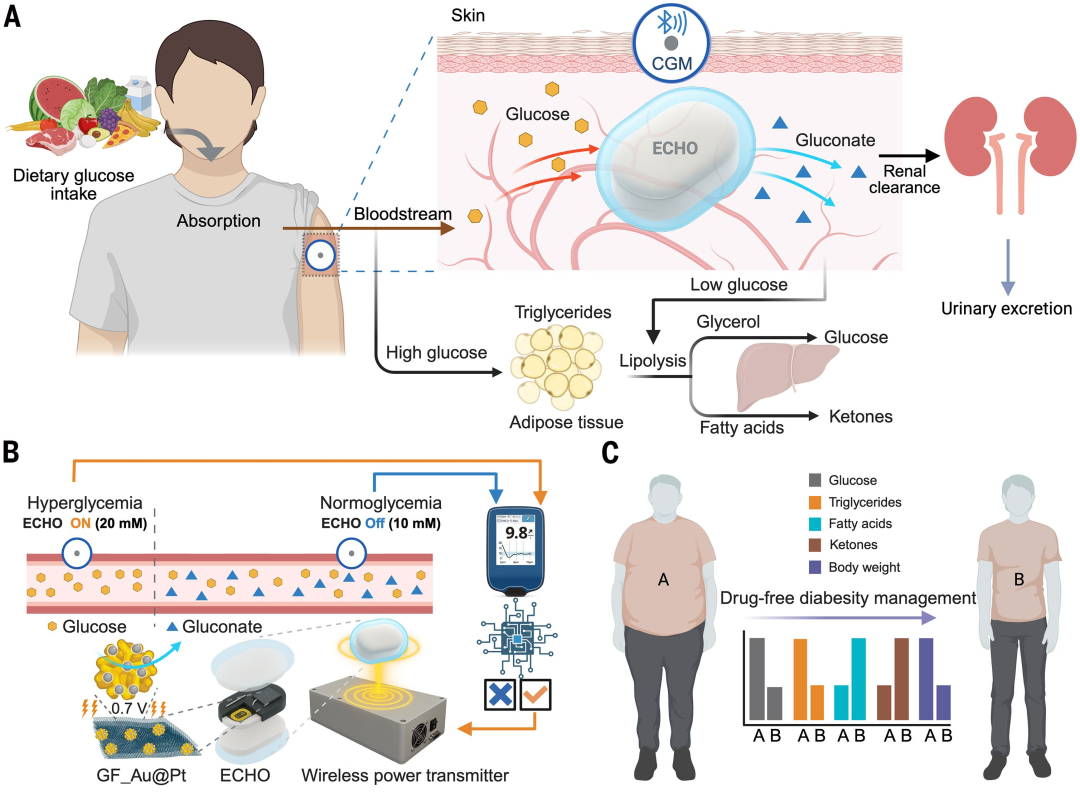 Fig. 2. Mechanism and Metabolic Improvement of the Closed-Loop ECHO-CGM System
Closed-Loop Intelligent Control: Connecting the Glucose Meter to a Miniaturised Factory
The real intelligence lies in the closed loop.
The researchers ingeniously used the high-glucose vibration alarm function of the CGM reader. When blood glucose reached or exceeded 10 mmol/L, the reader vibrated; an external vibration sensor captured the signal and passed it to a controller, which switched on the wireless power supply immediately for a single 5-minute electrocatalytic glucose-lowering pulse. The system then used real-time glucose feedback to decide whether to trigger another cycle. This feedback mechanism, based on actual glucose readings, achieved true on-demand glucose lowering.
The device can also be monitored remotely through a smartphone or cloud-based Internet of Things, and in future it may even be combined with artificial intelligence algorithms to deliver dynamic intervention according to the patient’s lifestyle.
Clinical Meaning and Limitations: How Far Is It from Mouse to Human?
The study provides a highly imaginative drug-free treatment platform for diabetes and obesity. For patients who cannot tolerate existing glucose-lowering drugs, who have poor adherence, or who face a heavy economic burden, such an adjustable and reversible physical intervention would be highly attractive. The work also illustrates the broad prospects of combining bioelectronics with metabolic engineering.
Objectively, however, there is still a long way to go before clinical application.
Species gap: the data so far come only from mouse models, and human blood volume, haemodynamics, and tissue microenvironment are far more complex than those of mice.
Implantation risk: as a subcutaneous device, its long-term biocompatibility in the human body, the long-term stability of the electrodes, and potential foreign body reactions all require years or longer of validation.
Energy and capacity: the total amount of glucose oxidised in a single pulse is limited, and whether the device could fully replace medication or insulin in patients with severe hyperglycaemia remains an open question.
Surgical cost: the benefit of “no needles” is built on the basis of an operation, and whether patients will accept this remains to be tested by the market.
Summary
The study published in Science demonstrates that it is feasible to use a wirelessly powered, enzyme-free electrocatalytic device to achieve real-time, controllable, closed-loop glycaemic management in a living organism. It not only lowers blood glucose but also reduces weight by altering metabolic pathways, opening a new “electronic drug” track for the treatment of diabesity. Although at present it is only a proof of concept in mice, who can say that the endocrinologist of the future will not include a “electrocatalysis specialist”.
Article Key Points
- ECHO is a wirelessly powered implant with a platinum-decorated gold nanocluster electrocatalyst in graphite felt
- When powered, the catalyst selectively oxidises glucose to gluconate, which is excreted by the kidneys
- In vitro, 0.75 V and 10 mA reduced a 30 mmol/L glucose solution to 7 mmol/L within 2 hours
- In T2D mice, wireless activation restored hyperglycaemia to the normal range within 1 hour
- Once-daily stimulation over 6 weeks kept glucose normal with no hypoglycaemic events observed
- Body weight and triglycerides fell, while free fatty acids and ketone bodies rose, with no change in appetite
- The closed loop uses the vibration alarm of a commercial CGM reader to trigger a 5-minute powered pulse
- The study is a mouse proof of concept; human trials have not begun and the device must be explanted
Reference
[1] Debasis Maity et al., Wireless electrocatalytic closed-loop system for drug-free management of diabesity. Science394,eady8560(2026).

