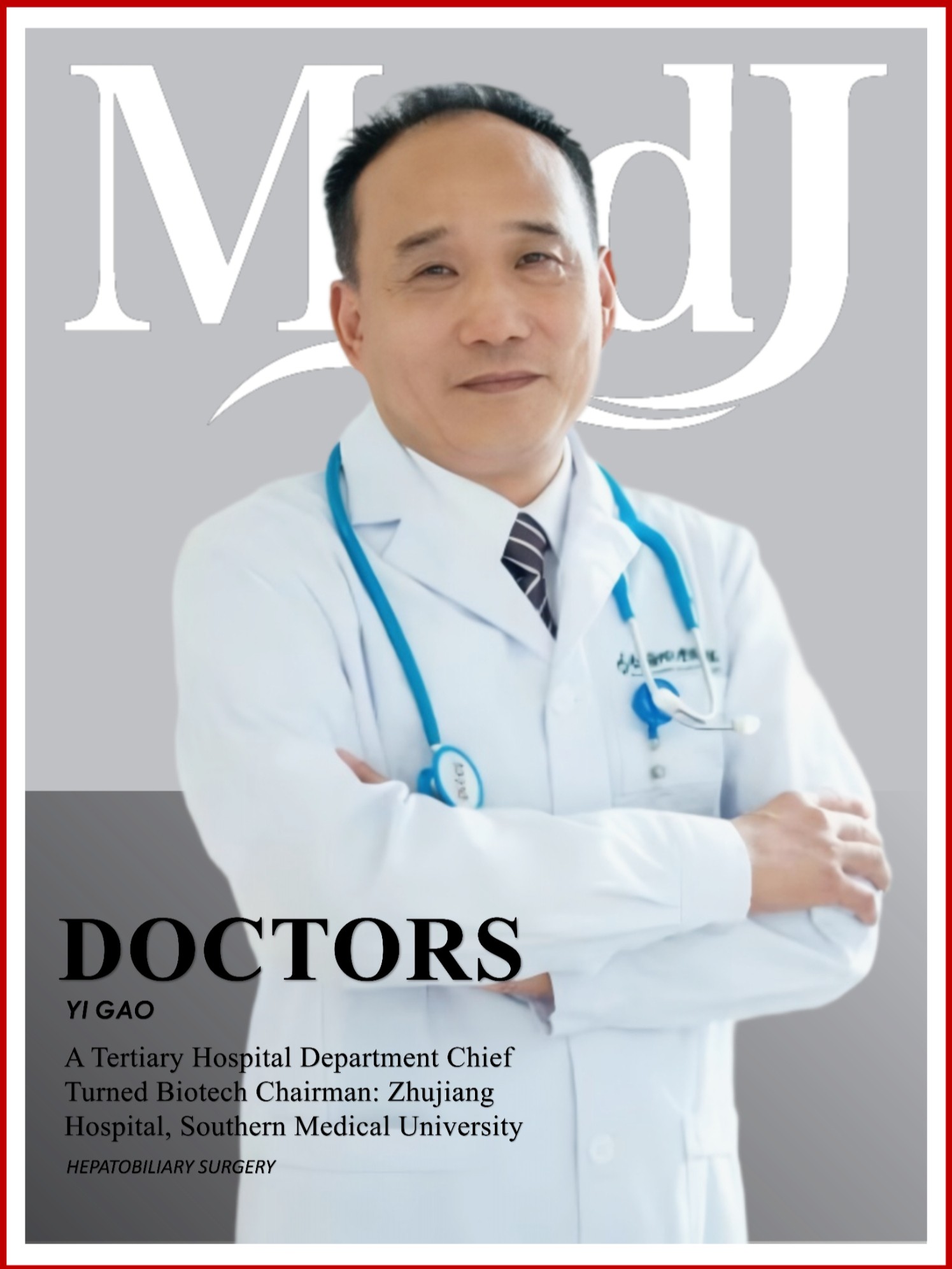
Prof. Yi Gao, director of the Second Department of Hepatobiliary Surgery at Zhujiang Hospital of Southern Medical University, has two identities: clinician and company chairman.
Once the youngest associate chief physician, chief physician, and second-grade professor at the hospital, Prof. Gao has worked in hepatobiliary surgery for nearly 40 years and has mastered advanced diagnostic and therapeutic methods in the field ranging from minimally invasive techniques to liver transplantation, successfully treating many patients with difficult diseases.
Outside clinical work, Prof. Gao is also chairman of a well-known biotechnology company in Guangdong. It was he who proposed the concept of a “combined bioartificial liver,” and the related artificial liver products have already received clinical trial approval from China’s National Medical Products Administration.
His goal is to improve the therapeutic benefit of bioartificial liver treatment, lower the price, and benefit more patients with liver failure.
The Youngest Chief Physician
In 1992, after obtaining a doctorate in surgery from the Second Military Medical University, now Naval Medical University, Prof. Gao came to Guangzhou and became a hepatobiliary surgeon at Zhujiang Hospital of the First Military Medical University, now Southern Medical University.
He soon distinguished himself clinically, becoming in succession the youngest associate chief physician, the youngest chief physician, and the youngest second-grade professor at the hospital. This record was not broken until 2025.
Clinically, single-incision laparoscopic surgery became a hallmark of the Second Department of Hepatobiliary Surgery during Prof. Gao’s tenure as director.
Compared with traditional multi-port laparoscopy, single-incision surgery is more in keeping with the concept of minimally invasive surgery, but it is also technically more difficult.
In general, standard laparoscopy uses three ports. Once the instruments enter the body through three incisions, they form a stable triangular relationship that gives the surgeon more operating space. In contrast, with single-incision laparoscopy all instruments enter and exit through a single opening, making the working space narrow and eliminating triangulation. Instrument collision is common, placing extremely high demands on the operator.
Therefore, affected by the technical difficulty, equipment, and surgeon mindset, very few hospitals in hepatobiliary surgery could perform this technique more than a decade ago.
“At the time, only three hospitals in the country had successfully carried it out: PLA General Hospital, Sir Run Run Shaw Hospital, and Zhujiang Hospital,” Prof. Gao recalled.
In 2009, Prof. Gao led his team in pioneering the use of single-incision laparoscopy for hepatobiliary surgery in South China, performing cholecystectomy. In 2010, he completed the first single-incision laparoscopic hepatectomy in South China and the second in China. In 2013, he completed China’s first single-incision 3D laparoscopic cholecystectomy.
Within just a few years, the Second Department of Hepatobiliary Surgery at Zhujiang Hospital became the national center performing the largest number of single-incision laparoscopic procedures.
Thereafter, Prof. Gao and his team were not satisfied with merely being followers. They continued to focus on clinical technical research in single-incision laparoscopic surgery and on the development and promotion of single-incision instruments.
Prof. Gao and his team created the “three-point method” for single-incision laparoscopic cholecystectomy, the “five-step method” for single-incision laparoscopic left lateral hepatectomy, and the “tunnel method” for single-incision laparoscopic splenectomy. These techniques received five authorized patents and four grant awards.
Before the age of 40, Prof. Gao had already become an excellent surgeon and department chief. Yet he still felt regret: the artificial liver project he had resolved to study when he first moved south to Guangzhou had consumed more than 10 years, and in his words, he “had not produced much of a result.”
From Tumors to Liver Failure: Multiple Breakthroughs
When he was a doctoral student, Prof. Gao trained under the team of Academician Mengchao Wu, known as the “father of Chinese hepatobiliary surgery.” At that time, liver cancer was the hot research topic among peers, but after doing more and more of it, Prof. Gao realized, “I was just a small stone. I could not make a splash in that vast ocean.”
After deciding not to keep “butting his head” against tumors, he gradually shifted his research focus from liver tumors to liver failure beginning at age 31. “In liver cancer, everyone in medicine and surgery, basic and clinical, was already working on it. Hepatitis belonged to infectious disease specialists and cirrhosis to gastroenterologists. What was left was liver failure.”
China is a country with a high burden of liver disease, with more than 400 million people affected and more than 500,000 new cases of liver failure each year. As the end stage of liver disease, liver failure carries an extremely high mortality rate of 50% to 80%. In China, about 400,000 to 800,000 patients die from liver failure every year.
Even today, liver failure remains a medical challenge without a specific curative treatment. Management mainly includes comprehensive internal medicine treatment, artificial liver support, and liver transplantation.
Liver transplantation is the most effective treatment for liver failure, but demand is enormous and donors are scarce. Data show that fewer than 6,000 patients in China receive liver transplantation each year, and because patients with liver failure are critically ill, many die before a donor liver becomes available.
After evaluation, Prof. Gao turned his attention to the field of artificial liver support systems.
An artificial liver is an extracorporeal device somewhat analogous to blood purification. According to its composition and properties, artificial liver support systems can be divided into non-biological, biological, and hybrid types. To date, only non-biological artificial liver systems have been approved for clinical application.
What Prof. Gao wanted to study more deeply was the biological artificial liver. “The entire world was a blank in this field. Around 2003, the United States launched a clinical trial using human hepatocyte sources, but it also failed to reach its endpoint.”
The starting point of Prof. Gao’s artificial liver research was 1996, the year he obtained a National Natural Science Foundation general project. But until 2006, 10 years of work by him and his team had failed to produce the expected effect. In his words, “I started studying it at 31, and by 40 I still had not produced anything.”
It was not until 2006 that he encountered a key turning point in his research career.
That year, at the initiative of Academician Lanjuan Li, the National High Technology Research and Development Program first included “bioartificial liver” in the Eleventh Five-Year Plan project guidelines and, for the first time, adopted a competitive funding mechanism.
Prof. Gao decided to seize the opportunity. Competing with him were Peking Union Medical College Hospital, the First Affiliated Hospital, Zhejiang University School of Medicine, and Tongji Hospital in Wuhan. Faced with hospitals with greater fame and stronger apparent strength, he encouraged the young people on his team by saying that winning would be good, but losing would not be a loss either.
At the same time, he prepared to proceed on “two fronts”: making the cell product himself while inviting another team to build the machine. “We physicians do not know how to make equipment. So I searched online and discovered that there really was a Chinese scientist who had published a related paper.” That scientist was Prof. Ming Li of the Institute of Electrical Engineering, Chinese Academy of Sciences.
After managing to contact Prof. Li, Prof. Gao recalled to MedJ that he persuaded him to join the team after a three-hour phone call. “The defense was held at Beijing Railway Hotel, with 17 experts reviewing the project on site.” In the end, the project he led, Development of a Human Cell-Based Hybrid Bioartificial Liver, successfully received funding of RMB 10.91 million.
During the Eleventh Five-Year Plan period, Prof. Gao’s team developed the world’s first combined bioartificial liver prototype and verified the feasibility of the treatment principle, achieving major progress in R&D.
Becoming Company Chairman and Pushing the Artificial Liver Toward Clinical Use
The year 2011 was another major turning point in Prof. Gao’s life. “I founded a company and became its chairman.”
He told MedJ that after successfully completing the Eleventh Five-Year Plan project, he was preparing to apply for the Twelfth Five-Year Plan 863 Program. This time, however, integration of industry and research was required, meaning a company had to participate.
“That was really worrying. At the time even dialysis machines were basically imported, so what company would be willing to make this with you?” With no alternative, Prof. Gao said, “I decided to start one myself.”
At the time, it was not easy for an officially employed doctor at a public hospital to establish a company. “There was no clear policy support, and the hospital had to approve it under considerable pressure,” Prof. Gao said. “In addition, there was only a model machine at the time. For such a project, which requires long-term, heavy investment and is unlikely to show returns within several years, raising funds was not easy.”
Ultimately, with support from multiple sides, a biotechnology company focused on artificial liver technology came into being. Prof. Gao’s team also obtained major special funding under the Twelfth Five-Year Plan 863 Program totaling RMB 13.45 million. During the decade spanning the Eleventh and Twelfth Five-Year Plans, Prof. Gao’s team achieved breakthrough progress in seed cells for bioartificial liver, large-scale culture and cryopreservation of human hepatocytes, bioreactor development, and new bioartificial systems.
“Later we also obtained funding under the Thirteenth Five-Year National Key R&D Program and multiple provincial and municipal science projects, with a cumulative contract amount of RMB 114 million,” Prof. Gao said.
To this day, he has been on the road toward a bioartificial liver for more than 30 years, and dawn is finally breaking for clinical application.
In August 2023, the world’s first stem-cell bioartificial liver drug-device combination product independently developed by Prof. Gao’s team received clinical trial approval from the National Medical Products Administration.
“This is our third-generation product,” Prof. Gao said. “Results from large-animal studies confirmed that, compared with conventional treatment, the stem-cell bioartificial liver now approved for drug clinical trials can raise patient survival from 17% to 87.5%.”
The principle of a bioartificial liver is to place cultured hepatocytes in an extracorporeal bioreactor and use an extracorporeal circulation device to guide the patient’s blood or plasma through the reactor, thereby achieving material exchange with the hepatocytes. The hepatocyte source is the key. Differences in liver function between cell sources directly affect the functional potential of the bioartificial liver.
Prof. Gao said, “Our current cell-source products include two main categories: mesenchymal stem cells and hepatic cells.”
Mesenchymal stem cells can suppress liver injury caused by excessive inflammation and, through paracrine actions and the secretion of exosomes, exert immunomodulatory effects and stimulate tissue regeneration. Mesenchymal stem cells are usually derived from umbilical cords. “The umbilical cord itself is medical waste, so through legal donation channels it is relatively easy to obtain.”
These umbilical cord cells undergo modifications such as gene editing to extend telomerase activity. The natural passage number of cord cells is eight to 10 generations, but processed cells can be expanded to 120 generations. At present, his team has stored more than 2,000 cord cell strains, estimated to support use in 800,000 patient-times.
For hepatic cells, Prof. Gao’s team chose the safer chemical reprogramming technology to induce differentiation into hepatic progenitor cells. This can not only realize large-scale production of liver cells, but also provides good protein expression as well as strong biotransformation and metabolic function.
Advancing the Clinical Application of Bioartificial Liver
“At present, we already have a total of eight products, including cell products and reactor devices, which will be submitted for approval one after another,” Prof. Gao said. The company has established an industrial base of more than 3,000 square meters in Guangzhou and will also establish production bases in cities such as Yibin and Qingdao in the hope of further promoting the industrialization and scaling-up of bioartificial liver technology.
In addition, the two clinical trials approved in August 2023 are being conducted at leading centers including Nanfang Hospital of Southern Medical University, the Third Affiliated Hospital of Sun Yat-sen University, and the First Affiliated Hospital, Zhejiang University School of Medicine, and more than 50 patients have already been enrolled.
According to Prof. Gao, “The preliminary results meet expectations. The medical device should be able to apply for marketing this year, while the cell product belongs to a Class 1 innovative drug and will require more time.”
“A world liver, made in China” is the concept of Prof. Gao and his company. He said, “One operation can save only one person. I hope our products can save people batch after batch.”