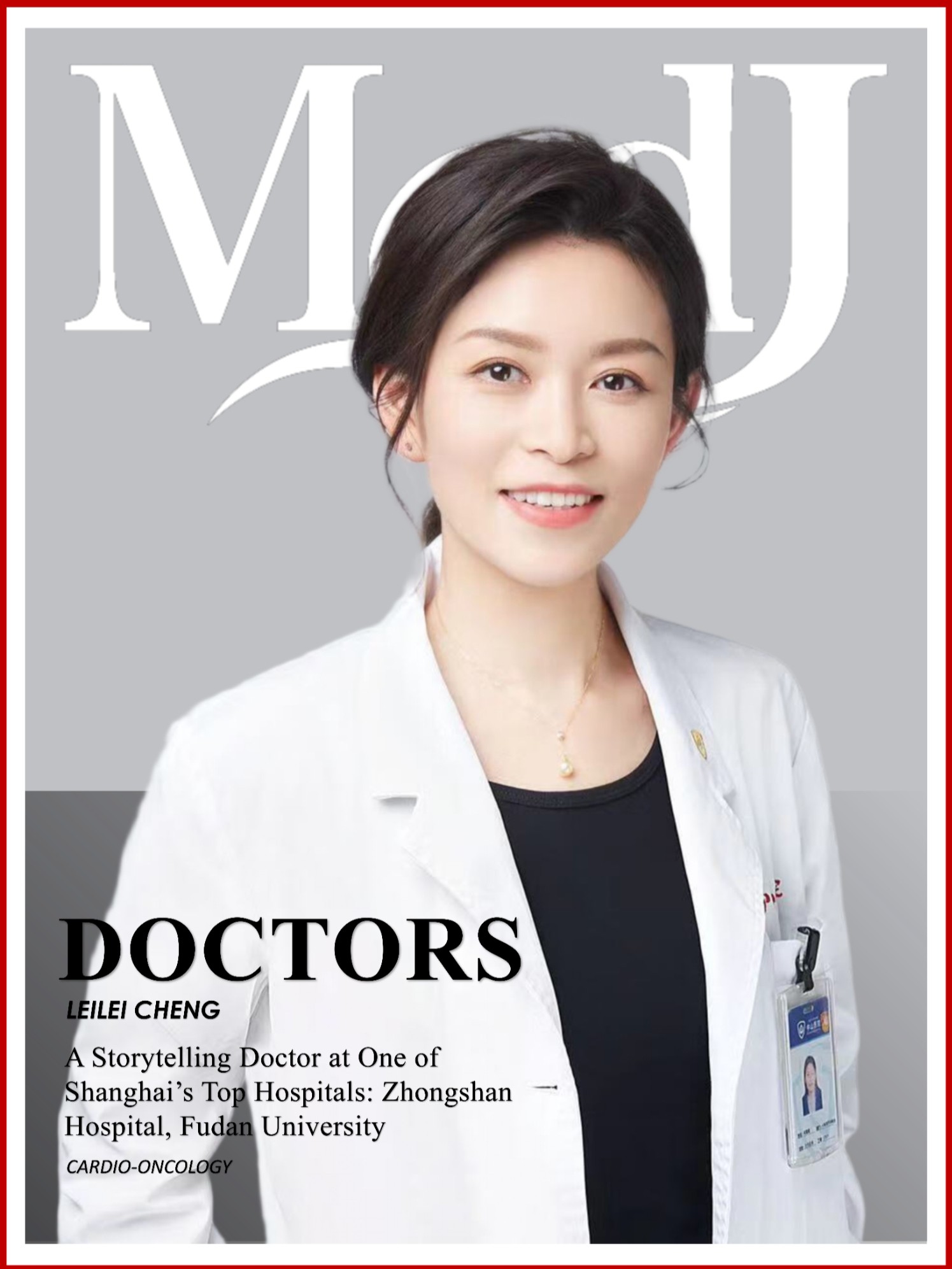
Prof. Leilei Cheng, chief physician in cardiology at Zhongshan Hospital affiliated with Fudan University, dreamed of becoming a writer from childhood. In the end she entered medicine, but she never gave up writing. Today she has managed to take both paths seriously.
Clinically, she is one of China's best-known cardio-oncology experts. Under the guidance of Academician Junbo Ge, she helped establish the first multidisciplinary cardio-oncology clinic in East China to address the question of who manages the heart of a patient with cancer.
In writing, she has published several narrative-medicine popular science books and created a wide range of audio and video health content, reaching hundreds of millions of viewers. Patients call her the doctor who tells stories best.
The First Multidisciplinary Cardio-Oncology Clinic in East China
The cardio-oncology MDT at Zhongshan Hospital is one of the busiest in the institution. A half-day clinic may see more than ten or twenty patients, and each session has to be divided into groups for simultaneous history-taking and discussion.
This heavy workload reflects both the rapid growth of clinical demand and the scarcity of specialized cardio-oncology services. Prof. Cheng recalls families who searched repeatedly for help after serious immune-therapy complications but still could not obtain a correct diagnosis until they reached her team.
Cardio-oncology focuses on four broad areas: cardiovascular adverse effects of anticancer treatment, cardiovascular support for patients who already have heart disease when cancer is diagnosed, diagnosis and treatment of benign or malignant cardiac tumors, and management of shared risk factors of cancer and cardiovascular disease.
Prof. Cheng emphasizes that traditional chemotherapy, targeted therapy, and immune checkpoint inhibitors can all damage the cardiovascular system, and in severe immune checkpoint inhibitor-related myocarditis, high-dose glucocorticoid treatment must be started early. Yet limited awareness still causes hesitation among some doctors.
It was in this context that the MDT clinic was launched in 2018 to integrate cardiology, echocardiography, oncology, imaging, surgery, pharmacy, and other specialties so that individualized treatment plans could be formulated.
From a Marginal Topic to a Major Trend
Prof. Cheng's interest in cardio-oncology dates back to 2009, when she was searching for a research direction. A paper on anthracycline-related heart failure in survivors of childhood leukemia opened her eyes to the possibility that many cancer treatments may silently injure the heart.
For a long time, however, the field remained marginal because many cardiac injuries progressed slowly and were easily ignored. The spread of immune checkpoint inhibitors changed that understanding dramatically. Although immune-related myocarditis is uncommon, its mortality is extremely high.
At Zhongshan Hospital, where Prof. Cheng's team has built strong expertise, mortality in immune-related myocarditis has been brought below 5%, far lower than many reported averages.
By 2021, the team had expanded from the MDT model to a dedicated specialty clinic, allowing less complicated patients to receive a plan and continue care locally, while severe cases remained in the multidisciplinary setting. Similar models are now spreading across China.
Using Science Communication to Bring the Field Into Public View
Today the cardio-oncology MDT clinic at Zhongshan Hospital sees nearly one thousand patient visits a year, most of them referrals from outside hospitals. Some cases require hours just to organize the pile of previous reports and reconstruct the treatment course.
Prof. Cheng has used writing and public communication to make the field visible. Her book Speaking From the Heart 2 became China's first popular science volume devoted to cardio-oncology, and many patients now come to her clinic carrying her books or having first learned the field from her videos.
Public communication has also helped research recruitment. Because patients understand the field better and trust the team, they are often willing to join clinical studies. The group has further promoted training courses, online and offline education programs, AI tools for cardio-oncology, and translational innovation, with dozens of patents already moved toward application.
In Prof. Cheng's view, those achievements come from three things: always putting the patient first, working together across specialties, and making good use of opportunities for scientific and technological innovation.