


Writing medical records and assisting in surgery during the day, then letting AI autonomously derive mathematical theorems at night — this is not a scene from science fiction, but the real daily life of a neurosurgery resident.
Recently, Alex Townsend, Associate Professor in the Department of Mathematics at Cornell University, made public on his personal website an article to be published in SIAM News. The article reports that Shanmu Jin, a resident physician in the Department of Neurosurgery at Peking Union Medical College Hospital, used GPT-5.6 Sol (ChatGPT Work mode) to prove the Crouzeix conjecture, a problem that has puzzled the mathematics community for 22 years.
After verification by Townsend, by Anne Greenbaum of the University of Washington, and by Michel Crouzeix — the proposer of the conjecture himself — the three parties unanimously confirmed: the derivation is rigorous and the logic holds.
A clinician with no formal mathematics training, leveraging a large language model, has cracked a top-tier problem in pure mathematics. This has not only shaken the mathematical community, but may also point to a new direction for physicians and medical students.
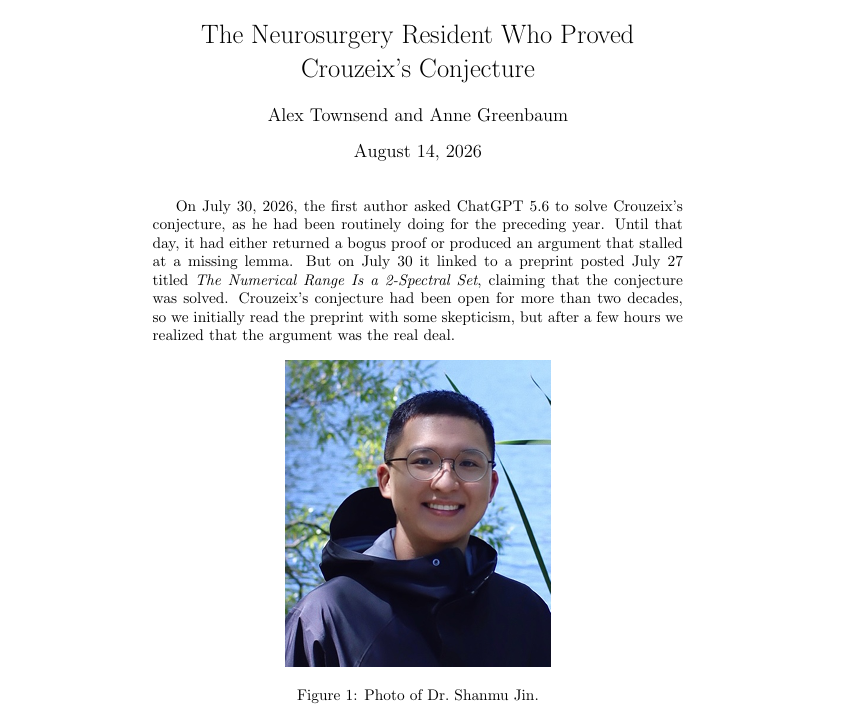 Fig.1.Screenshot of Alex Townsend’s article
Using AI to Tackle a Mathematical Problem
According to Townsend’s article in SIAM News, on July 30 this year, he was using ChatGPT 5.6 to attempt to derive the Crouzeix conjecture in his usual way. Previously, the model had either produced proofs riddled with gaps or got stuck at key lemmas.
But this time, the AI pushed forward a preprint uploaded three days earlier. The paper was titled “The Numerical Range Is a 2-Spectral Set,” and the author line read: Shanmu Jin.
Townsend and Anne Greenbaum of the University of Washington, the other author of the article, were initially full of doubt — after all, the conjecture had been open for more than 20 years, and the academic community had accumulated a vast body of research without ever breaking through.
The two spent hours going through the paper line by line, and ultimately confirmed that the logic of the argument held. Subsequently, the conjecture’s proposer, Michel Crouzeix, also independently completed the verification. The three unanimously agreed that Shanmu Jin’s derivation is valid. It should be noted that the paper is still a preprint and has not yet passed formal peer review.
Public information shows that SIAM News is the authoritative news journal of the Society for Industrial and Applied Mathematics (SIAM), and SIAM is one of the most influential academic organizations in applied mathematics worldwide. The two authors of the article, Townsend and Greenbaum, are both well-known mathematicians in the field.
Townsend is an Associate Professor in the Department of Mathematics at Cornell University, holds a PhD from the University of Oxford, and has received honors including the Leslie Fox Prize, the NSF CAREER Award, and a Simons Fellowship. Greenbaum is the Boeing Endowed Professor of Applied Mathematics at the University of Washington, a SIAM Fellow, and a leading scholar in numerical linear algebra.
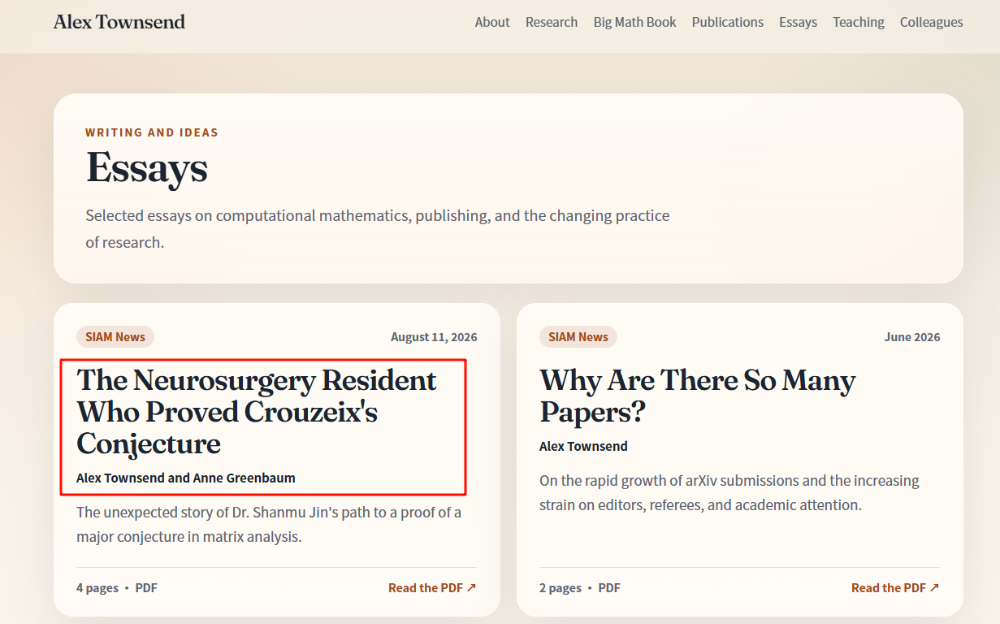 Fig.2.Alex Townsend’s personal website
What is the Crouzeix conjecture, and what makes it difficult?
In 2004, French mathematician Michel Crouzeix formally proposed this conjecture: for any complex square matrix A and polynomial p, the spectral norm of the matrix polynomial satisfies ‖p(A)‖₂ ≤ 2 max_{z∈W(A)} |p(z)|.
In simple terms, it attempts to use the maximum value of a function on a convex set (the numerical range) in the complex plane to bound the size of a matrix function. This inequality is a key bridge connecting approximation theory in the complex plane with matrix function analysis, GMRES iterative methods, and Krylov subspace methods, and is of high value in numerical computation and engineering applications.
For many years, the academic community has been trying to tackle this problem. In 2007, Crouzeix proved that the constant 11.08 could make the inequality hold; in 2017, Crouzeix and Palencia optimized the constant to 1+√2 ≈ 2.414; in the same year, the American Institute of Mathematics (AIM) even organized a one-week dedicated workshop to focus on the problem, but the conjecture was never fully proved.
The core theorem in Shanmu Jin’s paper was born out of an approximately 16-hour, fully unsupervised autonomous derivation process under GPT-5.6 Sol (ChatGPT Work mode).
Different from a regular prompt, he used a highly customized set of instructions, for example: restricting the model from accessing the public internet and external materials, with no human intervention throughout the derivation; requiring the model to generate multiple completely independent proof ideas in parallel, launching a large number of sub-agents to build proof frameworks separately, while forbidding all agents from prematurely converging on the same line of reasoning; requiring each candidate proof to undergo adversarial verification, relying solely on counterexamples to filter out derivations that do not hold, and so on.
This set of instructions was adapted from a template that OpenAI used to tackle the double-cycle cover conjecture. Currently, Shanmu Jin has open-sourced the full set of instructions and simultaneously uploaded multiple iterations of the manuscript, Lean formal verification code, and all axiom-checking materials, so that colleagues worldwide can reproduce and check the derivation.
Townsend specifically noted in the article that all of Shanmu Jin’s related mathematical research was completed in the gaps of his heavy neurosurgery clinical work.
Just 8 days after the first version of the preprint was released, mathematicians Emiel Lorist and Felix Schwenninger posted another independent proof — only 5 pages long — that used the classical double-layer integral representation combined with a 2-expansive perturbation lemma; the argument was entirely different from Shanmu Jin’s. The two noted that they also used ChatGPT 5.6 to organize and explore their proof ideas.
Townsend wrote in the article that, after seeing the independent result, Shanmu Jin was delighted, noting that the two entirely different proofs complement each other, and that two complete solutions appearing in quick succession was deeply encouraging to him.
AI Is Now Helping Humans Tackle Medical Problems Too
Public information shows that Shanmu Jin has a multi-disciplinary background, having obtained his MD in 2024. As for his mathematics background, during his school years he had only taken the general basic mathematics courses for science and engineering; all his advanced knowledge of matrix analysis and related topics was self-taught.
He told Townsend by email that his entry into matrix analysis was triggered by clinical research on transcranial ultrasound. While self-studying the field, he came across the Crouzeix conjecture and was deeply attracted by its extremely concise statement and the geometric intuition of the numerical range.
Even with such a breakthrough achievement, Shanmu Jin remained very modest in correspondence, frankly saying that luck played a large part in finding the core proof idea.
Townsend and Greenbaum wrote in the article that a clinician without formal mathematics training, relying on a large language model to prove a major conjecture that had been open for more than 20 years, would have been unimaginable just a few years ago. They predicted that in the future, cases of non-specialist mathematical researchers achieving major breakthroughs with the help of AI will continue to grow.
In fact, Shanmu Jin’s story is not an isolated case. AI is helping “outsiders”from different fields to tackle problems that once only top experts could reach.
In medicine and the life sciences, such cross-disciplinary breakthroughs are no longer rare. In 2021, DeepMind’s AlphaFold2 solved the protein-folding problem that had puzzled biology for 50 years, and its core developer, John Jumper, was not a biologist but a theoretical chemistry PhD, ultimately rewriting the research paradigm of the entire field of structural biology.
Even family members of patients are using AI to cross professional barriers.
In 2023, a boy in the United States had been seen by 17 doctors for recurrent pain without a diagnosis; his mother, a non-medical-professional, entered the medical records into ChatGPT, and the AI proposed a diagnosis of “tethered cord syndrome” — a cause none of the doctors had mentioned. A neurosurgeon ultimately confirmed the diagnosis and performed the surgery.
At the same time, cases of clinicians breaking through professional boundaries with the help of AI are also emerging.
A growing number of internists are self-learning Python and machine learning to mine new diagnostic and treatment patterns from massive clinical data; radiologists are collaborating with computer scientists to push AI image-reading accuracy beyond human experts; pathologists are using deep-learning algorithms to discover early cancer signals in tissue slides that are invisible to the naked eye.
For physicians and medical students, there may be a deeper implication behind all this. Future medical breakthroughs may no longer come only from biologists in the lab — they may also come from a neurosurgeon who understands matrix analysis, or a pathology resident who can write code.
When AI takes on the heaviest derivation and computation, humanity’s core competitiveness may be shifting from the “memorizer of knowledge”to the “asker of questions” and the “judge of direction.”
References
[1] https://alextownsend.net/essays/SIAMNews_CrouzeixConjecture.pdf
[2] https://alextownsend.net/essays/

