


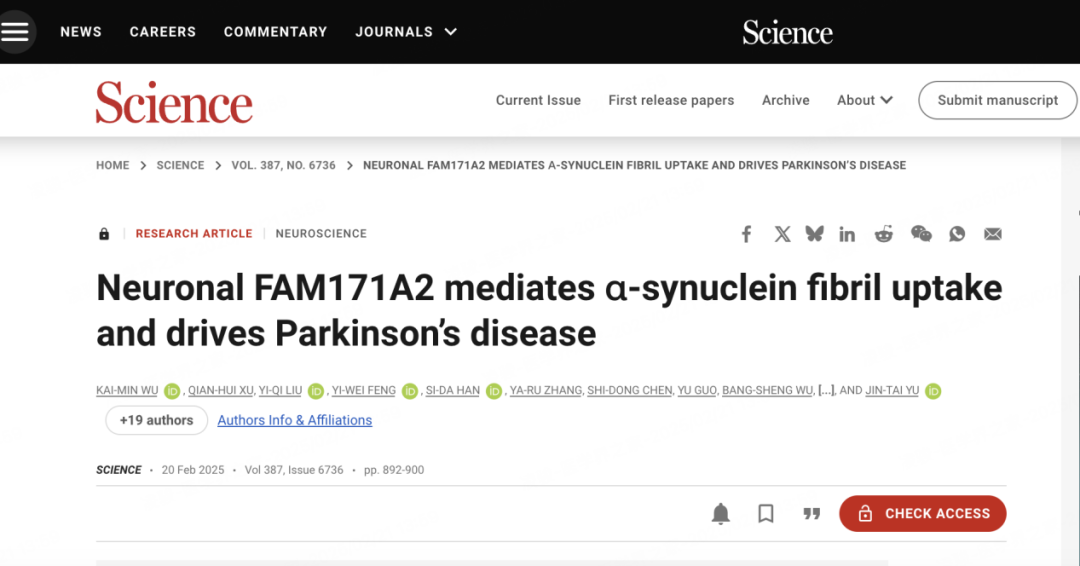
At 3 a.m. Beijing time today (21st), the international top-tier academic journal Science published a groundbreaking research achievement by a team of Chinese doctors. This discovery marks a milestone in Parkinson's disease research and is expected to usher in a new era of targeted therapy for the disease.
For a long time, clinicians could only alleviate the symptoms of Parkinson's disease, with no therapy capable of achieving a "cure." Numerous attempts to develop treatments targeting the root cause of Parkinson's disease have also ended in failure.
However, this research, led by Professor Yu Jintai's team from the National Center for Neurological Disorders and Huashan Hospital affiliated with Fudan University, has, after five years of effort, for the first time globally identified an original therapeutic target for Parkinson's disease, FAM171A2, and screened out potential small-molecule candidate drugs.
What is even more exciting is that, although Chinese medical innovations have frequently appeared on the global stage in recent years, most of these achievements are based on foundational research discoveries made by overseas teams. This study, however, started from scratch, combining genetics, neurobiology, and artificial intelligence, truly achieving "source innovation" by Chinese doctors.
Millions of Patients Without a Cure
Parkinson's disease is the second most common neurodegenerative disease globally, after Alzheimer's disease. Data shows that in 2015, there were 7 million Parkinson's disease patients worldwide, and this number is expected to rise to 13 million by 2040, with half of these patients coming from China.
In the brains of these patients, there exists a pathogenic protein called pathological α-synuclein. This protein can appear as early as 15 years before the onset of the disease. It misfolds and aggregates, disrupting the normal function of neurons and leading to neuronal death.
Initially, patients may not feel any abnormalities. However, over time, these toxic proteins spread, invading neighboring healthy neurons and inducing more α-synuclein aggregation and neuronal death in other brain regions.
When they invade the substantia nigra region of the midbrain, they cause the death of dopaminergic neurons, leading to the most common motor symptoms of Parkinson's disease—bradykinesia, resting tremor, and muscle rigidity. When they spread to the cerebral cortex, patients may experience cognitive impairments such as memory decline... until they eventually lose all functional abilities and become bedridden.
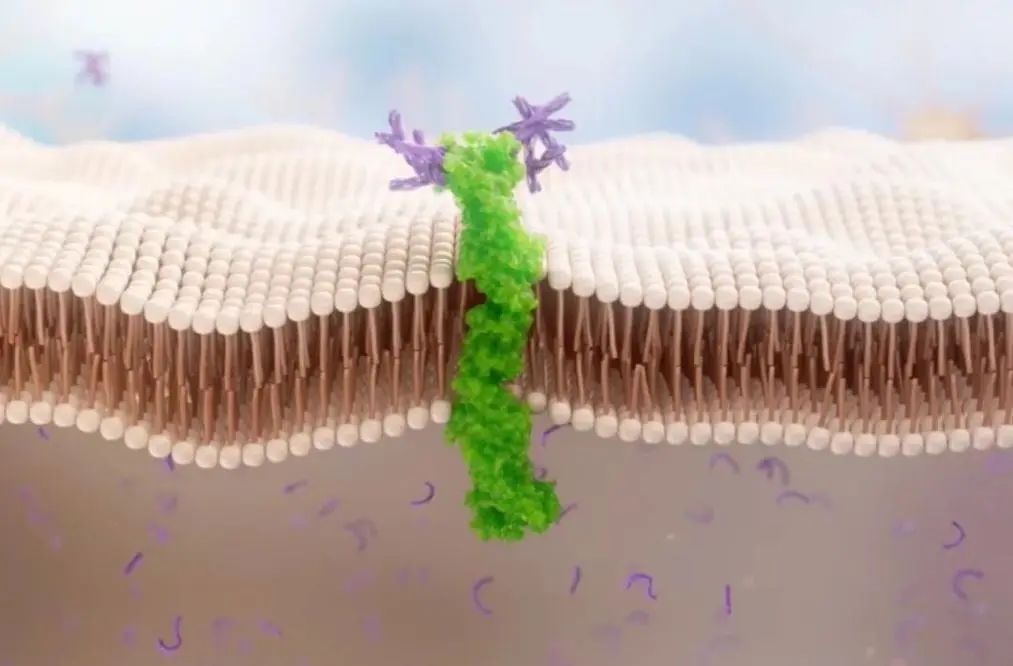
Schematic diagram of the binding between pathological α-synuclein and FAM171A2 protein
"I am a 'veteran' in treating Parkinson's disease, but after so many years, Parkinson's disease remains not only a medical challenge but also a social issue, placing a heavy burden of disease, care, and economic costs on patients, families, and society," said Professor Wang Jian, Director of the Department of Neurology at Huashan Hospital.
"In fact, clinically, we have at least a dozen drugs and methods to help Parkinson's patients improve their current symptoms. But unfortunately, none of these methods can stop or even slightly delay the progression of the disease. Therefore, Professor Yu Jintai's research carries an extremely important medical mission," Wang Jian said.
Yu Jintai told MedJ, "To solve this medical problem, we first need to understand how these toxic proteins spread in the brain and why they can invade from one brain functional area to another."
To this end, relying on the Fudan University Intelligent Computing Platform (CFFF), Yu Jintai's team first conducted a genome-wide association analysis on over 1 million patients and healthy participants, identifying the key gene FAM171A2.
The expression of this gene is significantly higher in Parkinson's patients compared to healthy individuals and is strongly associated with disease progression.
To confirm the discovery, the team further constructed a Parkinson's disease animal model with FAM171A2 knocked out in neurons. The experimental results showed that once FAM171A2 was knocked out in mice, the aggregation and spread of toxic proteins in the brain were rapidly inhibited, and neuronal death was significantly reduced, reverse-verifying that this could be a key to treating Parkinson's disease.
A Milestone Discovery
According to Yu Jintai, the FAM171A2 protein is a neuronal membrane protein, but its function had never been studied before.
"This means that initially, we did not know its detailed structure, let alone how it promotes the spread of toxic proteins," Yu Jintai said.
To address this, the team first used total internal reflection fluorescence microscopy imaging technology and discovered that the FAM171A2 protein on the neuronal membrane acts like a "smart recognition gate," selectively and with high affinity binding to pathological α-synuclein, causing it to spread wildly in the brain and damage neurons in various regions.
"At this stage, we had basically clarified the pathological logic of Parkinson's disease development. But to block this process and develop drugs to treat patients, we needed to know the three-dimensional structure of the FAM171A2 protein," Yu Jintai told MedJ.
On this critical issue, the team turned to artificial intelligence, using the Alphafold platform to predict the structure of the extracellular domain 1 of the FAM171A2 protein and identify its specific binding site with the toxic protein.
Based on this discovery, the research team again used AI technology, through protein structure prediction and virtual screening, to successfully identify a small molecule from over 7,000 compounds. "In vitro experiments showed that it could very efficiently block the binding of the FAM171A2 protein to the toxic protein."
"At the same time, we returned to animal experiments for validation and found that after injecting this small molecule, the uptake of pathogenic protein fibers by dopaminergic neurons in mice was significantly inhibited," Yu Jintai said.
Prior to this, there had been no functional experimental research on this protein in the industry. After clarifying its physiological and pathological functions in the nervous system, this discovery could also provide new therapeutic targets for other α-synuclein diseases such as Lewy body dementia and multiple system atrophy, as well as other neurodegenerative diseases like Alzheimer's disease and frontotemporal dementia.
It is reported that the team's future goal is to further study strategies targeting FAM171A2, aiming to make milestone contributions in the treatment of neurodegenerative diseases, comparable to Nobel Prize-winning work such as PD-1 in cancer treatment.
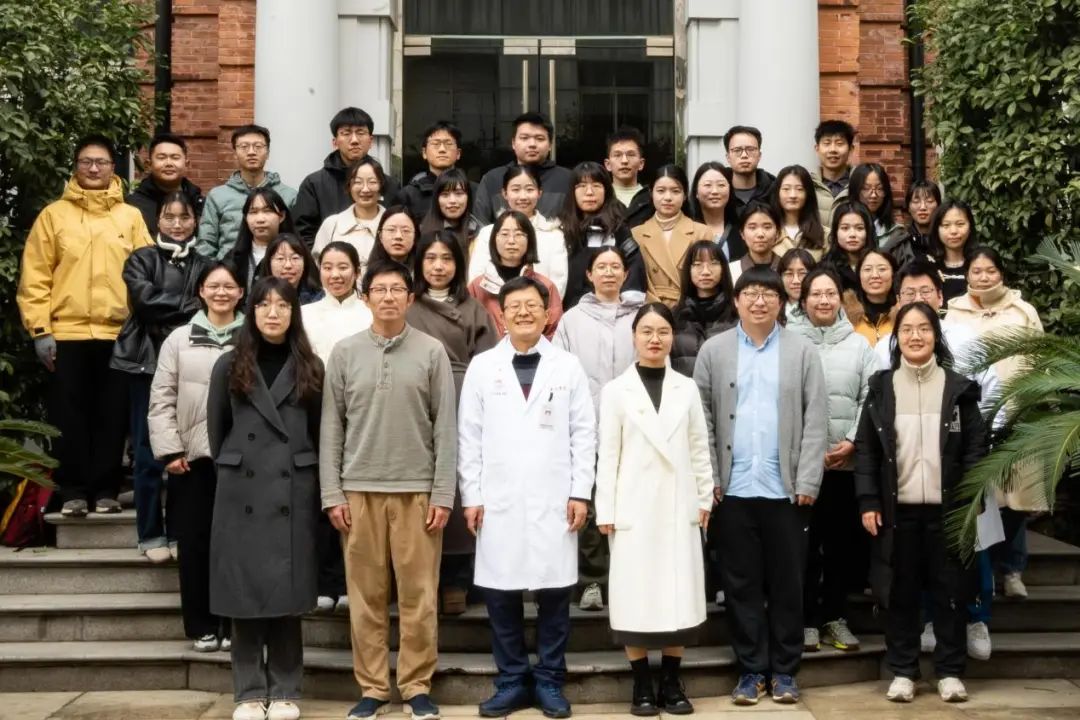
Source: Huashan Hospital; Professor Yu Jintai's team
A New Paradigm in Medical Research
After the research was submitted, the reviewers at Science gave high praise.
"Identifying neuronal receptors for pathological α-synuclein aggregates is the 'holy grail' in Parkinson's disease research, as it provides a method to block pathological spread and delay disease progression."
"This study addresses a crucial and highly significant scientific question, presenting a very interesting, novel, important, and translational research," noted international reviewers.
Wu Kaimin, a postdoctoral fellow at Huashan Hospital affiliated with Fudan University, is the first author of this study. When the project started, she was still pursuing her Ph.D. "In fact, from the beginning, this research faced numerous challenges. It took us over a year just to determine the experimental methods for how pathological α-synuclein is involved in Parkinson's disease pathogenesis, during which we constantly adjusted our research plan."
Wu Kaimin said, "When exploring how the FAM171A2 protein binds to the pathogenic protein, advancing molecular experiments was not our strong suit. Fortunately, the teachers from the Fudan University Institute for Translational Brain Research and the Shanghai Institute of Organic Chemistry, Chinese Academy of Sciences, provided us with a lot of help."
In fact, the significance of this research is not limited to the discovery itself. "This world-class problem was solved by Professor Yu Jintai's team because it is a massive project, the result of interdisciplinary collaboration and multi-technology platform integration, which is rare globally," said Professor Lu Bai, Director of the Shanghai Institute of Natural Sciences.
It is understood that this research relies on Fudan University's AI4S (AI for Science, AI-driven scientific research), integrating the advantages of Huashan Hospital's national-level center resources and collaborating with a multidisciplinary team composed of experts in neurology, artificial intelligence, mathematics, and brain science.
Taking data-driven and structure prediction as examples, Yu Jintai said, "Regarding the pathogenic targets of Parkinson's disease, if we followed traditional methods, we would need to 'guess' and test one by one, making it difficult to discover that the previously unstudied FAM171A2 protein is a pathogenic target. The discovery of small molecules is similar; testing one by one would be too time-consuming and labor-intensive."
"Now, through AI, we can quickly screen out the most promising candidates from vast amounts of data and thousands of drug structures, then study and validate them, greatly improving research feasibility and shortening the development cycle," Yu Jintai said.
Currently, Yu Jintai's team has applied for an international patent for "intervening in FAM171A2 to treat Parkinson's disease." This research was supported by the National Key R&D Program of China, the National Natural Science Foundation of China, and the Shanghai Municipal Science and Technology Major Project.
"This is a significant piece of work, but it is also just a beginning," Yu Jintai said. For example, the small-molecule drug currently screened out will need further validation for drug properties, including how to cross the blood-brain barrier, long-term treatment effects, and other issues.
"Therefore, in the coming years, we will systematically explore more and more promising small-molecule drugs, while also investigating the feasibility of antibodies, gene therapy, and other methods, gradually advancing them to clinical trials until they are finally applied in clinical practice to treat Parkinson's patients," Yu Jintai said.

