


Diabetes is a disease that humanity has never fully overcome in several thousand years, but scientists from China have recently offered a highly imaginative new solution.
Haifeng Ye’s team, led by the Dean of the School of Life Sciences at East China Normal University, identified a naturally occurring probiotic and, through genetic engineering, enabled it to automatically sense blood-glucose changes after entering the human body, and to secrete a “glucose-lowering agent” in real time whenever blood glucose rises.
This is, in effect, turning an ordinary gut bacterium into a temporary, oral “biological controller.”In animal experiments, monkeys given the bacterium orally once every three days maintained stable blood glucose throughout.
On August 12, this study was published in the top journal Nature. The team stated that this is a programmable oral live-probiotic drug capable of glucose-responsive, on-demand glucose regulation, and that they will continue to advance the translation into human clinical trials.
Real-Time Sensing of Blood-Glucose Changes
As a class of chronic, progressive diseases, related statistics show that there are about 530 million patients with type 2 diabetes worldwide; the core pathological feature is persistent hyperglycemia caused by insufficient insulin secretion, which in turn leads to metabolic syndrome, kidney disease, endocrine dysfunction and other complications.
Over the past years, treatment options for type 2 diabetes have continued to evolve. The advent of GLP-1-class drugs has pushed glucose control to a new level.
But the issue is that long-term, high-dose use of GLP-1 drugs can carry certain side effects, and patient dosing is “fixed-time, fixed-dose” — it does not adjust with real-time changes in blood glucose. More precisely regulated treatment remains a challenge.
What Haifeng Ye’s team set out to solve is transforming the treatment system from passively receiving external commands into actively sensing internal state. In other words, the drug automatically senses the patient’s blood-glucose changes inside the body, and decides whether to “switch on” or “switch off”based on the situation.
The breakthrough idea came from a bacterium called Pseudomonas putida.
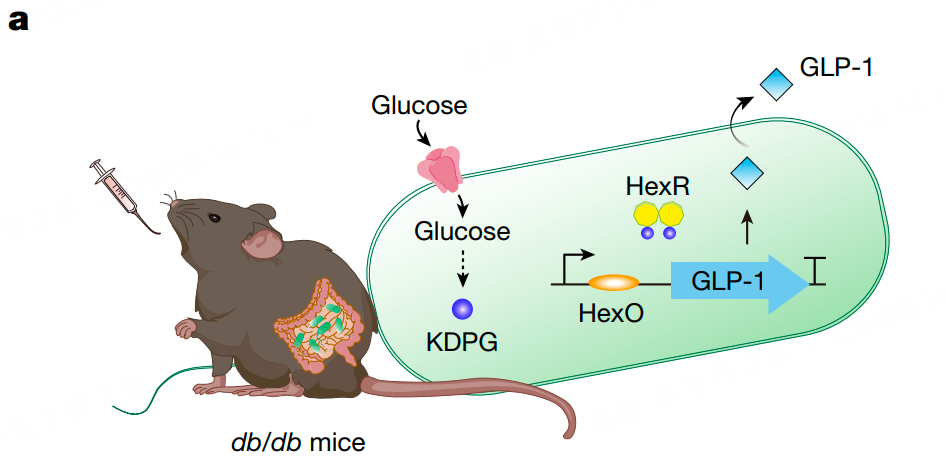
Inside this bacterium, there is a protein called HexR. Normally, it sits tightly bound to a specific site on the DNA, locking down a stretch of gene behind it and preventing the bacterium from reading the gene and translating it into protein.
Once the bacterium takes up glucose, however, a series of metabolic reactions causes HexR to change conformation, and the previously locked DNA behind it is released, allowing the gene to start working again.
In plain terms, the HexR protein system is like a “glucose-sensing valve” — a naturally occurring “glucose-sensitive sensor.”
Having selected this “template,” the team spent years modifying and testing it, ultimately constructing a synthetic biological sensor.
Laboratory results showed that when glucose concentration is below 5 mmol/L, the system barely activates; once the concentration exceeds 10 mmol/L, the response rises sharply — which lines up well with the clinical diagnostic threshold for diabetes (fasting blood glucose above 11.1 mmol/L).
Using Bacteria to Lower Glucose
The sensor has been built, but on its own it does not treat disease. It still needs a “chassis” — a bacterium that can safely enter the human body and bring this sensing capability to where it is meant to act, namely the gut.
The team selected a probiotic — Escherichia coli Nissle 1917 (EcN). This strain has been in clinical use for nearly a century. “One reason we chose it is that it is closer to application, because this strain is already used in some marketed probiotic products,” Haifeng Ye said in an interview with Science and Technology Daily.
With the “chassis” in hand, the team used gene editing to “install” the engineered HexR sensor into it. At this step, the bacterium already has the ability to sense glucose and switch on the gene when blood glucose rises.
But what is plugged in downstream of the switch is what really determines whether the bacterium is useful.
The answer is GLP-1. Haifeng Ye’s team connected a gene encoding a human GLP-1 analog directly downstream of the “glucose sensor.” Once the sensor is activated, the bacterium starts its own “glucose-lowering drug” protein-synthesis system, producing GLP-1 in real time.
At this point, the complete precision glucose-lowering pathway is ready: patient takes the drug — blood glucose rises/falls — sensor turns on/off — drug is secreted/withheld.
The team named the therapy “GIFT” — both an acronym for a “glucose-sensing intelligent functional therapeutic” probiotic, and a hope that it will become a gift to patients with diabetes, Haifeng Ye told China Science Daily.
Animal studies showed that, in multiple diabetic mouse models, 30 days of continuous oral GIFT produced comprehensive improvement in blood glucose, glucose tolerance, insulin resistance and glycated hemoglobin, alongside improvement in liver, kidney and gut injury-related indicators.
In a spontaneous type 2 diabetes cynomolgus monkey model, the glucose-lowering effect of a single oral dose of GIFT lasted 3 days; after dosing every 3 days for 5 consecutive weeks, the animals showed significant relief of glucose intolerance and insulin resistance, with no abnormal indicators in complete blood count, liver or kidney function throughout.
Advancing Clinical Translation
Even more persuasive is the team’s head-to-head comparison of GIFT with the star glucose-lowering drug semaglutide in mouse experiments.
The results showed that after a single oral dose of GIFT, the peak serum GLP-1 concentration in mice was only about one-fiftieth of that in the semaglutide group, yet this “low concentration”was already sufficient to produce glucose-lowering efficacy.
At 6 hours after semaglutide injection, mice showed elevated immunoglobulin E and interferon-β, and other inflammatory phenomena, suggesting allergic and thyroid-related adverse reactions; in the oral GIFT group, no such adverse effects were observed.
In addition, when further combined with insulin, the hypoglycemia rate in the semaglutide group rose significantly, whereas GIFT — capable of sensing glucose changes in real time and releasing the glucose-lowering substance on demand — did not show any increase in hypoglycemia risk when combined with insulin.
“The research process was bumpy, but meaningful,” Haifeng Ye said in an interview with China Science Daily, noting that GIFT has built a complete “sense–respond–regulate–feedback”closed-loop system, forming a self-responsive regulatory process.
This means that, in the future, patients may not only be able to say goodbye to injections, but also avoid the systemic adverse reactions caused by persistently high drug concentrations, with the potential to reduce the risk of hypoglycemia.
The team likewise noted in the article that the system still faces several challenges, including the fact that the “genetic circuit” currently has to rely on plasmid carriage — a stretch of DNA independent of the bacterial chromosome that can self-replicate but is relatively unstable — and the long-term colonization stability still needs improvement.
In addition, E. coli Nissle 1917 carries a known gene segment that produces a genotoxic substance, which will need to be knocked out in subsequent versions.
According to reports, the team is currently leveraging industrial collaboration and plans to formulate GIFT into an enteric-coated capsule that can resist gastric acid. If all goes well, the team expects to obtain U.S. Food and Drug Administration (FDA) Generally Recognized As Safe (GRAS) certification in about two years, and bring it to market as a health product.
“The non-human primate results have given the team a lot of confidence,” Haifeng Ye said. Scientific research must take translation and application as its goal; going forward, the team will further verify the long-term safety of the intelligent probiotic strain, promote clinical translation and industrial implementation, and open a feasible new path for diabetes management.

