


Eight years ago, after retiring, Mr. Zhou had expected to begin a second chapter of life. Instead, a physical examination delivered what felt like a death sentence: a giant liver cancer with multiple metastases, the largest lesion measuring 13 cm.
By the standards of the time, such a patient would usually survive only a few months. But Mr. Zhou came under the care of the team led by Prof. Gaojun Teng at Zhongda Hospital, Southeast University. With a standardized regimen of TACE combined with targeted therapy and immunotherapy, he has now achieved eight years of high-quality survival while living with tumor.
“He is now physically stable, in good spirits, and little different from a healthy older adult,” Prof. Teng said. Long-term survival like this was almost unimaginable in the past.
In fact, Mr. Zhou is only one of many beneficiaries. Over nearly 20 years, Prof. Teng’s team has refined this China Protocol from clinical exploration into an international standard and generated high-level evidence that has rewritten global guidelines for patients with intermediate and advanced liver cancer.
China’s answer to the “king of cancers”
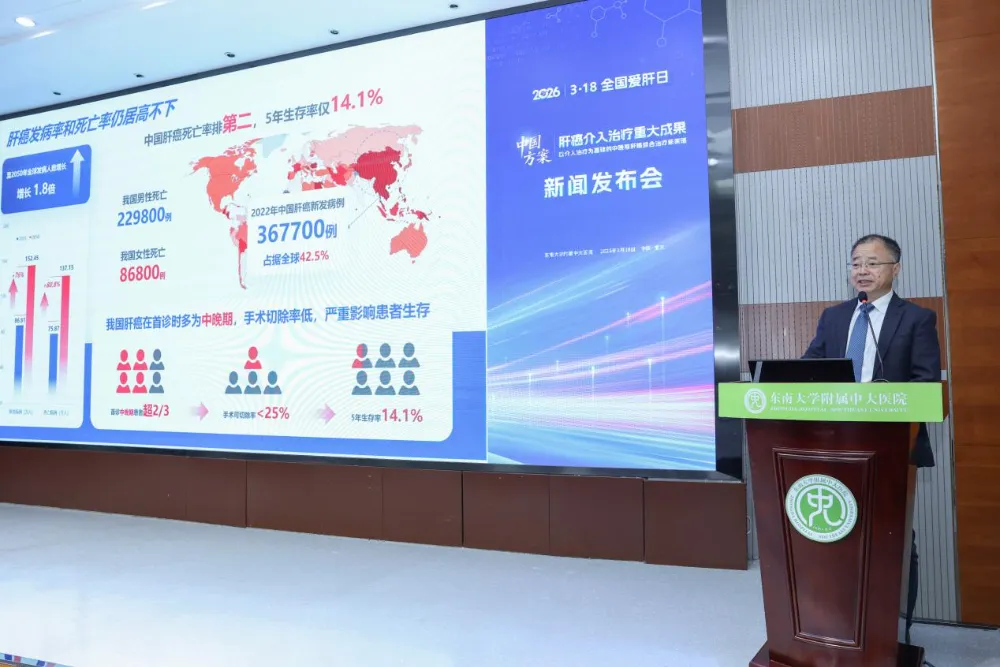
Liver cancer is a heavy burden in China. Nearly half of the world’s incident and fatal liver-cancer cases occur in China each year, and because the disease is insidious and rapidly progressive, it is known as the “king of cancers.”
More cruelly, more than 70% of patients are diagnosed at an intermediate or advanced stage and lose the chance for curative surgery. Their 5-year survival rate is only 14.1%, and most die within months of diagnosis.
For decades, interventional therapy, including TACE, was the main option for unresectable liver cancer. It could slow progression, but the effect was limited.
In recent years, targeted therapy and immunotherapy have brought new hope, yet not every patient is suitable for immunotherapy, and interventional therapy itself also needs to become more standardized and precise.
Could these treatments be combined? As a leading figure in Chinese interventional medicine, Prof. Gaojun Teng, who has spent nearly 40 years on interventional diagnosis and treatment for liver cancer, proposed exactly that, but innovation, patient selection, and timing all required rigorous evidence.
In 2021, Prof. Teng launched CHANCE, the China Liver Cancer Clinical Research Alliance, bringing together top multidisciplinary teams from more than 100 renowned hospitals across the country.
“We started with more than 100 hospitals and now have 156. Since it was established in Nanjing in 2021, CHANCE has become the most influential interventional-based liver-cancer clinical research platform in the world,” Prof. Teng said.
Among the major results unveiled this time, the CHANCE2005/CARES-005 study led by Prof. Teng was especially landmark.
Completed by 22 high-level centers nationwide, it is China’s first highest-level evidence-based study independently designed by interventional specialists and conducted with domestically developed original drugs. The findings were formally published in the Journal of Clinical Oncology in 2026.
Taken together with earlier studies, the data show that for intermediate-stage liver cancer, TACE combined with targeted therapy and immunotherapy is superior to TACE alone, extending overall survival by 9.9 months. For advanced liver cancer, TACE plus targeted-immunotherapy is superior to targeted-immunotherapy alone, extending overall survival by 6.7 months.
The TACE-based combination significantly lowers the risk of progression and prolongs progression-free survival in unresectable liver cancer. Its benefits extend beyond traditional intermediate-stage disease to patients with advanced disease and high tumor burden, marking China’s shift from following to leading in comprehensive interventional therapy for liver cancer.
A full treatment system built through serial innovation
CHANCE2005/CARES-005 is only one part of the story.
Before this, Prof. Teng’s team had already completed a series of major studies, including CHANCE001, CHANCE2201, CHANCE2202, and CHANCE2211, with results published in top journals such as The Lancet Gastroenterology and Hepatology.
“In highly condensed form, the conclusion is this: for intermediate-stage liver cancer, combination therapy is better than interventional therapy alone; for advanced liver cancer, combination therapy is better than targeted-immunotherapy alone,” Prof. Teng said.
The studies also clarified the synergistic mechanism, optimal sequence, target populations, and efficacy evaluation standards for TACE combined with targeted and immune therapy, thereby establishing a relatively complete chain of evidence.
MedJ learned that relying on CHANCE, Prof. Teng’s team has built the world’s largest liver-cancer data cohort for interventional therapy combined with targeted therapy and immunotherapy, launching more than 80 clinical studies across 22 provinces and more than 100 tertiary hospitals in China.
At the same time, all of these studies were led by Chinese experts, carried out by Chinese teams, based on Chinese patient data, and conducted with original Chinese drugs, fundamentally changing China’s long-standing dependence on foreign evidence in liver-cancer care.
“Our work is absolutely Chinese in character,” Prof. Teng stressed. “Even when there are international studies, we still have to find what suits Chinese patients.”
On the strength of high-quality evidence, TACE combined with targeted therapy and immunotherapy has been written into the Guideline for the Diagnosis and Treatment of Primary Liver Cancer, upgraded from an optional strategy to a preferred regimen, achieving full-chain translation from study to guideline to nationwide use.
At the same time, Prof. Teng’s team has delivered major original breakthroughs in interventional devices and techniques.
“Technical innovation is the hard core of improving liver-cancer outcomes,” Prof. Teng said. One example is the world’s leading iodine-125 radioactive seed stent system created by the team, which has brought a revolutionary advance in treating liver cancer complicated by portal-vein tumor thrombus and malignant biliary obstruction. “We started this work in 2003, and over more than 20 years we have treated more than 50,000 patients.”
To date, Prof. Teng’s team has led the development of more than 10 international and domestic technical standards and guidelines covering every step of liver-cancer intervention, building a full-course system that spans early, intermediate, and advanced disease and integrates multiple technologies with individualized precision treatment.
These standards are widely used in China and are also being promoted globally through the International Society of Multidisciplinary Interventional Oncology, founded by Prof. Teng together with experts from the United States and Singapore, taking Chinese interventional techniques and Chinese standards to the world.
These medical innovations have ultimately benefited large numbers of patients, giving them not a passive wait for death before the king of cancers, but a chance at renewed life.
Looking ahead, the team will continue to focus on bottlenecks in major diseases such as liver cancer, deepen cross-disciplinary integration between medicine and engineering, accelerate the clinical translation of interventional robots, novel microspheres, AI-based precision efficacy prediction, and other frontier technologies, and keep refining comprehensive treatment for intermediate and advanced liver cancer to produce more original, leading results.
“Our ultimate goal is to make the intractability of intermediate and advanced liver cancer a thing of the past,” Prof. Teng said.

