


Until a few weeks ago, “Goobie and Doobie” was an unnoticed account on the YouTube video site, posting videos that often consisted of hours-long still shots of a river, an ocean or a mountain.
That is, until three weeks ago, when Goobie, the account's owner, made his first appearance in a 48-minute video, calmly sharing his journey from graduating from a top medical school as a neurosurgeon, quitting his job after 10 years to become a hobo, and his disillusionment with the healthcare system.
The video reached a staggering 10 million views in just two to three weeks, with nearly 60,000 people commenting on the video. With this video, the number of followers of “Goobie and Doobie” has increased from a few hundred to 260,000 followers.
Why did the resignation of a neurosurgeon resonate with so many people?
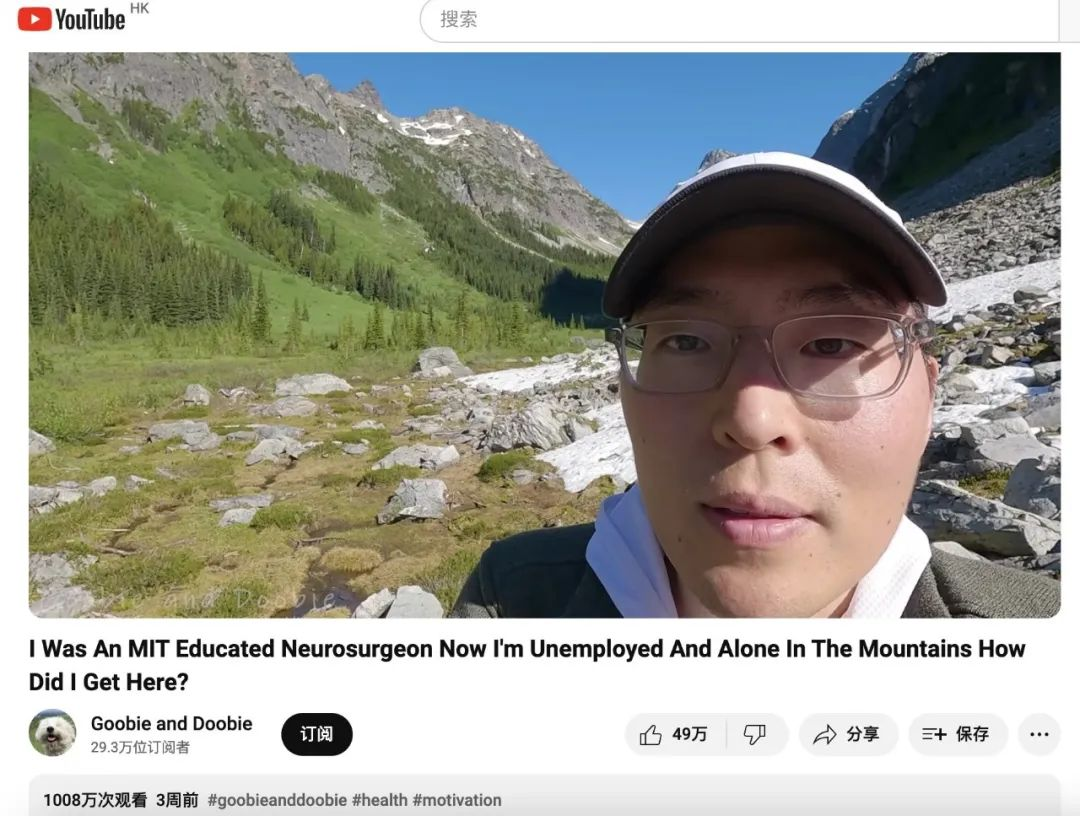
Fig.1 Goobie's personal channel
Surgery can't cure the pain
Goobie said he attended MIT (Massachusetts Institute of Technology) in college, then four years of medical school, and 10 years as a neurosurgeon after six years of training in neurosurgery. “I quit last year and no one understood why I quit.”
This is the story of a man going through a mid-life crisis, and Goobie hopes that by sharing his story, he can help others like him who are going through a difficult phase in their lives.
Goobie chose to become a doctor to help others. He remembers the Hippocratic Oath when he went to medical school, “There was an older doctor in the department who said that your job as a doctor is to relieve [patients'] pain not to operate or prescribe drugs. It's possible to relieve pain by operating or prescribing drugs, but it's also possible to just listen.”
This statement had grown with Goobie during medical school and has stuck with him as he became an intern and a doctor later in life.
Goobie said he became a neurosurgeon because he has always been interested in how the brain works. While in medical school, he followed cutting-edge research, such as brain-computer interfaces. Later, he managed to get into neurosurgical training and spent six years learning how to do brain surgery and spinal surgery. However, as his research became more advanced, Goobie thought that his dream of putting robotic arms or legs on humans might not come true.
At the age of 29, Goobie successfully entered a prestigious hospital in the United States to become a neurosurgeon.
“My partners were great, the hospital I worked at was great, but I felt very unhappy.” Goobie admits that it seemed out of character, because to outsiders, he was well paid, his job was respected, and his colleagues were nice, but he just wasn't happy, “I tried my best at the time, but I still couldn't describe what the problem was.”
Goobie recalls the oath he took and the words of the old professor - a doctor's job is to help patients relieve their pain. He agrees that a good doctor should be that way, and while he is up to date on all the latest surgeries and knows how to do them well, and does help a lot of patients relieve their pain, there are still a lot of patients that he can't help.
“If someone is suffering from spinal degeneration, the pain may be caused by a herniated disc that is pressing on a nerve, or a badly worn disc. I can surgically remove the herniated disc or surgically place titanium pins or rods in the spine to immobilize the joint and eliminate joint displacement. If that doesn't solve the patient's pain, electrodes are implanted to block the pain signal.”
But then Goobie realized that the surgeries he was performing weren't solving his patients' problems; they made them better for a while, but didn't solve their underlying problems.
Then there were the patients to whom he could only say, surgery can't help you either. “I felt heavy because I was their last hope. I thought doctors could relieve patients of their pain, and I did relieve many of them, but there were still many whose pain I couldn't relieve.”
Confusion: Is healthcare a cure or a profit?
Goobie's physician assistant had a graphic analogy for their work, which was like a house with a leaky roof that broke down the walls, and the doctors did the surgery as if they were going into the house and fixing the damaged walls, but leaving the leaky roof alone.
This inspired Goobie to start asking his patients in the clinic: What do you do for a living? What do you usually eat? What medications do you take? Do you smoke? Do you drink? Do you have many friends? How's the family? Do you sleep well when you're stressed ...... “I ask a ton of questions of all my patients.”
After long-term observation, Goobie found that patients' lifestyle and behavior affect the direction of their disease. Some patients have a healthy diet, get enough sleep, have good social relationships, keep up with sports and exercise, don't have bad habits, and release stress through meditation and other means when they are stressed at work. “People who do this recover quickly, I don't need to operate on them again, and (some) recover weeks before I do.”
Conversely, in the case of patients with poor lifestyle habits, even if they get better temporarily after surgery, they will relapse after a period of time, then have surgery again, get better for another six months or a year, and then the same problem will come back. “It's that problem of the roof leaking.”
Goobie understood that a healthy lifestyle also brings health to the patient, not just better back pain, but better skin, digestive tract, and hair loss .......
But that's not how the healthcare system is set up, “The problem with the healthcare system is that hospitals have to make money, they have to grow in economic volume. But if you find a way to help a patient get well that doesn't include surgery and drugs, then the hospitals and the doctors are in big trouble because you're out of a job if you can't charge the patient for the kind of method you've found.”
Goobie feels that something is wrong with the country's healthcare system, and that the current focus of medicine is not on “how to get patients well,” but rather on surgery, drugs, and other means of making money.
This puts Goobie in an ethical dilemma as a doctor, a feeling he calls “moral injury,” meaning that he is doing something that violates the moral code and disrupts the inner order. He could not bear the thought of profiting from the suffering of others. The patient is like the house with the leaky roof; his job is to fix the damaged walls but not the roof.
At the time, Goobie's wife wasn't working, and he was the family's sole source of income, and he had to keep working and keep doing what he no longer believed in. “It broke me down, I gained 40 pounds, sad, angry, frustrated, hopeless.”
The year before his contract expired, he turned 38, and most surgeons work into their 60s, but he didn't know how to continue. If he continued working for another 20-plus years, he felt his body and mind would collapse and he would die before he lived to be 60.
“I knew I was going to die, physically and mentally, and I talked to my wife about whether it would be okay to take up doctoring as a part-time job. Go do something that makes you happy, like getting back to nature.” Goobie said, “With my wife's support, I went and talked to the hospital about finding someone to replace me, and last September, I resigned.”
How do doctors feel about Goobie's feelings?
When he first quit his job, Goobie didn't know what he was going to do next, and it was embarrassing for people to ask him about his resignation.
“After a while, instead, I thought it was good to not have a plan; not having a plan means you don't have to do something at a certain time. I don't have to have spinal surgery anymore, and I don't have an income, but I still have a little bit of savings, and I'll be able to live off of that for a long time.” Goobie says that's probably what a lot of people would call a mid-life crisis, but he feels like he's had a bad time for the last nine years, and that's where the crisis is.
“Right now, I may be facing a crisis financially, but I've never been happier. I sleep well and eat healthy. I take my dog outdoors for hikes, and my wife and I go out for daily walks.” Goobie's dog, Doobie, is seven years old, and he started the video account “Goobie and Doobie” because he wanted to document his life with his dog, knowing that she would pass away before he did.
Through his outdoor lifestyle, Goobie has become healthy, lost weight, and gained inner peace from listening to nature, and he hopes that the videos he posts will help more people relieve stress.
Goobie stayed true to his heart and lived his true self. Many people find resonance in him and think he is doing what many people want to do but are afraid to do.
A doctor said that he has been practicing medicine for 14 years and understands exactly how Goobie feels, “I've always wondered how I would make ends meet if medicine wasn't my only source of income. Medicine has consumed so much of my youth, and I think it's time to get out there and live a happy life.”
A family doctor said he practiced medicine because he wanted to help people, but he shared Goobie's frustration, especially the lack of time to listen to his patients, “I'm planning on quitting my job, too, and you've inspired me tremendously. I'm going to take a year off and figure out a more satisfying way to help people.”
A retired caregiver echoed Goobie's sentiments, saying that medications and surgeries are only tools for treating patients, and that the tools for wellness should be healthy food, exercise, sleep, etc. Another patient described how she was asked by her doctor to lose weight before having back surgery, and as a result, she hasn't had a relapse in 30 years and has been saved the trouble of surgery.
A domestic medical industry practitioners watched Goobie's video is very emotional, he said, although the rapid development of medicine, but there are still many diseases can not be completely cured, especially in the field of brain science is full of unknowns, “the treatment of disease has not been a doctor's one-sided thing, the need for doctors and patients to work together.”
He believes that most doctors may have had Goobie's feeling that hospitals need to maintain income and expenditure, there will inevitably be overmedication, but also let some doctors have the feeling of violating the original intention of learning medicine, and then doubt the meaning of medical treatment and the value of patients, “can not change the general medical environment, then keep kindness and responsibility, starting from the impact of patients. ”

