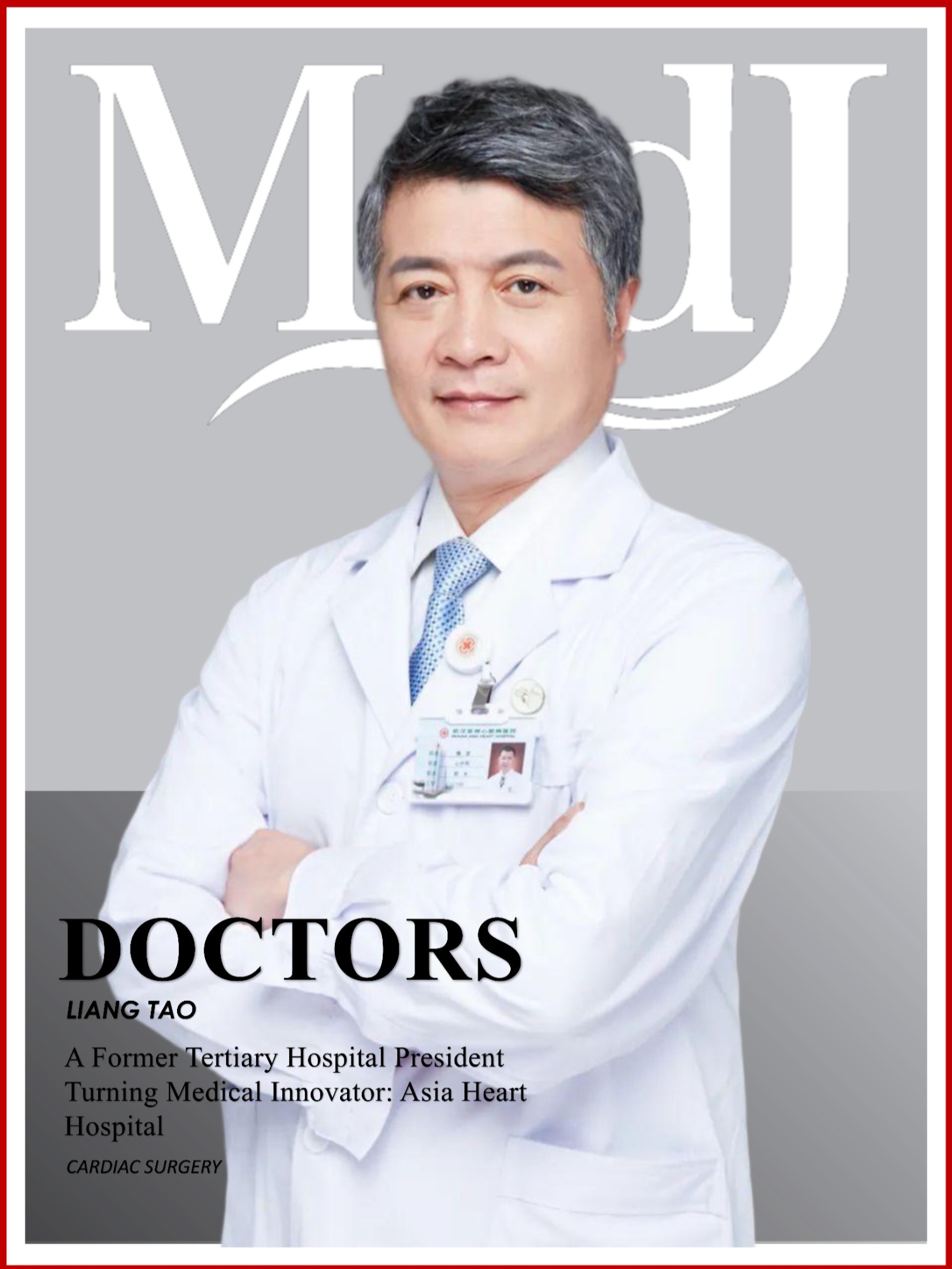
In May 2025, renowned cardiac surgeon Prof. Liang Tao took on a new identity—entrepreneur.
His start-up, Xinjing Medical, is focused on a globally pioneering project, the “AI artificial heart,” and in July 2025 received investment from Optics Valley Intellectual Property Investment. It was reportedly the first investment made by the fund since its establishment.
Prof. Tao is highly respected in medicine. He is the former president of Wuhan Asia Heart Hospital and has worked in cardiac surgery for more than 30 years. He won the Golden Scalpel Award from the Chinese Medical Doctor Association for cardiovascular surgeons, and both his surgical volume and outcomes have been widely praised by experts at home and abroad.
Prof. Tao has long reflected on entrepreneurship. He told MedJ, “Even if a person is made of iron, he can only hammer in a few nails. But once results are transformed into products, thousands upon thousands of doctors and patients can benefit.”
Although the road of entrepreneurship and translation of results is not easy, Prof. Tao said he is highly confident in the product because the “AI artificial heart” addresses a real clinical pain point and can solve practical problems. Before this, he had already led his team to complete more than 20 original achievements that were domestically leading and had realized integration between medicine and engineering.
“If we do it, we do something that is unique in the whole world,” said Prof. Tao.
More than 10,000 Cardiac Operations
In 1999, Prof. Xiaodong Zhu—an academician of the Chinese Academy of Engineering, former chairman of the Chinese Society for Thoracic and Cardiovascular Surgery, and former president of Fuwai Hospital in Beijing—came to Wuhan and founded China’s first private specialty hospital for heart disease, Asia Heart Hospital.
That same year, 37-year-old Prof. Tao joined Asia Heart Hospital as director of cardiac surgery. At that time, the annual number of cardiac surgical procedures in Hubei Province was fewer than 1,000, and complex, high-difficulty heart operations were basically not available.
The industry generally believed that private hospitals had an inherent trust disadvantage. However, only four years after its establishment, the annual surgical volume of cardiac surgery at Asia Heart Hospital had already risen to the top three nationwide, and it has remained a leader ever since. About 45% of Hubei Province’s cardiac operations are performed at Asia Heart Hospital.
As of February 2025, the cardiac surgery team led by Prof. Tao had completed more than 99,500 cardiac procedures of various kinds, while Prof. Tao himself had performed more than 10,000 operations.
Prof. Tao was elected a newly inducted member in the cardiac surgery section of the American Association for Thoracic Surgery. At present, there are only a little over 20 Chinese thoracic and cardiovascular surgery experts in the association.
“Pursuing excellence to safeguard every heart” is the slogan of Asia Heart Hospital. In Prof. Tao’s view, a surgeon’s pursuit of excellence is also reflected in continuous innovation: achieving the most effective results in the safest way and at the lowest possible cost.
Aortic valve disease is a common valvular heart disease. Once it progresses to a certain degree, it damages cardiac function. After symptoms of heart failure appear, patients often die within two to three years if the condition is not effectively controlled. Severe acute aortic regurgitation also carries a high risk of sudden death.
Surgery is the main treatment for severe aortic valve disease. More than a decade ago, the standard replacement procedure mainly used mechanical valves, and the vast majority of patients required lifelong anticoagulation after valve replacement.
In 2008, Prof. Tao took the lead nationwide in conducting research and clinical application of bovine pericardial aortic leaflet replacement for patients with aortic regurgitation. On this basis, he created the minimally invasive bovine pericardial aortic valvuloplasty technique. The technique obtained a national invention patent and later won both the Wuhan Municipal Science and Technology Progress Award and the Hubei Provincial Science and Technology Progress Award.
“Bovine pericardial valvuloplasty preserves and maintains the patient’s own valvular structure, which is more consistent with normal physiology. It also spares patients from lifelong anticoagulants after surgery and reduces the financial burden,” Prof. Tao explained.
Another new technique developed by Prof. Tao is the modified Commando procedure, or double annular enlargement. The Commando procedure is a complex surgical technique used to manage complicated cardiac lesions and is one of the most technically demanding operations in cardiac surgery. Prof. Tao’s modified approach offers better exposure and hemostasis, simplifies the steps, and lowers risk.
Among Asian patients, especially women with smaller body size, small aortic annuli and small mitral annuli are not uncommon. In these patients, conventional valve replacement often allows only small prosthetic valves to be implanted, which can lead to patient–prosthesis mismatch, stuck valves, thrombosis, pannus formation, and impaired cardiac function.
Prof. Tao’s modified double annular enlargement technique enables more efficient use of the native annulus through precise anatomical reconstruction, making implantation of larger prosthetic valves possible. It significantly improves hemodynamics and long-term prognosis and enhances quality of life.
“Double annular enlargement has, in a sense, lifted the ceiling of valve replacement surgery. Any valve size can be implanted, especially in reoperative patients,” said Prof. Tao.
This technique has also become known as the “Tao procedure” and has been promoted from Wuhan to multiple cardiac centers across China. In 2010, the fourth Golden Scalpel Award—known as the “Oscars” of Chinese cardiac surgery—was presented to Prof. Tao. In August 2025, the Tao procedure also received the top prize among the first batch of core medical technologies in Wuhan: the Pilot Technology Award.
A Long Road to Translation
Deep work at the operating table gradually led Prof. Tao to realize that many clinical pain points require more than the precision at the tip of one surgeon’s scalpel. The treatment of Stanford type A aortic dissection is one such challenge.
Type A aortic dissection is extremely dangerous. Without timely treatment, mortality reaches 50% within 48 hours of onset and exceeds 70% within one week.
The standard operation is to implant a four-branched artificial graft and stented graft to replace the diseased aorta. But the procedure is extremely difficult and places very high demands on the surgeon, anesthesiology team, perfusion team, and intensive care team. Only a few cardiac centers are capable of performing it. Data show that only 10% of patients in China obtain timely surgery each year.
Moreover, the key part of the operation—resecting the diseased great vessel and replacing it with an artificial graft—must be performed under deep hypothermic circulatory arrest. After cardiopulmonary bypass is established, the patient’s temperature is lowered to 20–25°C and extracorporeal circulation is stopped.
At that point, all organs are without blood supply, and the chief surgeon must race against time to complete graft docking and suturing before bypass is resumed.
“This step takes more than 20 minutes on average. A few exceptionally skilled doctors can do it in under 10 minutes,” Prof. Tao explained. The duration of deep hypothermic circulatory arrest directly affects prognosis: the longer it lasts, the greater the risk of complications.
How can more doctors become capable of treating these patients? Is there a way to shorten the time under deep hypothermic circulatory arrest? In 2015, Prof. Tao proposed an integrated artificial great vessel in which the connection between the four-branched graft and the covered stent was designed as a single piece and required no suturing.
Prof. Tao explained, “You can simply put it in directly. There is no need for docking and suturing. This can greatly shorten the intraoperative deep hypothermic circulatory arrest time and lower the technical difficulty, enabling more hospitals to perform the surgery independently and reducing the risk that patients die because long-distance transfer delays treatment.”
But from scientific achievement to actual product, Prof. Tao’s journey has taken 10 years and is still not fully successful.
“In the industrial chain, doctors are good at only the two ends: identifying solutions from clinical pain points at the beginning, and clinical application and verification at the end,” Prof. Tao said. “But a mature product requires too many steps, too much knowledge, and too much money—from a hand-made prototype to animal studies to clinical trials to marketing application and then mass production.”
For example, when conducting animal studies for the integrated artificial great vessel, there was no suitable traceable animal research center in Wuhan, so Prof. Tao repeatedly had to take a team of more than 10 people and over a dozen boxes of equipment to Shenzhen for surgery on animals.
In May 2024, the project began clinical enrollment. “But there is still some distance before the product can be marketed,” Prof. Tao said helplessly. “In fact, I was the first person in the world to obtain a patent for a related product, but now our progress has fallen behind.”
Like the integrated artificial great vessel, Prof. Tao has three other products being translated through cooperation with companies. Even the shortest-running project has already taken six years. “All have entered the clinical trial stage, but it will still take time before they are truly applied in clinical practice,” he said.
Becoming the “Pig” Standing at the Innovation Wind Opening
In May 2025, Prof. Tao founded a company and prepared to conduct independent R&D.
The AI artificial heart is one of its flagship products. “It is intended for stage-specific support in patients with heart failure after heart transplantation, myocarditis, and other conditions,” Prof. Tao said. He analyzed currently available products for similar uses and found that either the support volume is insufficient or the duration of support is not long enough.
“My route is different. It uses a new concept to provide systemic perfusion. Testing shows that this product can perfuse 7 liters of blood per minute, meeting the needs of a normal adult, and it can be maintained for several months,” said Prof. Tao.
The AI component uses algorithms to analyze the patient’s condition in real time and automatically adjust the working mode.
“An artificial heart assists the left ventricle, but this increases the burden on the right ventricle. Therefore, more support is not necessarily better; a balance is required. With artificial intelligence, feedback from the patient can be used to calculate the optimal support flow and the best pressure control,” said Prof. Tao.
The beating of the heart is directly tied to life and death, and the learning curve for heart surgery is especially long. “Making surgery simpler so that more people can master it” is Prof. Tao’s wish. A more convenient and easier-to-operate physiologic cardiac pacemaker is another direction he is pursuing.
Physiologic pacing such as left bundle branch pacing is currently the most advanced pacemaker implantation technique. It can simulate the heart’s natural beat and avoid problems such as ventricular dyssynchrony caused by traditional right ventricular pacing.
“But puncturing the left bundle branch or His bundle is not easy. Compared with right ventricular implantation, doctors need longer training to locate the site accurately.”
Prof. Tao found an approach that can both achieve physiologic pacing and allow rapid, simple identification of the implantation site—septal pacing.
“The pacing site is at the atrioventricular node, making synchronous pacing of both ventricles possible and avoiding pacemaker syndrome. Moreover, with this product design, puncture can be completed simply by using ultrasound to guide the device to the interventricular septum. There is no need to enter a catheterization laboratory, and with simple training doctors can master it relatively quickly.”
Prof. Tao has also envisioned a temporary pacing application for emergency rescue. “I want to make the device simple, like a gun. As long as the doctor can read cardiac ultrasound, he or she can pull the trigger and hit the target in one shot. If it is simple enough, it can become widely adopted. If even emergency doctors in ambulances can learn this technology, more patients can be saved.”
In the past, Prof. Tao cooperated with companies as a technical partner, which was a relatively stable path. Building his own brand, however, clearly brings much greater difficulties and risks.
He may succeed, and he may be even more likely to fail. At present, the proportion of scientific achievements successfully commercialized in China is not high, and for innovative medical products the timeline is even longer. For years there may be only investment and no return.
Why choose the more difficult road?
Prof. Tao said the first reason is his feelings as a doctor; the second is that today the industrial chain has become more mature, with specialized teams for every link; and the third is that a more cautious investment climate may actually make it easier for true innovation to attract capital.
“Most important is national policy support for innovation. The prospects are bright,” Prof. Tao said. “I hope we can become the ‘pig’ standing in the wind opening. The first step is to stand where the wind is.”