


Like an increasing number of children, 6-year-old Xiaomin is troubled by urinary system stones.
This year, he was found to have stones throughout his kidneys and bladder. The local hospital had performed a bladder incision to remove the stones, but for the stones in the kidneys, the doctors said they were powerless due to technical limitations and other reasons.
If kidney stones are not removed in time, Xiaomin could eventually develop renal failure once they cause obstruction and infection. After being referred to the Children's Hospital, Zhejiang University School of Medicine (hereinafter referred to as "Zhejiang Children's Hospital"), the director of the urology department, Yan Xiang, performed a "world's first" surgery for him—the world's thinnest electronic flexible ureteroscope (Fr6.3) was applied for the first time in pediatric stone removal.
Yan Xiang told "MedJ" that the incidence of pediatric urinary stones is rising. He has treated the youngest stone patient, who was only over a month old, "Prevention and treatment of stones must start from childhood."
Behind the innovation of surgical technology, it also highlights the current dilemma in the treatment of pediatric urinary stones: Although the methods and interventional techniques for treating pediatric stone diseases are similar to those for adults, sometimes it is necessary to consider the unique anatomical and physiological differences of pediatric stone patients when directly applying adult technology, making the surgical difficulty greater than that for adults.
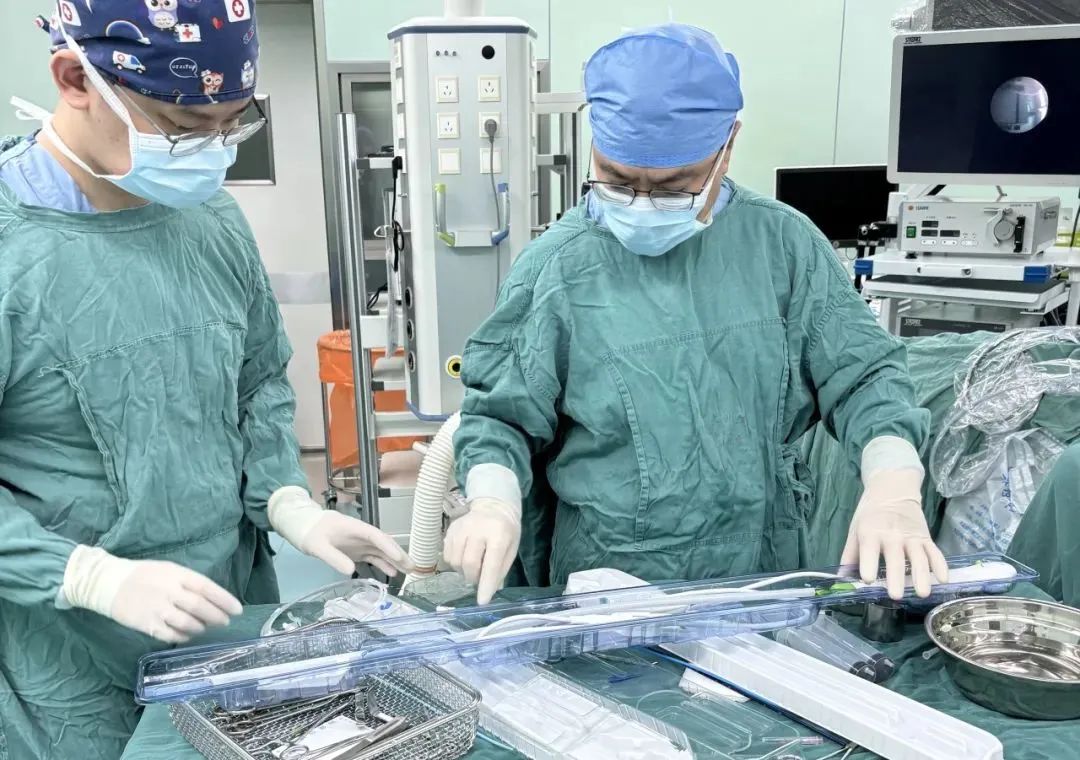
Director Yan Xiang (right) during surgery / All images in this article are provided by Zhejiang University School of Medicine's Children's Hospital
The treatment of pediatric urolithiasis patients is challenging
A few months ago, Xiaomin presented with hematuria, and upon examination, it was found that he had stones in both his bladder and kidneys. Genetic testing results showed that Xiaomin suffers from Primary Hyperoxaluria Type 3. In layman's terms, his body lacks a special enzyme, leading to the accumulation of large amounts of oxalate that form stones.
Primary Hyperoxaluria Type 3 is an extremely rare genetic disease, with only about 3 cases in every 1 million children. Before coming to Zhejiang Children's Hospital, Xiaomin had undergone a cystotomy to remove stones at a local hospital. For the stones in the kidneys, local doctors assessed that the three commonly used methods of stone fragmentation and removal were not applicable.
Currently, there are three commonly used treatment methods for urinary stones in clinical practice: extracorporeal shock wave lithotripsy, percutaneous nephrolithotomy, and ureteroscopic lithotripsy. Among them, extracorporeal shock wave lithotripsy uses ultrasound to break up the stones, and patients expel the stones through urine after surgery, but this option was ruled out first.
"Stones caused by primary hyperoxaluria are harder, and they are multiple and scattered, and the patient is too young to tolerate an increase in the intensity of the shock waves, unable to cooperate with the doctor to complete the surgery," said Yan Xiang.
Imaging examinations showed that the stones in Xiaomin's kidneys were widely distributed. If we liken the interior of the kidney to a house, Xiaomin's kidney stones were scattered in more than a dozen rooms. If percutaneous nephrolithotomy were to be used, it would require more than ten punctures in the child's waist, which would be highly traumatic and difficult to completely remove the stones.
After ruling out the first two treatment methods, only ureteroscopic lithotripsy remained. Yan Xiang explained, "This involves inserting the endoscope from the urethral opening all the way into the kidney, entering each 'room' to remove the stones, and is suitable for scattered and multiple kidney stones." This method removes stones through the body's natural cavities and is considered minimally invasive surgery.
At the local hospital, doctors also considered this method, but the commonly used ureteroscopes were too thick. If they were to be used on children, it would be necessary to first implant a dilator in the child's urethra and keep it for two weeks, waiting for the urethra to fully expand before surgery could be performed.
Considering that the ureters of young children are thinner, it is difficult to place a ureteral sheath during surgery, and there are issues with poor irrigation fluid return and high pressure after the ureteroscope enters the ureter. Postoperatively, there may be extravasation of irrigation fluid and infection. Especially when the child's ureteral conditions are poor, forcibly placing a ureteroscope can lead to tearing, perforation, and postoperative stenosis, among other complications.
This requires an ultra-thin ureteroscope to smoothly enter the child's ureter.
A few months ago, Yan Xiang learned from peers that a domestic company had developed the world's thinnest Fr6.3 (diameter about 2.1mm) ultra-thin electronic ureteroscope, which had completed a stone removal surgery in an adult patient abroad. He immediately contacted them and introduced this ureteroscope to Zhejiang Children's Hospital. Xiaomin's parents also came to Zhejiang Children's Hospital through other doctors' recommendations, hoping to try using this ultra-thin ureteroscope to remove the stones.
In the end, the surgery was successfully completed, and Yan Xiang removed three "pea-sized" stones from the child's kidneys, as well as numerous tiny stones.
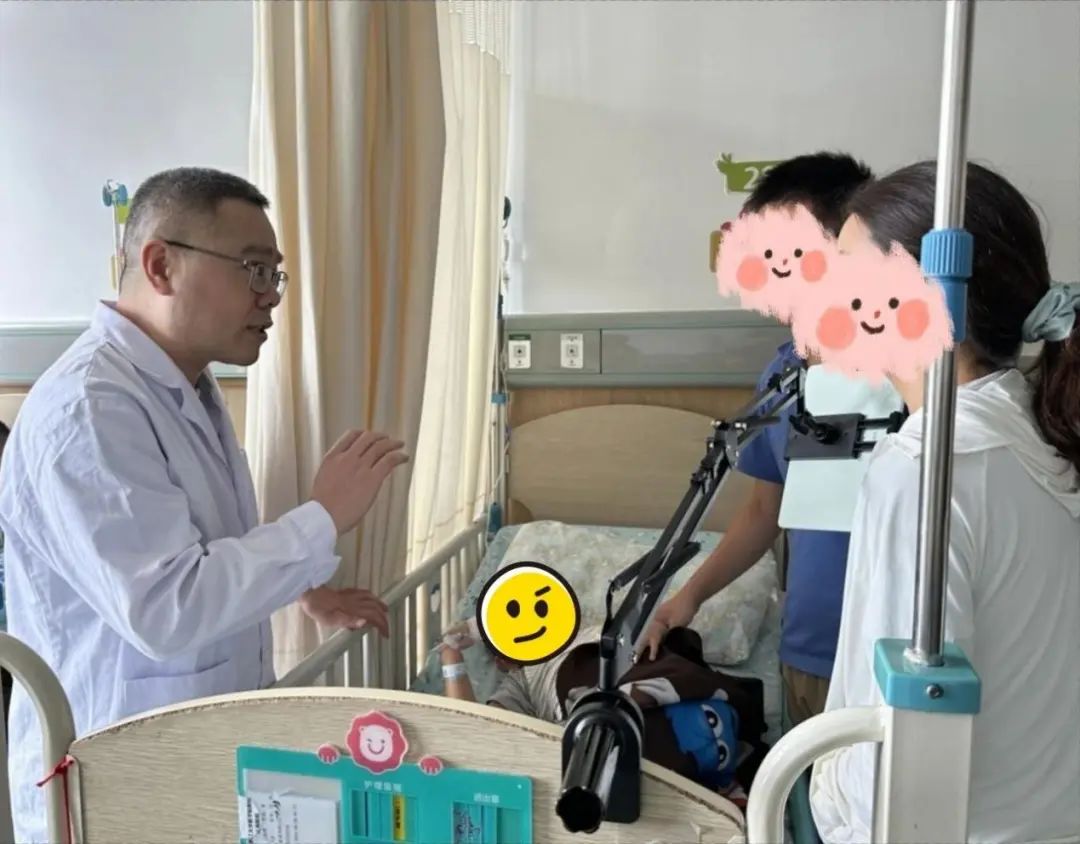
Director Yan Xiang (left) visits Xiao Min
Be vigilant about the trend of pediatric urolithiasis
Although the surgery was successful, Yan Xiang said that Xiaomin may still need to undergo multiple stone fragmentation and removal surgeries in the future, with a more comprehensive treatment plan jointly formulated by various departments such as Endocrinology and Metabolism, Hepatobiliary Surgery, Nephrology, and Nutrition.
He told "Medical Community" that patients with primary hyperoxaluria need to take medication for a long time to reduce oxalate synthesis or clear oxalate through hemodialysis, but these methods cannot completely suppress the formation of oxalate stones, with a disease recurrence rate close to 100%. Therefore, diagnosis and metabolic assessment are crucial, and a comprehensive metabolic assessment is needed to determine the underlying diseases that make children prone to stones.
Over the years, the incidence of pediatric urolithiasis has been on the rise globally. A population-based study conducted in the United States estimated that between 2005 and 2016, approximately 65 out of every 100,000 children developed urinary system stones each year, a significant increase in prevalence compared to 1999.
In comparison, a Chinese population study involving 14,256 asymptomatic children showed a prevalence of urolithiasis of 0.53%.
"The etiology of pediatric urolithiasis is more complex than that of adults," Yan Xiang introduced, saying that while adult urinary stones are usually caused by external factors such as improper diet, pediatric urolithiasis not only has external factors like dietary imbalance, dehydration, and environmental conditions but also needs to clarify whether there are internal factors such as genetic metabolic diseases, as genetic factors may lead to metabolic abnormalities and increase the likelihood of children developing urinary stones.
For children with urinary system stones, about 15% to 25% are asymptomatic, usually discovering stones incidentally during other imaging examinations. Among symptomatic children, pain is the most common, with other symptoms including developmental delays,gross hematuria (visible blood in the urine), and recurrent urinary tract infections.
Yan Xiang reminds that early diagnosis of pediatric urinary system stones is crucial. Taking Xiaomin as an example, although such patients face a high risk of urinary stones throughout their lives, if a diagnosis can be made as early as possible, and adjustments are made in diet and lifestyle, the risk of stone recurrence can be effectively reduced, and the number of stone fragmentation and removal surgeries can also be decreased.
In order to provide more standardized diagnosis and treatment for children with urolithiasis, Yan Xiang, who originally worked in the urology department of a tertiary general hospital for adults, was invited to join Zhejiang Children's Hospital.
In 2020, he established the first pediatric urolithiasis center in China at Zhejiang Children's Hospital, bringing together multidisciplinary forces within the hospital to participate in the diagnosis and treatment of pediatric urolithiasis. In 2023, it was approved by the China Stone Alliance to establish the East China Pediatric Stone Diagnosis and Treatment Base, serving as a national regional medical center for complex and difficult stone children from all over the country.
The center has treated the youngest pediatric urolithiasis patient, who was only over a month old. For children of such a young age, Yan Xiang does not recommend immediate surgery but recommends physical stone removal through methods such as stone-eliminating exercises and gentle tapping, while actively investigating the causes of stones and correcting poor feeding methods. Fortunately, this patient successfully passed the stones after physical therapy and is under continuous observation and follow-up.
"With the change of lifestyle, the incidence of pediatric urolithiasis is increasing at a rate of about 6% per year," Yan Xiang called for stone prevention and treatment to "start from childhood," requiring the joint attention of children and parents. Correcting bad living habits in childhood can also reduce the risk of developing urinary stones in adulthood.

