


At the recent European Wound Management Association (EWMA) annual congress, a premature baby girl drew global attention for helping pioneer a novel wound care treatment—one that could redefine clinical approaches. Just days after birth, the infant developed a severe neck infection with a deep, wide wound that was difficult to heal. Her condition progressed to sepsis and posed a risk of multi-organ failure. Unable to tolerate conventional treatments, the medical team proposed an innovative idea: wrapping the wound with fish skin while actively fighting the infection to promote healing.
A Global First in Preterm Wound Care?
Dr. Xiaoyan Hu, Chief Physician of the Burn Surgery Department at the First Affiliated Hospital of Naval Medical University (Changhai Hospital, Shanghai), highlighted two unusual aspects of the case in an interview with The Medical Community. First, the patient was an extremely premature infant—making the case particularly delicate. Second, fish skin is usually applied only after infection is under control. Using it during an active infection is rare and approached with great caution.
 A family photo of Eliana and her family. /Image source: Krystal DeVos
This might be the world’s first known application of fish skin in wound care for an extremely low birth weight preterm infant. The technique may even help avoid surgery in certain intractable infectious wounds.
A Non-Conventional Attempt to Save a Life
Eliana DeVos was born in April 2022 at just 23 weeks of gestation, weighing only 453 grams. Shortly after being admitted to the neonatal intensive care unit (NICU), she developed a life-threatening bacterial infection. “Doctors said it was necrotizing fasciitis—flesh-eating bacteria. She was too small to fight it,” said her mother, Krystal DeVos.
Necrotizing fasciitis is a rapidly progressing infection caused by multiple pathogens that destroys fascia, muscle, and subcutaneous tissue. The primary treatment is surgical debridement—removal of all necrotic and infected tissue—combined with aggressive antibiotic therapy. However, such procedures posed enormous risks for Eliana, given her low weight and fragile condition.
Despite multiple antibiotics, her condition worsened to sepsis, and signs of organ failure began to appear. By day 86 of her life, Eliana was transferred to Driscoll Children’s Hospital in the U.S., where the team proposed an unconventional treatment—fish skin.
Why Fish Skin Works
Dr. Xiaoyan Hu, a pediatric burn and wound care specialist, explained that fish skin—processed through sterilization and decellularization—is a type of biological dressing that can temporarily replicate certain skin functions:
Physical Barrier & Comfort: Fish skin has excellent elasticity and can adhere well to body surfaces, forming a physical barrier to prevent microbial invasion. Unlike daily dressing changes, fish skin reduces frequency and associated pain.
Moisture Retention & Healing: Its high moisture content helps induce expression of epidermal growth factor (EGF) and fibroblast growth factor (FGF), accelerating healing.
Collagen-Rich: Fish skin, especially from tilapia, is rich in type I and III collagen—key proteins found in human skin and essential for tissue repair.
Pain Relief: It protects exposed nerve endings, reducing pain perception during recovery.
A Remarkable Recovery
Driscoll Children’s Hospital had prior experience using fish skin in pediatric wound cases. In October 2022, it published a cohort study involving 15 children (mean age: 8 years 9 months) with acute or chronic wounds. With fish skin combined with negative pressure wound therapy, 95% of wounds fully healed, healing time halved, and no hypertrophic scars were observed. This is the largest pediatric cohort using fish skin published to date in the Journal of Wound Care (JWC).
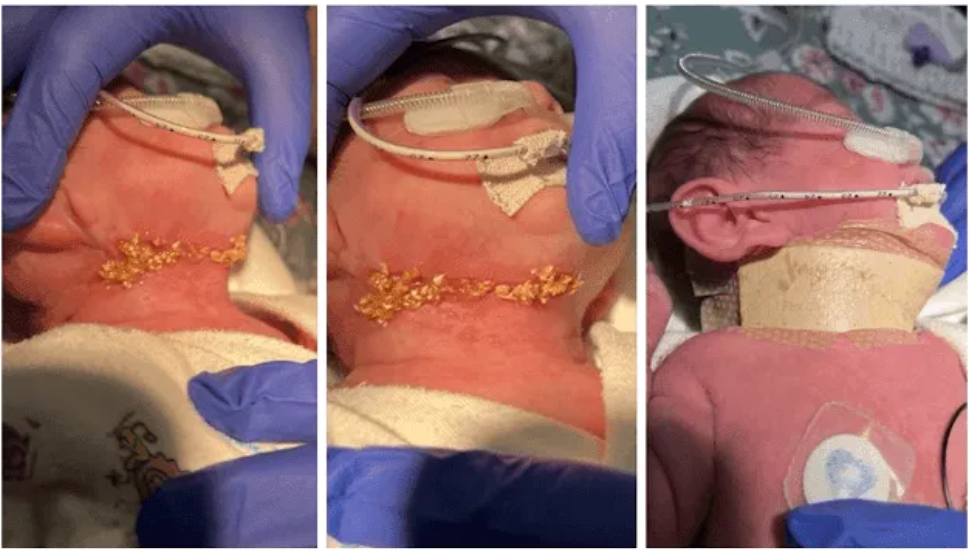 The medical team used fish skin dressings and medical-grade honey to achieve wound healing. /Image source: Driscoll Children’s Hospital
For Eliana, the team used a combination of medical-grade honey (a proven antimicrobial agent per Cochrane reviews) to clean the wound, followed by fish skin fragments mixed with honey and overlaid with intact fish skin. The FDA-approved fish skin used in this treatment is rich in Omega-3 fatty acids and collagen.
If Eliana had an allergic reaction to the fish skin, surgery would have been the only remaining option. Fortunately, the treatment worked remarkably well. By the first dressing change on day three, the team observed significant improvement. By day ten, her wound had begun to heal.
At the 2025 EWMA Congress, Dr. Vanessa Dimas from Driscoll Children’s Hospital presented Eliana’s case. Now over three years old, Eliana is reportedly healthy with only faint scarring on her neck.
The team also shared another case involving a premature infant weighing just over 500 grams—setting a new record for the lowest-weight patient treated with fish skin.
Is Fish Skin “Artificial Skin”?
Some media reports referred to fish skin as a form of “artificial skin.” However, experts clarify that fish skin is still considered a temporary wound dressing, not artificial skin.
“Artificial skin typically refers to permanent or semi-permanent constructs that integrate with host tissue, including epidermal and dermal layers, and appendages like hair follicles,” said Dr. Hu. Fish skin does not permanently integrate—it peels off as the wound heals.
In 2019, Brazilian doctors used fish skin on a man with second-degree burns from a firework accident. By day 17, fresh skin had formed beneath the fish skin covering.
In China, the most commonly used biological dressings are derived from porcine skin (e.g., irradiated or decellularized pig skin), which are readily available and widely applied. Like fish skin, they serve as temporary dressings and cannot permanently replace human skin.
Advanced Skin Regeneration in China
Dr. Hu’s team at Changhai Hospital is exploring advanced techniques suchas autologous epidermal cell transplantation. This involves harvesting a small patch of a patient’s healthy skin, culturing the epidermal cells in vitro until their numbers multiply by over a thousandfold, and applying the resulting transparent cell membranes to the wound.
In September 2022, this method was used successfully to treat a patient with extensive burns in China. Within a month, 100% of the wound area was repaired, and the patient regained mobility—much faster than the usual 2–3 month recovery.
In cases with large wounds and limited donor skin, surgeons may mesh the donor skin or cut it into postage-stamp–sized grafts. The gaps are then filled with autologous epidermal cell membranes.
Each Technique Has Its Role
Dr. Hu emphasizes that each treatment method has its own strengths and cannot replace the others entirely. For example, cultured epidermal cells are thin and lack the physical barrier or moisture retention of fish or pig skin. Additionally, they take time to prepare, unlike off-the-shelf fish skin.
In emergency situations—especially with accidental injuries—rapid treatment is critical. Biological dressings like fish or pig skin offer practical, low-cost solutions. A 2024 review by the Wound Healing and Management Cooperative (WHAM) noted that fish skin is widely used in low-resource settings like Brazil for superficial wounds, but evidence for deep or infected wounds remains limited.
Fish skin dressings were approved in North America and Europe around 2010, mainly for treating chronic wounds in adults. In China, research on fish skin is still at early stages, with most efforts focusing on manufacturing and animal experiments.

