


Physicians who save lives in their daily work can themselves be struck down by myocardial infarction (MI) and become critically ill patients. Recently, the Affiliated Hospital of Nantong University admitted just such a special critical case. A 39-year-old physician, Dr. Sun (alias), developed sudden severe chest tightness and pain and presented to the hospital’s emergency department. On admission, he was diagnosed with acute MI complicated by cardiogenic shock, with coronary angiography showing severe disease in all three coronary arteries, the highest-risk category of cardiovascular critical illness.
The hospital immediately assembled a multidisciplinary team in cardiovascular medicine and critical care. They performed two interventional procedures in sequence, completed revascularization under dual life support with extracorporeal membrane oxygenation (ECMO) and intra-aortic balloon pump (IABP), and successfully navigated multiple crises, including infection and coagulation imbalance. After more than 10 days of intense rescue, they pulled him back from the brink of death.
Acute MI is one of the highest-mortality cardiovascular emergencies worldwide, and its incidence has been trending younger in recent years. Professionals in high-stress occupations who experience chronic fatigue may ignore early warning signs, only to face a fulminant clinical picture once symptoms worsen.
Article Key Points
- 39-year-old physician (Dr. Sun) at Nantong University Hospital developed acute MI with cardiogenic shock
- Angiography: LAD 90% stenosis, LCX and RCA complete occlusion; three-vessel disease, highest critical-illness category
- Two staged PCI procedures performed under combined ECMO and IABP support
- Patient developed Pseudomonas pneumonia and D-dimer-driven anticoagulation bleeding-thrombosis conflict
- All life support (ECMO, IABP, intubation) successfully weaned after 10+ days; now in rehabilitation
- Per JACC GBD 2023: 19.2 million global CVD deaths in 2023; ischemic heart disease led with 8.91 million
- China Cardiovascular Health Report 2024: 122.2 million MI hospitalizations in 2023; in-hospital mortality 4.0%
- Among Chinese MI inpatients in 2023, those <55 years accounted for 21.8%; <45 years 6.9%
A Physician’s Acute MI, A Life on the Line
According to the hospital, Dr. Sun had experienced dull pain in the left back for one week before onset but did not take it seriously. On the day of onset, when crushing chest tightness and pain became unbearable, he rushed to the hospital’s emergency department.
By then, danger had fully arrived. On admission, his blood pressure was as low as 60/40 mmHg, and troponin was as high as 21 microg/L, with a normal reference of just 0.034 microg/L, more than 600 times the upper limit. While the MI diagnosis was clear, the patient had already developed cardiogenic shock, one of the most lethal complications of acute MI, with extremely high mortality.
In a race against time, Dr. Su Yamin, the cardiovascular medicine department’s deputy chief physician, performed emergency coronary angiography. The angiogram showed a long lesion in the proximal to mid-left anterior descending (LAD) artery, with the most severe point at 90% stenosis; the left circumflex (LCX) and the distal right coronary artery (RCA) were completely occluded.
In a normal heart, the coronary arteries are divided into left and right main branches. The left coronary artery has a short initial segment called the left main, which divides into the LAD and the left circumflex; the distal right coronary artery gives rise to the posterior descending and posterolateral branches.
Dr. Su noted that ordinary MI usually involves only a single vessel, but three-vessel severe stenosis or occlusion is the highest grade of cardiovascular critical illness.
During the procedure, Dr. Su prioritized opening the occluded RCA, implanting a drug-eluting stent, and placed an intra-aortic balloon pump (IABP) to maintain hemodynamic stability and prepare for further treatment.
After the procedure, the patient was transferred to the intensive care unit (ICU), but the situation did not stabilize. He developed persistent dyspnea and severe blood pressure fluctuations. The team led by Dr. Lu Yang, director and chief physician of the ICU, closely monitored the patient, performed endotracheal intubation and ventilator-assisted ventilation when the condition deteriorated sharply on multiple occasions, and initiated extracorporeal membrane oxygenation (ECMO) to support circulation.
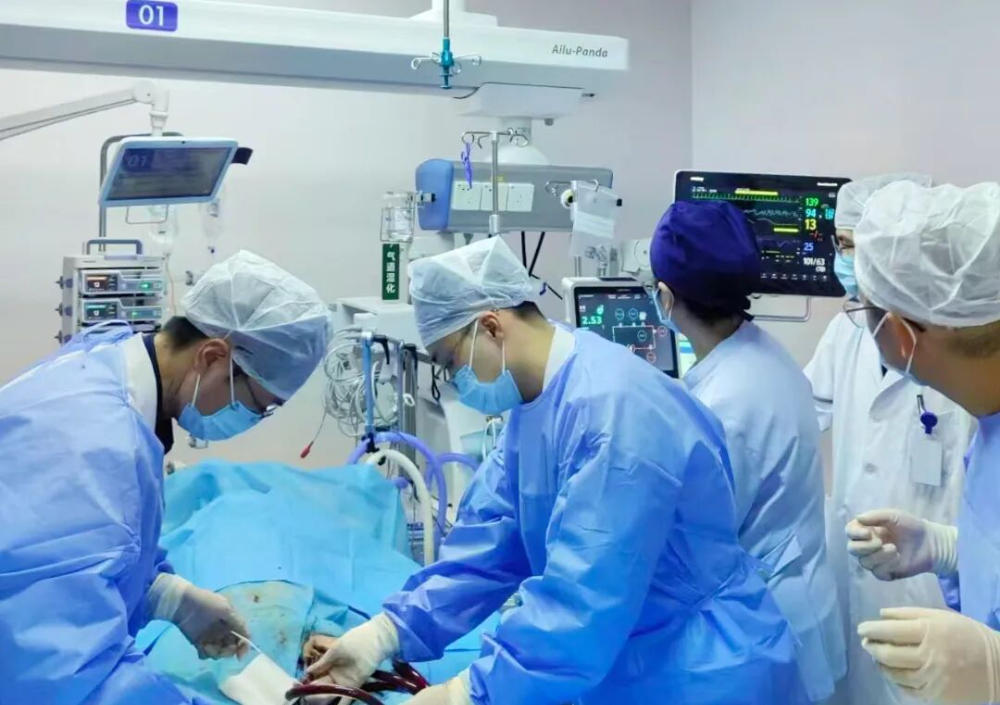 Fig. 1. The ICU Team Led by Dr. Lu Yang
Opening only the RCA, however, was far from sufficient to reverse the critical condition, leaving the two remaining lethal hazards in the LAD and LCX unresolved.
After multidisciplinary consultation, the cardiology and ICU teams concluded that without a second procedure, the patient had almost no chance of survival. That night, Prof. Sheng Hongzhuan, the cardiovascular medicine department’s director and chief physician, performed the second interventional procedure under combined ECMO and IABP support.
After intraoperative angiography confirmed the original RCA stent was patent, the team addressed the left coronary system, implanting multiple drug-eluting stents in the LCX and LAD in sequence, completing revascularization of the remaining two vessels and definitively resolving the underlying cause.
Complete revascularization was only the first hurdle; every subsequent step remained precarious. According to Dr. Lu, after ECMO initiation, the patient’s D-dimer rose sharply, creating a tension between anticoagulation and bleeding risk, and multiple indwelling lines caused recurrent fever. Pathogen testing confirmed Pseudomonas aeruginosa pulmonary infection, and drug dosing in the critical state was extremely difficult.
The team used real-time activated clotting time (ACT) monitoring to mitigate bleeding, used next-generation sequencing (NGS) pathogen testing to precisely identify the infection source and target antibiotics, and worked seamlessly with cardiology to dynamically adjust anticoagulation and anti-heart-failure regimens, gradually stabilizing circulation, controlling infection, and reversing the crisis.
During this period, the patient was transported to the digital subtraction angiography (DSA) suite while still on the ventilator, ECMO, and IABP, a high-risk transfer. Three ICU physicians and four specialty nurses accompanied the entire process, completing the transfer and procedure safely.
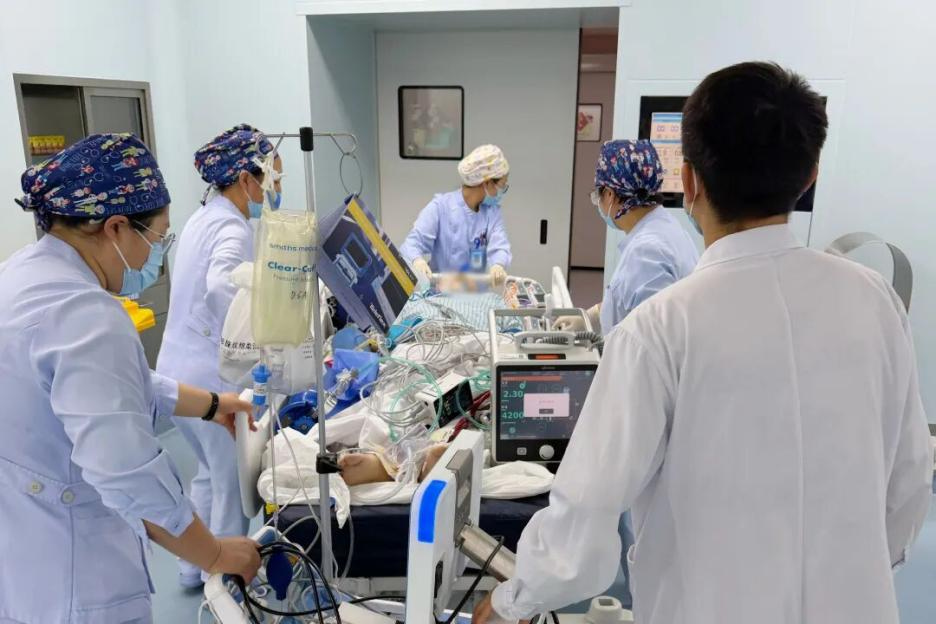 Fig. 2. Multiple Physicians and Nurses Participated in the Transfer.
After more than 10 days of treatment, the patient’s circulation, respiration, and infection status gradually improved. The hospital reported that once the medical team judged the condition stable, they sequentially weaned ECMO, endotracheal intubation, and IABP. All lines have now been removed, vital signs are stable, mental status is good, and the patient has entered the rehabilitation phase.
Acute MI: No Longer an “Old Person’s Disease”
Acute MI is among the leading causes of death globally.
According to a Global Burden of Disease (GBD) study published in December 2025 in the Journal of the American College of Cardiology, in 2023, cardiovascular disease caused approximately 19.2 million deaths globally, with ischemic heart disease accounting for approximately 8.91 million, the leading single cause of death.
The burden in China is similarly heavy. The China Cardiovascular Health and Disease Report 2024, released by the National Center for Cardiovascular Diseases, showed that among Chinese residents aged 18 and above, the crude incidence of acute MI is approximately 87.6 per 100,000, markedly higher in men than in women. In 2023, medical institutions nationwide admitted 1.222 million hospitalizations for acute MI, with an in-hospital mortality rate of 4.0%.
The report also notes that MI mortality is generally trending upward, meaning a substantial number of patients die before reaching hospital, and pre-hospital recognition and timely access to care remain weak links. In addition, rural CVD mortality has exceeded and remained higher than urban levels since 2009.
Acute MI is not an isolated disease but an acute manifestation of coronary heart disease. The full name of coronary heart disease is coronary atherosclerotic heart disease, in which cholesterol and other lipids deposit on the coronary artery wall to form plaques, causing stenosis. When a plaque ruptures and a thrombus forms, the vessel acutely occludes, and the myocardium undergoes sustained ischemic necrosis, leading to MI. The direct cause in this case is MI, but the underlying reason for the difficulty of treatment is severe triple-vessel disease involving the LAD, LCX, and RCA, a terminal stage of coronary disease progression.
In terms of treatment strategy, the key to MI care is opening the occluded vessel as early as possible; every minute of delay expands the area of myocardial necrosis. The European Society of Cardiology’s 2023 Guidelines for the Management of Acute Coronary Syndromes require that the interval from first medical contact to vessel opening be controlled within 120 minutes.
For critical patients in cardiogenic shock with multivessel disease, the guideline recommends that the first procedure address only the culprit vessel, with staged intervention for the remaining vessels, to avoid the additional risk of an excessively long procedure.
Notably, MI and coronary heart disease are encroaching on high-stress professional groups and young people. The China Cardiovascular Health and Disease Report 2024 shows that among acute MI inpatients nationwide in 2023, those under 55 accounted for 21.8% and those under 45 accounted for 6.9%.
The increase in young-onset cases is closely linked to the rising prevalence among young people of smoking, obesity, dyslipidemia, high mental stress, and sleep deprivation; MI is no longer the “old person’s disease” of traditional perception.
For prevention, controlling blood pressure, lipids, and blood glucose, smoking cessation and alcohol restriction, regular schedules, and moderate exercise remain the cornerstones. For those with suspicious symptoms, time is the most critical variable.
Typical acute MI presents as sustained, unrelieved crushing chest pain that may radiate to the back, left shoulder, and jaw, accompanied by diaphoresis, nausea, and dyspnea. Some patients have atypical symptoms such as stomach pain, toothache, or unexplained back pain that does not resolve with rest, and these are easily dismissed as minor complaints. But if they reflect myocardial ischemia, delayed care can be directly life-threatening.
If MI is suspected, an emergency call should be made immediately, all activity should be stopped, and the patient should lie still and wait for rescue, never driving or walking to the hospital on their own.
Successful acute MI treatment is not a one-time cure. After discharge, patients need long-term antiplatelet therapy and statins to stabilize plaques and prevent re-occlusion, along with cardiac rehabilitation, gradual return to exercise under physician guidance, and regular follow-up of lipid and blood pressure indicators.
Reference
[1] Affiliated Hospital of Nantong University. “Doctors are brothers! We spare no effort to save you.” Published Oct 7, 2026. https://mp.weixin.qq.com/s/Ym_Mcqrw5CJ-OKzFnaaEVA.

