


Fatty pancreas refers to the abnormal deposition of fat within pancreatic tissue. With the global rise in obesity and metabolic syndrome, alongside continued advances in imaging technology, fatty pancreas—a pathological change linked to ectopic visceral fat deposition and metabolic disturbance—is receiving increasing clinical attention. Beyond its well-known association with pancreatic disease, fatty pancreas is also involved in the pathology of multiple metabolic disorders and shows multidimensional links with metabolic dysfunction-associated steatotic liver disease (MASLD), diabetes, pancreatitis, and pancreatic cancer. Its clinical significance now extends beyond the pancreas itself, positioning it as a key intermediate link between systemic metabolic dysfunction and local pancreatic disease.
Terminology and concepts around fatty pancreas remain inconsistent, with non-standard terms, divergent diagnostic criteria, and a lack of systematic screening and management strategies. No formal international pathway currently exists for the diagnosis, treatment, and full-course management of fatty pancreas.
Convened under the Chinese Medical Association Endocrinology Branch and the Chinese Medical Biotechnology Association Chronic Disease Management Branch, the consensus was co-initiated by Academician Guang Ning of Ruijin Hospital, Shanghai Jiao Tong University School of Medicine; Academician Gaojun Teng of Zhongda Hospital, Southeast University; and Prof. Weiqing Wang, Chair of the Chinese Medical Association Endocrinology Branch. Drafting was led by Prof. Ling Li (Zhongda Hospital, Southeast University), Prof. Jiangao Fan (Xinhua Hospital, Shanghai Jiao Tong University), and Prof. Qiang Li (Peking University School of Basic Medical Sciences). The expert panel brought together specialists in endocrinology, gastroenterology, hepatobiliary and pancreatic surgery, oncology, clinical nutrition, pediatrics, imaging, pathology, and basic medical sciences. Drawing on the latest national and international evidence and Chinese clinical practice, the consensus focuses on the core clinical entity of metabolic dysfunction-associated fatty pancreas (MAFP) and consolidates recommendations on basic concepts, epidemiology, etiology and pathogenesis, diagnosis and differential diagnosis, comprehensive management and treatment, and prognosis and outcomes.
Published on 14 August 2026 in the Chinese Journal of Endocrinology and Metabolism, the consensus aims to provide a scientific and practical framework for risk stratification, systematic evaluation, and individualized management of fatty pancreas in China, advancing the field toward standardized, precise, full-course care and supporting the chronic disease prevention framework of Healthy China.
The consensus applies the GRADE system for developing and grading recommendations, and introduces good practice statements (GPS) for domains lacking direct supporting evidence. Each recommendation weighs four core factors: evidence quality, risk-benefit balance of the intervention, patient values and preferences, and resource use and accessibility. Final recommendations reflect a value judgment based on the trade-off between evidence level and clinical applicability, and are adopted only after broad consensus (≥75% expert agreement on the same recommendation grade) and methodological confirmation.
I. Overview
1. “Metabolic dysfunction-associated fatty pancreas” is recommended as the standard terminology to describe ectopic pancreatic fat deposition occurring in genetically susceptible individuals in the setting of metabolic abnormalities.
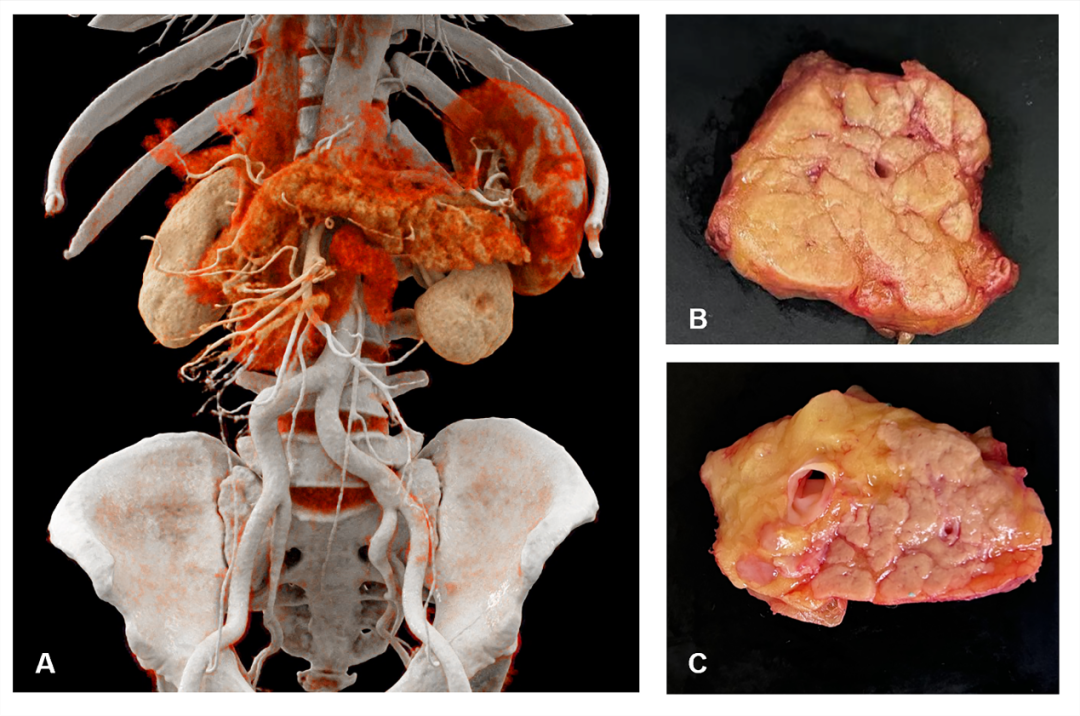 Fig. 1. Gross appearance of fatty pancreas. (A) Photon-counting CT (PCCT) cinematic rendering (CR) enables high-resolution three-dimensional visualization of the pancreas. (B) Non-fatty pancreas. (C) Fatty pancreas
Source for A: Southeast University; source for B and C: Nanjing Medical University; all images used with permission
Table 1. Clinical classification of fatty pancreas
|
Term |
Basic Concepts |
|
Fatty Pancreas |
A clinical pathological syndrome characterized by fatty infiltration of pancreatic tissue. |
|
Metabolic Dysfunction-Associated Fatty Pancreas |
Ectopic fat deposition in the pancreas caused by overnutrition and metabolic dysfunction. It is closely related to obesity, metabolic syndrome components, and MASLD, representing the manifestation of metabolic syndrome in the pancreatic target organ. Other risk factors include aging, menopause (decreased estrogen), and other endocrine diseases (such as polycystic ovary syndrome, hypothyroidism). |
|
Secondary Fatty Pancreas |
Secondary replacement by adipose tissue following pancreatic tissue atrophy caused by various reasons. It mainly occurs secondary to pancreatic structural factors (such as chronic pancreatitis, pancreatic fibrosis, pancreatic tumors, pancreatic duct obstruction) and the effects of drugs and toxins. |
|
Hereditary and Congenital Fatty Pancreas |
Fatty pancreas associated with hereditary or congenital diseases. It is related to genetic variations (such as CEL gene mutations) and congenital diseases (such as Johanson-Blizzard syndrome, Shwachman-Diamond syndrome, cystic fibrosis, etc.). |
|
Mixed Fatty Pancreas |
Fatty pancreas where two or more causes capable of leading to pancreatic fatty infiltration coexist. |
|
Idiopathic Fatty Pancreas |
Refers to idiopathic fatty pancreas without metabolic dysfunction and without secondary causes, but vigilance is required to avoid missing a diagnosis of secondary fatty pancreas. |
Note: MASLD = metabolic dysfunction-associated steatotic liver disease.
II. Etiology and Pathogenesis
2. “Pancreatic adipose tissue (PAT)” is recommended as the standard terminology for this specific adipose tissue
3. The principal causes of fatty pancreas are metabolic factors, including obesity, metabolic syndrome, MASLD, aging, and changes in estrogen levels. Other causes include pancreatic injury (such as chronic pancreatitis) and certain hereditary and congenital conditions.
4. The pathological hallmark of fatty pancreas is ectopic deposition of mature adipocytes within the pancreas, distributed both interlobularly and intralobularly, with rare involvement of the islets. Adipocyte numbers vary, from scattered cells to confluent sheets; massive fatty replacement may occur in areas of parenchymal loss.
5. Fatty pancreas and pancreatic fibrosis share a bidirectional but asymmetric relationship. Under metabolic dysfunction, MAFP is dominated by fat deposition, which can drive pancreatic fibrosis; in acute and chronic pancreatic injury, parenchymal necrosis and fibrosis are followed by irreversible fatty replacement as a structural remodeling process.
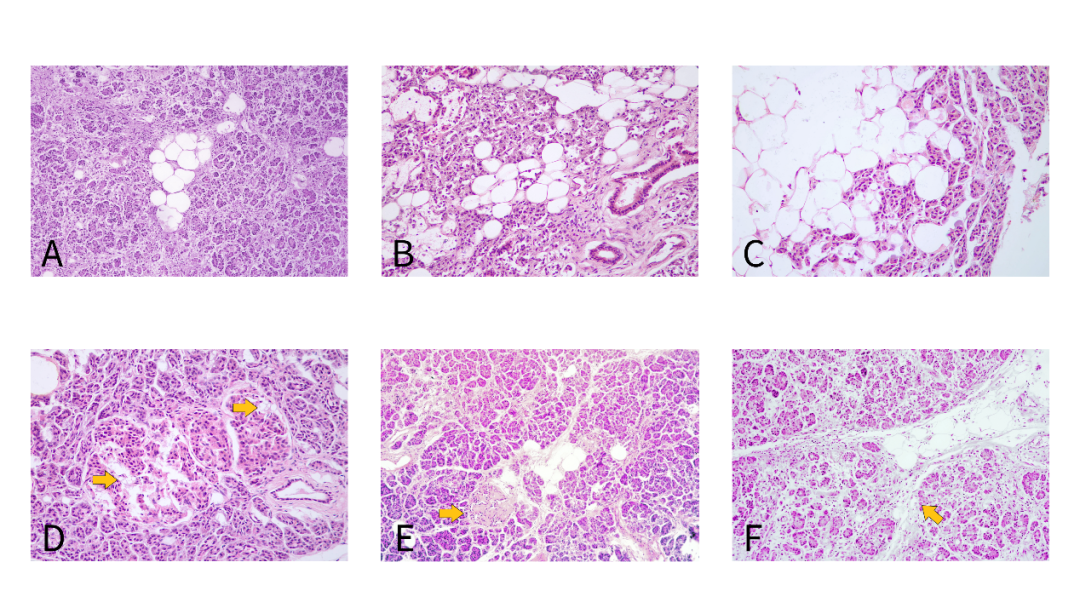 Fig. 2. Pathological findings in fatty pancreas. (A) Mild fatty pancreas with small amounts of mature adipose tissue in the interlobular and intralobular septa (HE, ×100). (B) Moderate fatty pancreas with intermediate amounts of mature adipose tissue (HE, ×200). (C) Severe fatty pancreas with mature adipose tissue replacing most of the lobular parenchyma (HE, ×400). (D) Pancreatic fat infiltrating an islet; adipocytes are visible within the islet (arrows) (HE, ×200). (E) Type 2 diabetes with fatty pancreas; amyloid deposition within the islet (arrows) (HE, ×200). (F) Secondary fatty pancreas in chronic pancreatitis; interstitial fibrosis with fatty replacement (arrows) (HE, ×200)
Source: Southeast University; used with permission
III. Epidemiology
6. Global overall prevalence of fatty pancreas is 18%-30%, with marked regional variation. In high-risk pediatric populations, prevalence can reach 50%-94%, and fatty pancreas significantly increases the risk of pediatric metabolic syndrome, cardiovascular disease, and pancreatic exocrine insufficiency.
IV. Clinical Associations and Outcomes
7. A significant bidirectional relationship exists between MASLD and fatty pancreas: MASLD is an important predictor of fatty pancreas, and fatty pancreas substantially increases the risk of MASLD and hepatic fibrosis. Patients diagnosed with MASLD should be routinely screened for fatty pancreas, and patients identified with fatty pancreas should be actively screened for MASLD and hepatic fibrosis.
8. Fatty pancreas may serve as an early warning signal for diabetes and cardio-renal-metabolic syndrome. Patients with fatty pancreas should undergo routine systematic screening for the components of metabolic syndrome, with assessment of target-organ function and adverse-outcome risk.
9. Fatty pancreas increases the risk of acute and chronic pancreatitis, and the degree of intrapancreatic fat infiltration is associated with pancreatitis severity. Enhanced prevention and management of pancreatitis is recommended in patients with fatty pancreas.
10. Fatty pancreas is a risk factor for pancreatic cancer. In patients with fatty pancreas who have high-risk pancreatic cancer features (such as new-onset diabetes at age >50 years with body mass index <25 kg/m², unexplained weight loss, or marked glucose fluctuations), screening and surveillance for pancreatic cancer is recommended.
V. Diagnosis and Differential Diagnosis
11. Non-contrast CT is suitable for fatty pancreas screening and for the diagnosis of moderate-to-severe fatty pancreas, with a diagnostic criterion of a pancreas-to-spleen CT attenuation ratio <0.7.
12. MRI-proton density fat fraction (MRI-PDFF) is the preferred non-invasive quantitative method for pancreatic fat content and can be used for diagnosis and severity grading of fatty pancreas.
13. Endoscopic ultrasound (EUS) is primarily used to differentiate benign from malignant pancreatic lesions and to guide pancreatic biopsy, but may also contribute to the diagnosis of fatty pancreas.
14. MAFP is diagnosed when pathologically or imaging-confirmed fatty pancreas is accompanied by at least one component of metabolic syndrome, after excluding secondary and hereditary/congenital fatty pancreas.
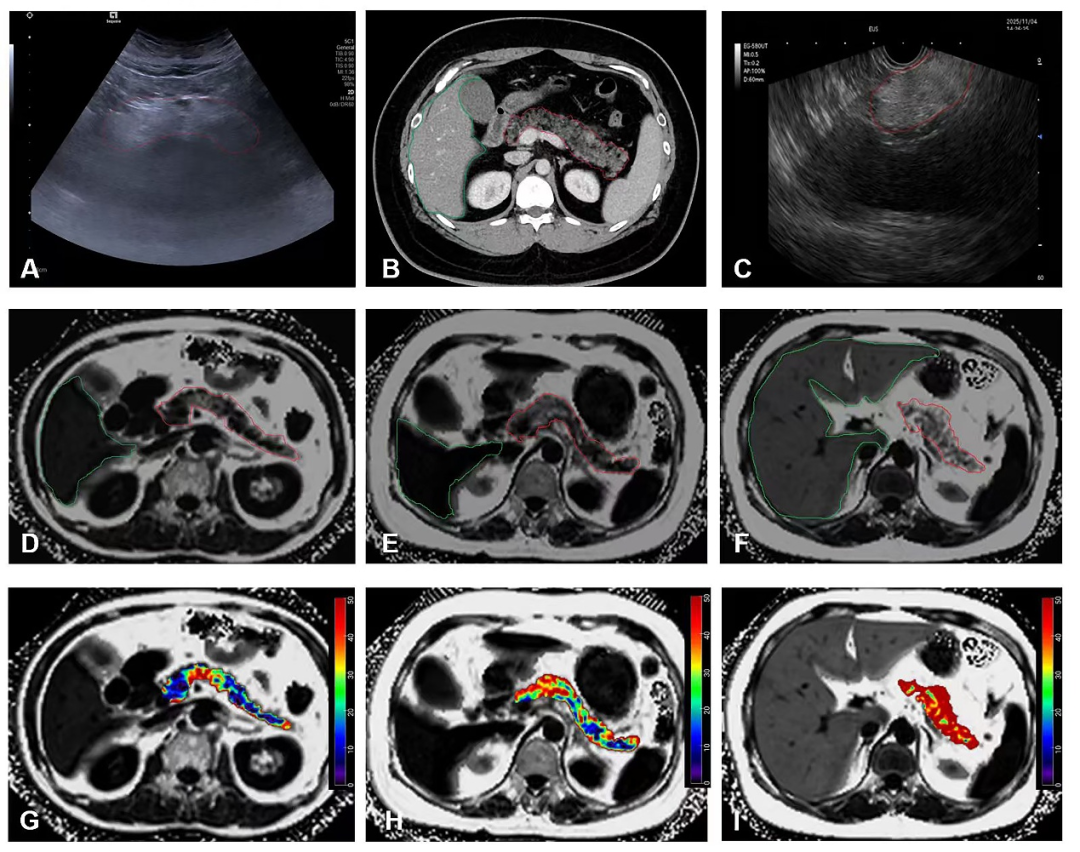 Fig. 3. Imaging findings in fatty pancreas. (A) Transabdominal ultrasound showing a diffusely hyperechoic pancreas with otherwise preserved margins and capsule but blurred internal lobular septa and posterior acoustic attenuation. (B) Abdominal CT showing diffuse fatty infiltration of the pancreas, more pronounced in the head and body than the tail. (C) EUS showing increased parenchymal echogenicity in the pancreatic head (circled). (D) MRI-PDFF showing mild pancreatic steatosis. (E) MRI-PDFF showing moderate pancreatic steatosis. (F) MRI-PDFF showing severe pancreatic steatosis. (G-I) MRI-PDFF fat-fraction pseudo-color maps showing mild, moderate, and severe pancreatic fat infiltration; the color scale runs from blue (low) to red (high)
Source: Southeast University; used with permission.
VI. Treatment and Follow-Up
15. Lifestyle intervention is the cornerstone of MAFP management, aimed at weight reduction and metabolic improvement. Patients with well-controlled metabolism should be followed up annually; those newly diagnosed or with multiple metabolic abnormalities should be followed up every 3-6 months.
16. Patients with MAFP should adhere to a negative-energy-balance diet, limit intake of ultra-processed foods, saturated fats, high-sugar or high-fructose foods, and sugar-sweetened beverages, and increase consumption of vegetables, whole grains, and unsaturated-fatty-acid-rich foods. Smoking and alcohol should be avoided.
17. Patients with MAFP should increase physical activity as much as possible. Routine recommendations include at least 150 minutes per week of moderate-intensity or 75 minutes per week of vigorous-intensity aerobic exercise, combined with 2-3 sessions of resistance training. Individualized exercise prescriptions should be developed with professional guidance after health screening and exercise-risk assessment, and tailored to patient preferences.
18. For MAFP patients with overweight/obesity, T2DM, or metabolic syndrome, pharmacotherapy that addresses the comorbidity while also producing weight loss, glycemic benefit, and metabolic benefit may be prioritized according to the corresponding disease indication.
19. For fatty pancreas patients with BMI ≥32.5 kg/m², or with BMI 27.5-32.5 kg/m² and severe obesity-related comorbidities such as T2DM, insulin resistance, or metabolic syndrome, bariatric-metabolic surgery may be considered after failure of conservative medical treatment, following multidisciplinary team evaluation.
Academic Advisors
- Guang Ning — Department of Endocrine and Metabolic Diseases, Ruijin Hospital, Shanghai Jiao Tong University School of Medicine
- Gaojun Teng — Medical and Life Sciences Division, Southeast University
Drafting Experts
- Ling Li — Department of Endocrinology, Zhongda Hospital, Southeast University
- Jiangao Fan — Department of Gastroenterology, Xinhua Hospital, Shanghai Jiao Tong University School of Medicine
- Qiang Li — Peking University School of Basic Medical Sciences
- Weiqing Wang — Department of Endocrine and Metabolic Diseases, Ruijin Hospital, Shanghai Jiao Tong University School of Medicine
Gastroenterology Experts
- Chengwei Tang — Department of Gastroenterology, West China Hospital, Sichuan University
- Zhendong Jin — Department of Gastroenterology, First Affiliated Hospital of Naval Medical University
- Weifen Xie — Department of Gastroenterology, Second Affiliated Hospital of Naval Medical University
- Jiaming Qian — Department of Gastroenterology, Peking Union Medical College Hospital, Chinese Academy of Medical Sciences
- Jin Chai — Department of Gastroenterology, First Affiliated Hospital of Army Medical University
- Ting Yu — Department of Gastroenterology, Zhongda Hospital, Southeast University
Endocrinology Experts
- Yufang Bi — Department of Endocrine and Metabolic Diseases, Ruijin Hospital, Shanghai Jiao Tong University School of Medicine
- Lei Ye — Department of Endocrine and Metabolic Diseases, Ruijin Hospital, Shanghai Jiao Tong University School of Medicine
- Cheng Hu — Department of Endocrinology, Shanghai Sixth People’s Hospital, Shanghai Jiao Tong University
- Tuo Li — Department of Endocrinology, Second Affiliated Hospital of Naval Medical University
- Yang Xiao — Department of Metabolism and Endocrinology, Second Xiangya Hospital, Central South University
- Xiaomu Li — Department of Endocrinology, First Affiliated Hospital, Zhejiang University School of Medicine
- Huijuan Yuan — Department of Endocrinology, Henan Provincial People’s Hospital
- Xiqiao Zhou — Department of Endocrinology, Jiangsu Province Hospital of Chinese Medicine
- Yuwei Zhang — Department of Endocrinology, West China Hospital, Sichuan University
Pancreatic Surgery Experts
- Qiang Xu — Department of General Surgery, Peking Union Medical College Hospital, Chinese Academy of Medical Sciences
- Kuirong Jiang — Pancreas Center, First Affiliated Hospital of Nanjing Medical University
- Zipeng Lu — Pancreas Center, First Affiliated Hospital of Nanjing Medical University
Pathology Expert
- Pingsheng Chen — Department of Pathology, Southeast University Medical School
Imaging Experts
- Di Chang — Department of Radiology, Zhongda Hospital, Southeast University
- Jia Li — Department of Ultrasound Medicine, Zhongda Hospital, Southeast University
Pediatrics Experts
- Junfen Fu — Department of Endocrinology, Children’s Hospital, Zhejiang University School of Medicine; National Clinical Research Center for Child Health
- Jie Wu — Digestive, Hepatology, and Nutrition Center, Beijing Children’s Hospital, Capital Medical University
Basic Medical Sciences Experts
- Xiongzhong Ruan — Metabolic Disease Research Institute, Chongqing Medical University; Lipid Research Center, Second Affiliated Hospital of Chongqing Medical University
- Xiao Han — School of Basic Medical Sciences, Nanjing Medical University
- Xiao Yu — School of Basic Medical Sciences, Shandong University
- Kun Qian — School of Biomedical Engineering, Shanghai Jiao Tong University
- Hulin Jiang — School of Pharmacy, China Pharmaceutical University
- Fangfang Zhang — School of Life Science and Technology, China Pharmaceutical University
Methodology Experts
- Shiyao Chen — Department of Gastroenterology, Zhongshan Hospital, Fudan University
- Jingxin Li — School of Public Health, Nanjing Medical University
Consensus Drafting Secretariat
- Xiaoyuan Wang — Department of Endocrinology, Zhongda Hospital, Southeast University
- Liang Qi — Department of Endocrinology, Zhongda Hospital, Southeast University
- Xiaoyu Li — Department of Endocrinology, Zhongda Hospital, Southeast University
- Yingqi Lyu — Department of Endocrinology, Zhongda Hospital, Southeast University
- Chao Sun — Department of Gastroenterology, Xinhua Hospital, Shanghai Jiao Tong University School of Medicine

